Pegasus InfoCorp helps build customized web software and undertakes web development software solutions for clients internationally. We also build front end websites, and offline software that integrates with our web based software. Our services/ custom built software solutions include Web Development, web development, web software, small business web software development and enterprise scale business software development on web technologies.
The Israeli Defense Forces and the United States military have drawn up plans to renew joint strikes on Iran in the coming weeks, according to two Israeli sources familiar with the plans.
The Israeli sources said the strikes would almost certainly take place after the U.S. midterm elections, citing President Donald Trump’s reluctance to further destabilize oil markets in the final days of the campaign.
The White House said Thursday that the U.S. will not resume attacks on Iran before the Nov. 3 midterm elections.
US Navy - PHOTO: U.S. Navy Command Master Chief John Shubert, assigned to Airborne Command and Control Squadron (VAW) 115, conducts leadership training aboard Nimitz-class aircraft carrier USS Theodore Roosevelt, Oct. 20, 2026.
“The United States will not be attacking Iran at any time prior to the midterm elections,” White House spokesperson Anna Kelly said in a statement to ABC News.
'Hunting season is open as soon as the elections end and it's obvious that they're not going to wait long,' one Israeli source said.
The New York Times was first to report on the planning.
Asked about the Times' reporting, a White House official said the administration does not comment on 'sensitive military plans that may or may not exist.'
The official added that Trump 'keeps all options on the table' to prevent Iran from acquiring a nuclear weapon.
The Pentagon declined to comment.
Israeli Prime Minister Benjamin Netanyahu is firmly in favor of renewed action against Iran, but both sources said the decision for joint strikes to resume is 'only for Trump to decide.'
One Israeli source did not rule out Israel striking unilaterally should the U.S. choose not to participate, but added Israel would still require U.S. consent.
Trump has repeatedly said that he would restart the war after the midterm elections and has threatened to 'end' it after the midterms.
He gave a somewhat conflicting answer on the status of negotiations with Iran when asked Wednesday night, initially saying talks are ongoing 'a little bit,' but moments later saying 'I think we're not negotiating.'
'A little bit, but we'll see what happens,' Trump said, when asked for an update on negotiations.
US Navy - PHOTO: A U.S. sailor signals an F-35C Lightning II assigned to Strike Fighter Squadron 147 as it takes off from the flight deck of Nimitz-class aircraft carrier USS George Washington Oct. 7, 2026.
Asked if he is 'over' negotiating with Iran, Trump responded, 'No, I think we're not negotiating with -- We are going to have something one way or the other that'll happen fairly soon.'
'Most people seem to think it's after the election, and we're going to see what happens,' he added.
The plans to renew joint strikes were discussed during Defense Secretary Pete Hegseth's unannounced visit to Israel earlier this week, according to one Israeli source, who added that new intelligence was shared between both sides.
New strikes would aim to further erode Iran's economy and build on the ongoing U.S. blockade, with targets to include petrochemical facilities crucial to Iran's oil industry, one of the sources said.
The source added that striking Iranian nuclear facilities, such as those at Pickaxe Mountain, is also part of the new plans, but added there are no plans to strike civilian infrastructure like power plants.
The source emphasized that regime change in Iran, and not a negotiated deal, is the Israeli government's top goal.
'The only question is the timing,' they said.
The U.S. military has been repositioning personnel at U.S. military bases in the Middle East, a source familiar with the matter told ABC News.
Social Media via Reuters - PHOTO: Smoke and flames rise from King Khalid Airport, after Yemen's Iran-backed Houthis said they attacked the airport, in Riyadh, Saudi Arabia, October 8, 2026, in this screengrab obtained from a social media video.
The repositioning of forces is similar to what occurred quietly prior to the start of the war with Iran in February, according to the source.
Asked for comment on an NBC report about the reduction of military and diplomatic personnel in the region, CENTCOM spokesman Capt. Tim Hawkins said in a statement: 'We regularly move U.S. service members and assets to optimize mission readiness. We do not discuss related movements for operational security reasons. U.S. forces remain vigilant and ready to protect American personnel and interests across the region.'
Earlier Wednesday, the State Department ordered the departure of non-essential personnel and family members in Saudi Arabia -- a decision officials say is a direct response to the risk posed by Iranian-backed Houthi militants, who have attacked Saudi oil infrastructure and airports on Saudi Arabia from Yemen.
There have been much smaller posture adjustments at several other embassies in the Middle East -- changes officials say are also linked to the Houthi threat and other matters not connected to any plan to resume combat against Iran.
ABC News' Nick Kerr and Emily Chang contributed to this report.
This article originally appeared on ABC News at https://abcnews.com/Politics/us-israel-drawing-plans-resume-attacks-iran-post/story?id=137479897
With the Trump administration signaling that work on the triumphal arch near Arlington National Cemetery could begin two weeks from Thursday, opponents of the project urged a federal judge to issue an order blocking the construction unless it is authorized by lawmakers.
The request for a preliminary injunction comes a day after the Justice Department filed notice with a federal judge indicating that construction on the arch could begin on Nov. 5, immediately after the National Capital Planning Commission is set to grant its final approval of the project.
Judge Tanya Chutkan had previously ordered that the government must give at least 14 days' notice before starting work on the arch. Wednesday's notice would keep with that timeframe.
Harrison Design/U.S. Commission of Fine Arts - PHOTO: A rendering of the ‘triumphal arch,” that the Trump administration is planning to build near Arlington National Cemetery.
The Vietnam-era veterans who have brought a lawsuit against the arch asked Chutkan to step in so that the administration can't 'render the arch a fait accompli before this Court has made a final determination whether Defendants' project is unlawful.'
The veterans' filing accuses the administration of having 'barreled ahead, doing site testing, drawing architectural plans, and seeking approvals from commissions populated by friends of the administration.'
All the while, the filing says, the Trump administration has 'failed to obtain (or even to seek) approval from the one body that, by law, must authorize the project: Congress.'
The administration argues that the bill signed by President Calvin Coolidge in 1925 providing for the construction of Memorial Bridge also authorizes the arch, because the initial plan called for columns at the end of the bridge.
Opponents describe the administration's argument as 'entirely untethered' from the text of that 1925 law.
Trump's proposal would put the 250-foot arch in a traffic circle across the Potomac River from the Lincoln Memorial at the foot of the national cemetery. It currently faces legal challenges by the veterans and preservationists.
The administration acknowledged in September that the arch would cause 'adverse effects' on the setting and views along the rive, but those impacts 'cannot be fully avoided' because the arch's location is 'central to the undertaking.'
This article originally appeared on ABC News at https://abcnews.com/Politics/veterans-federal-judge-block-trumps-arch-congress-approves/story?id=137493537
When it comes to picking senators, no state is nearly as consistent as Kansas. The last Democrat to win there, a former county attorney named George McGill, was elected in 1932. Kansas's other senator, a Republican incumbent, won reelection in 1936. McGill lost to a Republican in 1938. And Kansas has been sending Republicans to the U.S. Senate ever since.
That's a 90-year winning streak.
But the composition of Kansas's Senate delegation could change on Nov. 3 — and with it, Republican control of the chamber as a whole. To the surprise of pretty much the entire political world, first-term GOP incumbent Roger Marshall is currently locked in a too-close-to-call contest with megachurch-pastor-turned-rookie-candidate Adam Hamilton — a former Republican who considered running as an independent before deciding to seek the Sunflower State's Democratic nomination.
'I'm not somebody who favors the Socialist Party,' Hamilton said Wednesday night during a debate against Marshall. 'I'm somebody who stands in the middle. I'm going to try to work for all Kansans, Republicans, independents and Democrats.'
Here's everything you need to know about one of the key figures of the 2026 midterms.
Yahoo
Who is Adam Hamilton?
In some ways, Hamilton is similar to James Talarico, the Democratic Senate nominee in Texas, who is equally unapologetic about his Christian faith. But where Talarico has studied at seminary on the side — his main gig has been serving in the Texas House of Representatives — Hamilton is a bona fide church leader.
Born in 1964 and raised in the Kansas City suburb of Prairie Village, Hamilton didn't go to church regularly as a child. His parents were teenage high school dropouts when they had him; they divorced by the time he was a teenager. Hamilton started drinking and taking drugs in seventh grade; two years later he got clean and started attending Pentecostal services on the recommendation of a door-to-door evangelist. Before long, Hamilton was heading up the church's youth group; he married a fellow attendee a week after high school graduation. Eventually, he earned a bachelor's degree in pastoral ministry from Oral Roberts University in Tulsa and a Master of Divinity from Southern Methodist University in Dallas.
In 1990 — when Hamilton was just 25 — his United Methodist denomination tapped him to start a church for nonchurchgoers in suburban Kansas City. Worshippers initially met in the small chapel of a local funeral home. Today, Hamilton's United Methodist Church of the Resurrection is the largest United Methodist congregation in the U.S., with an average weekly attendance of about 25,000 people online, on television and across its nine area campuses. Its Christmas Eve offering, which is devoted to mission work, has topped $2 million.
Hamilton has also written more than 30 books that have together sold millions of copies; his video-based lessons are used in Sunday school classes nationwide. In 2013, he preached at the National Prayer Service after President Barack Obama's second inauguration. Three years later, Obama appointed Hamilton to his Advisory Council on Faith-Based and Neighborhood Partnerships.
Hamilton was registered as a Republican as recently as 2020; when he was first considering a 2026 Senate bid, he formed an exploratory committee as an independent. At the time he told his congregation — 'a nearly equal mix of Republicans, Democrats and Independents,' according to the Associated Press — that he could 'bridge partisan divides in a highly polarized political climate' (as the AP put it).
'Every week, it seemed there was another news story in the last year where I would find myself shaking my head and thinking, we have to do better,' the self-described fifth-generation Kansan told the AP.
In college, Hamilton chose not to become a Pentecostal preacher because the denomination felt too black and white. In contrast, Methodism struck him as a thinking person's church, he told a local Kansas City paper in 2002. 'It seemed to me there was some gray in the world,' Hamilton explained. 'It is OK if you have doubts. It's OK if you have questions. We don't have to check our brains at the door.'
He now says he is an 'independent-minded Democrat' who is 'going to work across the aisle.'
At the Wednesday debate, Hamilton criticized Marshall for supporting the Trump administration's least-popular policies — tariffs, the war in Iran, immigration raids in farm country — while trying to distance himself from national Democrats. He called former President Joe Biden's immigration policy a 'disaster,' for instance, and promised not to 'support Chuck Schumer for Senate majority leader if the Democrats [were] to control the Senate.' When asked about transgender girls playing women's sports, Hamilton said he would not want his 12-year-old granddaughter competing against people assigned male at birth. 'It's not a fair fight,' he argued.
Hamilton, left, and Republican Sen. Roger Marshall participate in a debate at WDAF TV in Kansas City, Mo. on Oct. 21, 2026.
Charlie Riedel/AP via AP
At times, Hamilton — who reminded the audience that he has 'been a pastor for the last 38 years' and has 'not been a senator' — struggled to provide specifics on issues such as farm subsidies, the Social Security wage cap and AI regulation, according to the New York Times.
But Hamilton's general approach — his focus on 'decency,' affordability and 'bringing people together' — has its roots in his ministry. Following the recent surge of federal immigration agents to Minneapolis, he cited on his podcast an Old Testament verse that commands Israelites to treat foreigners with love and fairness. In April, he said that he had voted against a state constitutional amendment that would have cleared the way for tougher abortion restrictions, arguing lawmakers should not be 'the ethicists and the spiritual guides' for women (even as he lamented that his mother considered having an abortion when she was pregnant with him). And he has criticized Republican cuts to federal safety-net programs such as food stamps and Medicaid.
'I just want to know, when did it become 'woke' to care for your neighbor?' Hamilton asked the AP, claiming that 'Marshall would call [Jesus] 'woke'' if he were alive today.
How could Hamilton perform in the midterms?
Hamilton's local prominence, fundraising prowess, 'centrist' message and skill on the stump have made this year's Kansas Senate contest very competitive. ('No one has more practice at extemporaneous talking than a megachurch pastor,' the Times noted.) Marshall leads by 1 percentage point in the most recent poll to be released — but it's the only survey conducted over the last month that shows the Republican candidate ahead. The rest (save one tie) give Hamilton a slight edge (between 1 and 5 percentage points).
Both candidates have faced controversy. Marshall has pushed back on reports that he sued hundreds of patients over unpaid medical bills during his decades-long career as an obstetrician-gynecologist, calling the allegations 'blatant lies.' And Hamilton has admitted he made a 'mistake' by failing to bar a volunteer who had previously been accused of sexual abuse in 2005 from going on a retreat where he allegedly abused another boy.
'I was actually preaching that weekend at Church of the Resurrection, and I did not sign off on him going back. I should have checked to make sure that he wasn't going back,' Hamilton said during Wednesday's debate. 'That was a mistake on my part. But I will tell you, when he was investigated the next year, we forbade him from working with youth or children anymore. He left our church angry and upset. And again, we played a critical role several years later in getting him arrested and convicted.'
Kansas hasn't sent a Democratic senator to Washington, D.C., since the Dust Bowl days — a conservative bent that's also reflected in its heavily Republican state legislature and the fact that it has voted Republican in every presidential election since 1940 except for Lyndon B. Johnson's 1964 landslide.
But the state has elected two Democratic governors in recent years — Kathleen Sebelius (2003-2009) and term-limited incumbent Laura Kelly (2019-2027) — and there is a tradition of ticket-splitting that goes back even further. (Since 1957, neither major political party has held the Kansas governor's mansion for longer than eight consecutive years.)
Could Hamilton benefit from that sort of checks-and-balances heterodoxy on Nov. 3? It's possible. In Wednesday's debate, Marshall embraced the Trump agenda and explicitly told viewers that 'if you want [it] to continue, you need to come out, because we delivered on those things.' But even in Kansas, 53% of likely voters currently disapprove of how the president is handling his job. The fate of Hamilton's campaign, and perhaps his party's hopes of winning the Senate, will turn on whether he can convince those voters to cast their ballots for him on Election Day — even if they haven't voted for a Democrat in a long, long time.
This article originally appeared on Yahoo News at https://www.yahoo.com/news/politics/article/who-is-adam-hamilton-a-guide-to-the-megachurch-pastor-who-may-become-kansass-first-democratic-senator-since-the-great-depression-213234050.html
An aerial view of scorched grass in London, the UK, on August 11, 2026. - Dan Kitwood/Getty Images
More than 50,000 people are estimated to have died across Europe’s cities during the brutal heat waves that roiled the continent this summer — making this year’s heat the region’s deadliest on record, according to a new analysis.
About two-thirds of the deaths, more than 32,600, are directly attributed to climate change, driven by fossil fuel pollution, according to the findings, published in two peer-reviewed papers in the journal Nature Health.
“I think we can be quite confident in stating that the summer of 2026 is likely to have been the worst on record for heat-related mortality across much of Europe,” said Clair Barnes, an author on the reports and an extreme weather and climate change researcher at Imperial College London.
This stark death toll is revealed just weeks before international leaders gather in Turkey for the annual UN climate talks, and days after a UN report warned the world’s chance of limiting global warming to 1.5 degrees Celsius above pre-industrial levels has now vanished.
“We’re well off-track to limit the worst consequences of climate change, and governments need to realize that without faster action and coordination, things will only get worse,” Barnes said.
Europe is the fastest-warming continent and extreme heat, the deadliest form of extreme weather, is already becoming unbearable. Unprecedented high temperatures scorched the continent from late May until the end of August this year.
It was western Europe’s hottest summer on record, with temperatures about 2.9 degrees Celsius (5.2 Fahrenheit) above the 1991-2020 average. Individual days, however, saw much larger anomalies, with temperatures more than 12 degrees Celsius (21.6 Fahrenheit) higher than usual in some countries.
A tourist attempts to cool down near the Colosseum during a heatwave in Rome, Italy, on June 20. - Guglielmo Mangiapane/Reuters
To calculate the death toll, scientists compared the temperatures in 854 cities across 30 European countries this summer with those that would have been expected in a world without climate change.
They then used peer-reviewed research on the relationship between high temperatures and daily deaths to model the likely number of heat-related deaths between the start of June and the end of August. It’s a method that has been found to produce death toll estimates broadly in line with those later produced by national health authorities, the scientists said.
They estimated a total of 50,391 heat-related deaths across the cities, which make up about 40% of the population of the countries studied. The death toll is the highest for 26 years and substantially higher than that of previous major European heat waves in 2022 and 2003, the researchers found.
Southern and western Europe were worst affected, but typically cooler northern regions, including the UK, also experienced thousands of deaths.
The highest death rates were among people 85 or older, but heat can affect anyone, and more than 800 people between the ages of 20 and 44 died fromheat-related reasons, according to the findings.
This summer is “likely to have been the most dangerously hot summer that Europe has experienced to date,” the report concludes.
The scientists also found the role of climate change in heat deaths is becoming more pronounced. Earlier this century, fossil fuel pollution was responsible for about 40% of heat deaths compared to around two-thirds today.
Raquel Nunes, an associate professor in health and environment at the University of Warwick, who was not involved in the research, said the findings contribute to “growing evidence of how deadly extreme heat can be, despite being described as a ‘silent killer’ due to its impacts not always being immediately visible.”
One of the most concerning aspects was that the death toll was also high among younger people, with thousands under 65 estimated to have died, Nunes added.
“Until we kick the fossil fuel habit, we will continue to see increasingly hot and dangerous summers,” Barnes said. And that means even deadlier summers on the horizon.
“These numbers are a stark reminder that our hotter, more extreme summers are having an increasingly severe impact on public health,” she added. “Behind these statistics are real people whose lives were lost and real families who grieve for them.”
For more CNN news and newsletters create an account at CNN.com
This article originally appeared on CNN at https://www.cnn.com/2026/10/22/climate/europe-heat-wave-deaths-50000
WASHINGTON (AP) — A first-of-its-kind cancer vaccine is significantly reducing the chances that melanoma patients’ tumors come back, according to results of a major study released Thursday by drugmakers Moderna and Merck.
The vaccine was custom-brewed for each patient to match their tumor. Adding it to a standard post-surgery treatment reduced by 42% the risk of melanoma returning two years after surgery, according to the most advanced study to date of this new strategy for fighting cancer.
“The field has been looking for a win and I think this one is a big one,” said Dr. Hussein Tawbi of MD Anderson Cancer Center in Houston, one of the researchers in the international study.
The vaccine, called intismeran, is made with the same Nobel Prize-winning mRNA technology that was behind COVID-19 vaccines. Experimental personalized cancer vaccines made with mRNA and some other approaches also are being tested against other types of cancer including lung, kidney and pancreatic.
Experts not involved with the new study say its success bolsters the field.
“This is a new frontier,” said Karen Knudsen, CEO of the Parker Institute, which helps fund cancer immunotherapy research.
“It’s a big step forward for science, for oncology, because this vaccine will apply to many different cancers,” said Dr. Michael Atkins, deputy director of Georgetown University’s Lombardi Comprehensive Cancer Center.
Moderna and Merck had announced in August that the late-stage trial of intismeran was successful but the detailed results were set to be released Saturday at a meeting of the European Society of Medical Oncology in Madrid. Some of the data was leaked publicly late Thursday, prompting a full release ahead of the weekend's scientific presentation.
Most people think of vaccines as preventing an infection, like measles or whooping cough. There are already two cancer-preventing vaccines, the HPV and hepatitis B shots that block infection from those tumor-causing viruses. And research is underway to prevent some types of inherited cancer such as Lynch syndrome-caused colorectal cancer.
But a personalized vaccine designed to block surgically-removed cancer from returning is very different. For the intismeran study, scientists hunted gene mutations unique to each patient’s tumor, mutations that create proteins which shouldn’t be in the body unless those cancer cells start to grow again. The custom vaccine — nine doses given three weeks apart — teaches the patient’s immune system to watch out for and attack those so-called neoantigens.
How did it work? The study included more than 1,100 people with high-risk melanoma that was surgically removed. Everyone was given the standard follow-up therapy: Merck’s immunotherapy named Keytruda. The participants were randomly assigned to also receive custom-brewed vaccine doses or a placebo.
Two years later, 82% of the people in the vaccine group were still living without a recurrence of their cancer compared to 70% who had gotten standard Keytruda alone. The trial is continuing to track participants’ longer-term outcomes.
In 2024, Tony Hout joined the vaccine trial at MD Anderson after seeking care for a spot on his ear that had been bleeding intermittently and wouldn’t fully heal. Doctors recognized melanoma and during surgery discovered it had started to spread.
“I want to make sure I’m doing everything I can to be here for my family,” said Hout, 62, who has since moved to Cayuga, Indiana, and travels back to Houston every few months for a study check-up. Scans this week showed he’s still cancer-free.
The vaccine’s side effects were mainly the sore arm, fatigue and other reactions typical of mRNA coronavirus vaccination, MD Anderson's Tawbi said.
Moderna and Merck are talking with regulatory authorities about next steps for seeking approval of the vaccine.
Customized medicines generally are very expensive. The drugmakers aren’t discussing what such a cancer vaccine might cost.
But Moderna President Stephen Hoge said the company’s special cancer vaccine manufacturing facility in Massachusetts is providing doses for thousands of people enrolled in multiple studies underway internationally.
Hoge said it takes a few days to brew the vaccine but the whole process, starting with analyzing the tumor genetics to come up with what is essentially a recipe for each patient, can take roughly six weeks, sometimes more. Meanwhile, the melanoma patients had already started their standard Keytruda, a different kind of immunotherapy.
Moderna shares dropped 18% Thursday after the study’s full results were made public, but they remained more than 200% higher than they were in late August before investors were first told of the initial results.
___
The Associated Press’ health and science coverage receives financial support from the AP Fund for Journalism and private foundations. AP is solely responsible for all content. Find AP’s standards for working with philanthropies, a list of supporters and funded coverage areas at AP.org
This article originally appeared on Associated Press at https://www.yahoo.com/news/science/articles/novel-mrna-cancer-vaccine-helps-213950016.html
Calley Means, senior advisor at Health and Human Services (HHS) and co-founder of TrueMed, at the Semafor World Economy Summit during the International Monetary Fund (IMF) and World Bank Spring meetings in Washington, D.C., on April 25, 2025. —Kent Nishimura—Bloomberg/Getty Images
Calley Means, one of the key figures in the Make America Healthy Again (MAHA) movement, said on Thursday that he was stepping down from his role as a senior health adviser in the Trump Administration.
In a post on X, Means said that he was resigning “with tremendous respect” for President Donald Trump and Health Secretary Robert F. Kennedy Jr.
“They laid out a vision of combatting the entrenched, dark forces in DC that profit from Americans getting sick,” Means said. “More policy and cultural change has happened around these goals in the past 2 years than any time in history—and I know this movement is just getting started.”
News outlets including the New York Timesand POLITICO, citing anonymous sources with knowledge of the situation, have reported that Means was becoming increasingly frustrated because he felt that there was little movement on issues central to the MAHA agenda—for instance, on the issue of defining and regulating ultraprocessed foods.
Means, who was pivotal in coordinating an alliance between Kennedy and Trump during the 2024 election cycle, has championed the Administration's food-policy agenda, including efforts to persuade manufacturers to stop using artificial food dyes in their products and to restrict the purchase of soda with Supplemental Nutrition Assistance Program (SNAP) benefits in some states.
In his social media post, Means heralded those actions, as well as his efforts to reform dietary guidelines and his push for research into psychedelic medications.
“It was an honor to advocate for MAHA moms in the administration,” Means said.
Means is the latest figure in the Trump Administration, and specifically in the Department of Health and Human Services, to resign or be ousted from their role over the past year. In May, Dr. Marty Makary stepped down as the head of the Food and Drug Administration amid pressure from within and outside of the Trump Administration. Last year, the White House firedSusan Monarez as director of the Centers for Disease Control and Prevention.
In April, Trump withdrew his nomination of MAHA leader Dr. Casey Means—Calley Means’ sister—for the position of U.S. Surgeon General after the nomination failed to garner enough support in the Senate.
This article originally appeared on Time at https://time.com/article/2026/10/22/maha-leader-calley-means-steps-down-from-trump-administration-health-advisory-role/
WASHINGTON – The Supreme Court said New Hampshire can fully enforce a ban on voters using student IDs as a form of identification at the polls next month, a win for the Republican Party's effort to tighten voting procedures.
The court on Oct. 22 agreed to pause a lower court’s ruling that a student ID is among the forms of identification that may be considered by poll workers if the voter lacks an approved government-issued ID.
The state's U.S. Senate race is among the contests that will decide whether Republicans keep control of that chamber after the midterm elections. The Republican National Committee had backed the state's unsuccessful emergency appeal to the Supreme Court.
New Hampshire, controlled by Republicans, is among several states that have banned registered voters from using a student ID to verify their identity at the polls. A voting-rights group challenged the change as discrimination against younger voters and as an unconstitutional burden on their right to vote.
A federal judge in New Hampshire declined to block enforcement of the law as the case is litigated.
But the judge also said the new law had not changed the fact that a poll worker may accept or reject a student ID as a valid form of identification on a case-by-case basis through the state’s 'safety-valve' provision.
New Hampshire Secretary of State David Scanlan asked the Supreme Court to intervene.
Scanlan, a Republican, said the judge's Oct. 2 order injected uncertainty into the state’s voting procedures less than three weeks before the election. He also said the judge wrongly interpreted the state's law.
Coalition for Open Democracy, the group challenging the law, said the judge correctly concluded that state officials failed to identify 'any security or integrity concerns specific to student ID cards and why they are unique among other non-governmental forms of identification' that are allowed on a case-by-case basis.
The judge also found that the change had already kept one student from voting and could affect more because young voters may not have the government-issued IDs that are automatically accepted.
In the brief and unsigned opinion, the Supreme Court pointed to its previous rulings that federal courts should not alter rules on the eve of an election.
Justice Ketanji Brown Jackson was the only justice to publicly disagree with that decision. She said the federal judge had not changed the rules but only corrected the secretary of state's misinterpretation of them.
'I respectfully dissent because − even, and perhaps especially, when an election is looming − I would not disturb aclearly justifiable federal-court order issued to ensure that the public receives accurate information about a State'selectoral processes,' she wrote.
This article originally appeared on USA TODAY at https://www.usatoday.com/story/news/politics/2026/10/22/supreme-court-student-id-vote-republican-new-hampshire/92335101007/
Meta Chief Executive Mark Zuckerberg has made a deal with the firm's board allowing him to sell or transfer up to 20% of the company's new Class C stock so that his voting majority doesn't decrease even if he has to pay the billionaire tax. (Nic Coury / Associated Press )
Meta’s Chief Executive Mark Zuckerberg has wielded enormous power over the social media empire he built more than two decades ago, leading the California juggernaut through major scandals, scrutiny and technological shifts.
But the 42-year-old tech mogul considered leaving the state because he feared that a ballot measure to impose a one-time 5% tax on the assets of California billionaires could reduce the amount of control he has over Meta, a recent regulatory filing shows. Meta’s board struck a deal so he would stay in California. Meta is the parent company of Facebook, Instagram and WhatsApp.
The filing highlights how one of the world’s wealthiest people, whose net worth totals more than $200 billion, is bracing for the possibility that California voters pass Proposition 40, a wealth tax proposal that would primarily be used to fund healthcare.
Although supporters say the fear that billionaires will flee the state are overblown, the ultrawealthy have made moves to potentially avoid paying the tax or are funding campaigns to defeat it.
Zuckerberg’s influence over Meta is partly tied to how the company structures its stock. Zuckerberg holds roughly 60% of voting power over Meta even though he only owns about 13% of the company’s total shares.
Meta has a dual-class share structure, dividing the stock into Class A shares with one vote each and Class B shares with 10 votes each. Zuckerberg holds a large amount of Class B stock, which gives him majority control over company decisions.
If the wealth tax proposal passes, Zuckerberg is worried that it could reduce his voting power, according to the filing. The tech executive makes an annual salary of $1, so most of his wealth is linked to his stake in Meta. If he had to sell his Class B shares to pay the tax, that would reduce his voting majority in the company, according to the filing.
In September, he told Meta’s board that he planned to list his Palo Alto home for sale, pressuring board members to find a solution.
On Wednesday, Meta announced a new class of stock with no voting rights called Class C that would take effect in January. As part of the deal, Zuckerberg could sell or transfer up to 20% of Class C stock so his voting majority doesn’t decrease even if he has to pay the tax.
“Mr. Zuckerberg’s continued leadership role in our Company, and his continuing presence at the Company’s headquarters in California, is critical at this current inflection point for the Company and the tech industry in order to continue to provide value-maximization for all shareholders,” the filing said.
Since the company’s public debut, its share price has risen more than 1,700%, outperforming the S&P 500.
In Meta’s third-quarter earnings call Wednesday, Chief Financial Officer Susan Li said creating a new class of nonvoting stock benefits the company in various ways, including “capital raising, employee compensation, acquisitions, other general corporate purposes.”
“We believe this share class will maintain our founder-led structure. It will expand our funding tools and give us flexibility to invest behind the unprecedented momentum we’re seeing across every part of our business driven by AI,” she said.
Meta has roughly 66,700 workers globally. Its sprawling headquarters is in Menlo Park.
Some billionaires such as Anduril co-founder Palmer Luckey, Ripple co-founder Chris Larsen and Google co-founder Sergey Brin have opposed the wealth tax proposal. Nvidia CEO Jensen Huang, on the other hand, has said he doesn’t mind paying more taxes.
The Service Employees International Union-United Healthcare Workers West is backing the wealth tax proposal and says it applies to roughly 200 billionaires who have resided in California as of January 1, 2026, and could raise $100 billion.
More than $300 million has been contributed to fight the billionaire tax, including two propositions that could block it if they gather more votes. Although stock prices fluctuate, Zuckerberg could face a tax liability of roughly $12 billion based on his net worth.
In 2015, Zuckerberg and his wife, Dr. Priscilla Chan, pledged to give away 99% of his Facebook shares over their lifetimes when they celebrated the birth of their first daughter.
The couple created the Chan Zuckerberg Initiative, a philanthropic organization whose efforts include curing, managing and preventing all diseases. Although Zuckerberg lives in Palo Alto, he also owns real estate elsewhere, including in Hawaii, Washington, D.C. and Ireland.
Times data journalist Gabrielle LaMarr LeMee contributed to this report.
This article originally appeared on LA Times at https://finance.yahoo.com/technology/articles/meta-struck-deal-keep-mark-204441885.html
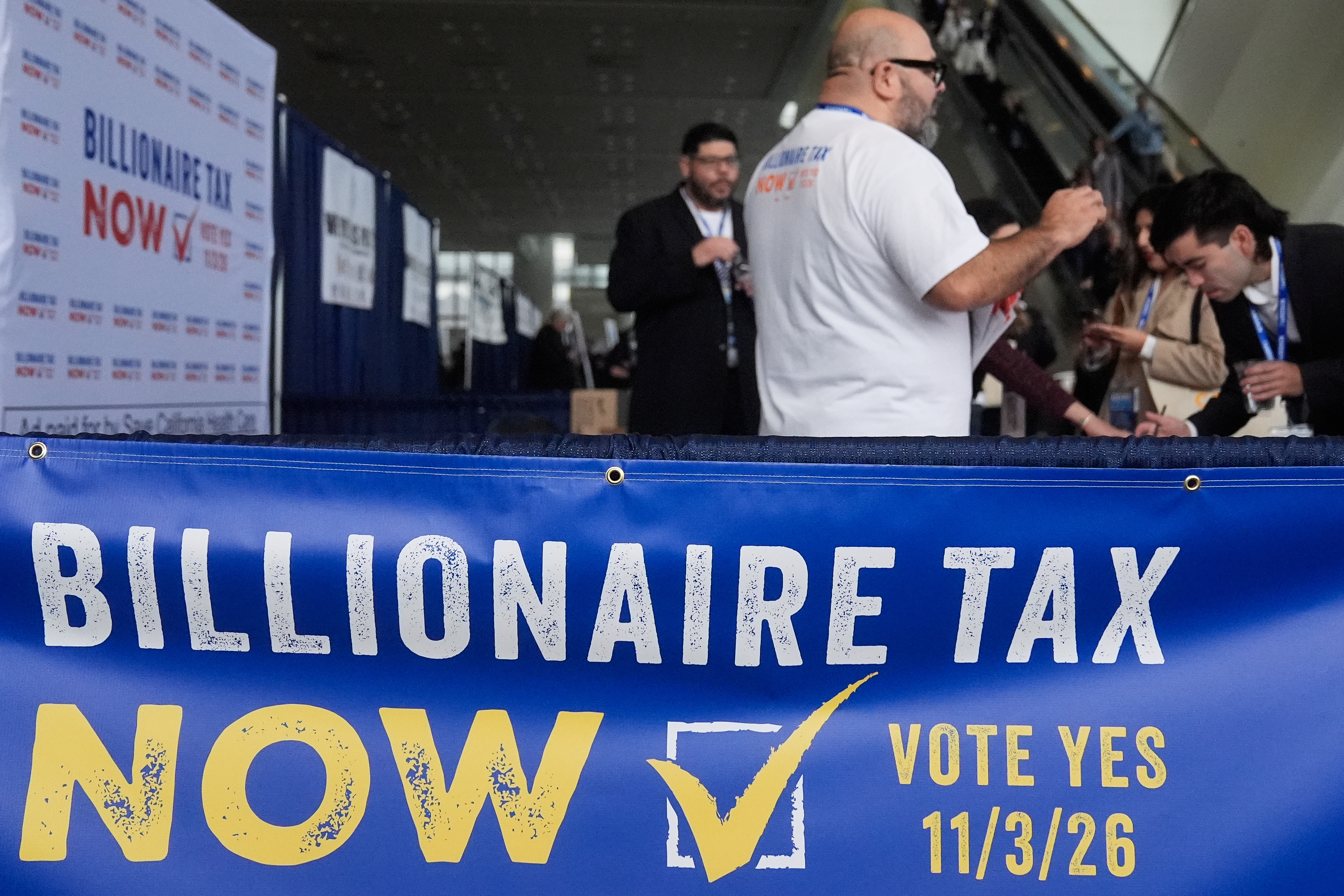
The California billionaire tax, Proposition 40, is finally coming to a vote on Nov. 3. The measure would levy a one-time 5% tax on the net worth of the state’s billionaires. Two competing initiatives on the same ballot, Props 41 and 42, are backed by opponents of the tax, including billionaires.
If either garners more yes votes than Prop 40, it could keep the tax from taking effect.
The labor union Service Employees International Union-United Healthcare Workers West (SEIU-UHW) is spearheading the campaign for the tax on the state's ultra-wealthy to prevent hospital and clinic closures, protect healthcare jobs, and help fund K-14 public education and state food assistance programs.
Opponents, including Gov. Gavin Newsom, say the tax would fuel an exodus of wealthy company founders and investors, spark job losses, and further weaken California's economy.
Prop 40 would levy a one-time 5% tax on the net worth of billionaire state residents, subject to the asset restrictions noted below. Taxpayers could choose to pay the tax in five annual installments, with a 7.5% annual deferral charge on the unpaid balance.
Who would pay?
Billionaire residents in California as of Jan. 1, 2026, would owe the tax in 2027. That's an estimated 255 eligible taxpayers, according to data from Altrata, a wealth-intelligence firm, reported by the Wall Street Journal.
The tax proposal is not based on income — that's a loophole that allows billionaires to pay less in income taxes than the average American. Rather, the proposed California tax is based on billionaires' assets, including equity holdings, often in their own companies. The impact on the most wealthy would vary widely.
A half-dozen or more high-profile billionaires relocated out of state as news of the proposed tax rolled out last year, so the number may be slightly lower.
Those who have reportedly relocated include Google co-founders Larry Page and Sergey Brin, though neither has said that their moves were related to the possible tax.
A Meta regulatory filing dated Oct. 21 said that founder and CEO Mark Zuckerberg told a special board committee that he was considering moving out of the state to avoid the tax if it were passed.
The committee said it was 'critically important to keep Mr. Zuckerberg in a leadership position with our Company and that he continue to reside in and manage the Company from our headquarters in California,' and approved a special class of stock that he could use to pay any wealth tax due.
The tax’s effect would vary widely. The Tax Foundation, a right-leaning tax policy nonprofit, projected that the tax would render Tony Xu, the founder of DoorDash, bankrupt, with a tax liability of $4.17 billion, unless he could challenge the initiative's valuation of his assets.
On the other hand, Jensen Huang of Nvidia would face a tax liability of more than twice that: $8.5 billion. He told Bloomberg that he's fine with that.
The California healthcare worker union, SEIU-UHW, launched the 'emergency tax' initiative to offset possible healthcare staffing issues and service reductions at healthcare facilities. The union estimates a nearly $100 billion loss of federal funding over the next five years due to the passage of the One Big Beautiful Bill Act.
How would the tax be calculated?
Taxpayers and trusts with assets over $1 billion would be taxed on businesses, securities, collectibles, and intellectual property, but the tax would exclude real property and certain retirement accounts and pensions.
How much would it raise?
The California Billionaire Tax Act is estimated to raise about $100 billion, according to the initiative's website. The Legislative Analyst’s Office, the state’s nonpartisan fiscal adviser, estimates that the state would collect tens of billions of dollars from the wealth tax but says the exact amount is harder to predict.
Keep hospitals, ERs, clinics, nursing homes, and home care facilities open and staffed
'Stabilize' healthcare insurance premiums and coverage
Maintain healthcare jobs
Fund K-14 public education programs and staffing
Fund California food assistance programs
Arguments in favor of the California billionaire tax
The Institute on Taxation and Economic Policy, a left-leaning think tank, supports the California billionaire tax, saying that the One Big Beautiful Bill Act 'cut health care and food support in part to pay for tax cuts for the very wealthiest Americans. The legislation gives more than $1 trillion in tax savings to the richest 1% of households over the next decade.'
ITEP added in the analysis that, 'ultra-wealthy households have many ways to enjoy a lavish lifestyle without selling most of their holdings, and so can largely avoid the individual income tax. The billionaire tax directly remedies this injustice by taxing all wealth, whether this wealth has been realized as income or not.'
Arguments against the California billionaire tax
The Tax Foundation believes the California billionaire tax, as drafted, contains 'aggressive design choices and possible drafting errors' that could result in the proposed one-time 5% tax being 'dramatically higher.'
It warns that 'the poorly drafted initiative' could force company founders to sell 'a significant portion' of their shares and lose their controlling interests. Stock prices could plunge, impacting retirement savings and investment account balances of working Americans.
The Hoover Institution, a right-leaning think tank, has said the wealth tax would leave California about $25 billion worse off, accounting for lost income tax revenue from billionaires leaving the state. It also estimated revenues from the levy would fall short of the $100 billion projection, more likely generating just $40 billion.
California voters will decide Nov. 3 whether to approve Proposition 40, a one-time 5% tax on the net worth of the state’s billionaires.
ASSOCIATED PRESS
What about federal wealth tax proposals?
Sen. Bernie Sanders (I-Vt.) has long advocated for a national wealth tax. His 'Make Billionaires Pay Their Fair Share Act,' co-sponsored by Rep. Ro Khanna (D-Calif.), was introduced in March.
The national tax would levy a 5% annual, not one-time, tax on the estimated 938 billionaires in the U.S., estimated to raise $4.4 trillion over the next 10 years. In the first year, the bill would give a $3,000 payment to 'every man, woman, and child' in a household earning $150,000 or less.
The bill moved to committees in both the Senate and House, where no further action was taken.
This article originally appeared on Yahoo Personal Finance at https://finance.yahoo.com/personal-finance/taxes/article/californias-prop-40-what-to-know-about-the-billionaire-wealth-tax-202611704.html
Holiday hiring is heating up with multiple companies saying they are adding temporary workers in the coming months, ahead of the holiday shopping season.
Amazon announced it is looking to fill 300,000 seasonal part-time and full-time roles across their national support operations during the holidays -- an increase of 50,000 positions compared to the same period in 2025. Seasonal employees will earn an average rate of about $20 an hour.
Shipping company UPS said it will hire 100,000 workers in the next few months, noting that many applicants can get a job offer in less than 7 minutes.
John Minchillo/AP - PHOTO: A UPS employee unloads a truck before making deliveries, June 29, 2023, in New York.
Spirit Halloween, the largest Halloween retailer in the U.S., said it plans to employ a record 52,000 associates at store locations.
Patrick T. Fallon/AFP via Getty Images - PHOTO: The 'Jack The Reaper' logo displayed in the windows of a Spirit Halloween seasonal holiday store in the location, August 26, 2024 in Los Angeles.
Poultry company Butterball, famous for their turkey hotline, also said they are hiring their largest team on record to handle calls coming into their 'Turkey Talk-Line' ahead of Thanksgiving.
The October jobs report from the U.S. Bureau of Labor Statistics will be released in November but data released in September shows that hiring has been increasing, although not as much as economists expected. Approximately 29,000 jobs were added in September, down from the 162,000 projected the month prior.
Inflation has also been top of mind for concerned shoppers as unemployment sits at 4.2%.
According to Indeed Hiring Lab, seasonal postings are up 10%, more than this time last year, but job postings for roles in physical stores have also declined.
Retail job postings have gone up 61%, Indeed said, but other roles are also available with loading and stocking jobs up 9%, sales roles increasing 8% and customer service positions rising 6%, as shoppers continue to purchase items online.
This article originally appeared on Good Morning America at https://abcnews.com/GMA/News/seasonal-job-hiring-amazon-ups-spirit-halloween-surging/story?id=137471181
Corey Lewandowski speaks to the press in July 2024..(Photo by Andrew Harnik/Getty Images) - Andrew Harnik/Getty Images
Justice Department prosecutors are investigating allegations of contract misconduct at the Department of Homeland Security, including the role of Corey Lewandowski who worked as de facto chief of staff to former Secretary Kristi Noem,according to multiple people familiar with the investigation.
The probe follows a criminal referral for Lewandowski from the DHS Inspector General’s office, which has been examining contracting practices at the agency during Noem’s and Lewandowski’s tenure, according to one of the people familiar.
The Justice Department declined to comment on the matter.
“Mr. Lewandowski has not been contacted by the Justice Department regarding any investigation, and he denies any wrongdoing when he was proudly serving his country in a voluntary capacity,” Lewandowski’s attorney Adam Trigg told CNN.
The Department of Homeland Security didn’t immediately return a request for comment on the matter.
The referral is an unusual move for the Trump administration, which has been hesitant to criminally investigate its own members.
Critics have instead largely accused the Justice Department of improperly targeting the president’s political enemies and accused DHS of protecting their own employees from scrutiny.
In recent months, as the allegations of possible corruption emerged, Washington, DC, US Attorney Jeanine Pirro told officials in her office that she wanted investigators to look into claims of kickbacks connected to contracting at DHS, according to a second source familiar with the investigation.
It’s still not clear which US Attorney’s office is leading the investigation.
Prosecutors have been awaiting results from the DHS inspector general probe, the person familiar with the probe said.
Lewandowski, a Republican operative, became a fixture at DHS early in President Donald Trump’s second term, serving as Noem’s chief adviser. But on paper, he was originally tapped to serve as a special government employee — a unique role meant to span a limited number of days.
Lewandowksi’s straddling of senior government functions at DHS and service as a special government employee was uncharted territory, according to multiple people who spoke with CNN.
Homeland Security officials ultimately viewed Lewandowski, a Trump ally, as Noem’s gatekeeper. He left the department when Trump fired Noem.
Noem’s handling of contracts within DHS was one of the main catalysts for her ouster by Trump earlier this year, notably when she claimed that Trump knew of a $220 million ad campaign prominently featuring the secretary.
During her tenure, Noem also tightened her grip on her department’s purse strings, ordering that every contract and grant over $100,000 had to cross her desk for approval — a move that Noem frequently defended as intended to cut down on waste but that multiple Homeland Security officials found unusual and unnecessary.
The inspector general, Joseph Cuffari, complained to Congress in early March that Homeland Security leadership had been obstructing some of his work.
Trump, when asked by a reporter on Thursday about the Lewandowski investigation, said he didn’t know much about it as he only just learned of it. He repeatedly said, however, that if people working for him are dishonest, he wants them prosecuted.
“They’re stealing from me, so I want my people to be honest,” Trump said. “And if they’re not honest, I’ll have my DOJ go and do whatever they have to do.”
This story has been updated with additional details.
For more CNN news and newsletters create an account at CNN.com
This article originally appeared on CNN at https://www.cnn.com/2026/10/22/politics/republican-corey-lewandowski-justice-department-investigation
Former White House press secretary Karoline Leavitt acknowledged Thursday that her successor Katie Zacharia, who stepped down after less than a week as press secretary, was not a good fit for the job.
“Look, White House press secretary is a tough job. I know that because I did it,” Leavitt said in an interview with Fox News Digital.
“Many people say it’s one of the hardest jobs in politics. It takes a lot of preparation. Sometimes you don’t know how someone will perform until they go out there,” she continued. “As the president said, we wish Katie the best. The job obviously was not for her.”
Leavitt said Trump is continuing his search for potential candidates, and she has offered to assist the president in finding a replacement.
“I do obviously talk to him about what the job entails, and he knows it very well. Nobody understands the press better than Donald Trump. He knows that he needs someone who is tough, who is smart, who understands his policies, who is loyal and can go out there and put up a fight,” she said.
Leavitt served as press secretary from the beginning of the second Trump administration in January 2025 until this August, saying she wanted to spend more time with her family.
Prior to serving as White House press secretary, Leavitt worked as press secretary on Trump's 2024 presidential campaign. Despite her exit from the White House, Leavitt is still seen as a close confidant of Trump's.
Leavitt’s comments came after Zacharia left the role after only five days on the job earlier this month.
Zacharia's departure followed intense scrutiny over a shaky first press conference, which lasted 14 minutes, as well as skepticism over her legal background.
Copyright 2026 Nexstar Media, Inc. All rights reserved. This material may not be published, broadcast, rewritten, or redistributed. For the latest news, weather, sports, and streaming video, head to The Hill.This article originally appeared on The Hill at https://thehill.com/homenews/administration/6165909-leavitt-says-zacharia-poor-fit/
The mother of a toddler found alive in an Arizona hospital morgue in February more than five hours after he was pronounced dead said Wednesday she thought she heard him breathing when she hugged him goodbye.
But instead of listening to her gut, Alexus Fiordilino said, she believed the doctor who told her those were 18-month-old Vincent’s last gasps and that any further attempts to save him would just prolong his agony.
“As a mom you don’t want to hear that,” Fiordilino, 30, said in an interview. “I didn’t want him to suffer. It seemed to be they’d done everything they could. And then he called it.”
Fiordilino was referring to Dr. Aryan Toosi, who pronounced Vincent dead at 6:20 p.m. on Super Bowl Sunday at Mercy Gilbert Medical Center in Gilbert, Arizona.
A little over five hours later, Fiordilino said, police were questioning her and her husband, Angelo, when a detective burst into the room and told them that a medical examiner’s employee who had come to collect Vincent’s body had discovered he was still alive.
“My husband and I just screamed in relief,” she said. “We were praising the Lord. We were crying. To go from hearing he was gone and then finding out he isn’t gone, it’s an unexplainable feeling.”
Fiordilino spoke out more than eight months after her son’s remarkable story of survival after he nearly drowned in the family swimming pool made national headlines and sparked multiple investigations into what happened on Feb. 8.
“Both admitted to smoking marijuana the morning of the drowning,” the police report said.
But Maricopa County Attorney Rachel Mitchell announced in July that the Fiordilinos would not be charged.
Fiordilino’s lawyer, John Brewer, said he plans to file a formal complaint this week against Toosi and the hospital. He said a review of Vincent’s medical records shows that critical test results that Toosi cited to justify ending efforts to save the child were not completed until after the toddler was declared dead.
“The parents were faced with having to decide whether to keep trying to revive their son, and the doctor provided them with false information,” Brewer said. “That’s beyond a conscious disregard for human life.”
The pool at the Arizona home where Vincent Lorenzo Fiordilino was found. (Gilbert Police Department)
Brewer’s office turned its records over to the Gilbert Police Department, which said it forwarded everything to the state attorney general’s office for review. The AG’s office said Wednesday that it has not made a decision to review this case.
Toosi’s lawyer, Scott Holden, released a statement in response.
“Dr. Toosi’s thoughts are with the young patient and family, and he wishes the child continued healing and recovery,” it said. “His commitment to delivering high-quality care has always been rooted in a desire to provide healing, safety and comfort to his community.”
Meanwhile, the hospital called the situation “heartbreaking” in a statement.
“Out of respect for the patient’s privacy, we cannot share any information and we are unable to comment on those involved in patient care,” it said. “Patient safety and exceptional care are our highest priorities.”
Asked how Vincent is doing now, Fiordilino said, “He’s getting better.”
Brewer said that while the boy is home with his family, he has many health challenges.
“Vincent is severely brain-injured,” he said. “He can’t swallow. He seizes up. He can’t sit up on his own or crawl.”
The tragic turn of events began around 5:38 p.m. Feb. 8 with a 911 call for help after Vincent was found floating face down in the family pool and a relative tried to revive him by performing CPR, according to a police report obtained by NBC affiliate KPNX of Phoenix.
Vincent was rushed to the emergency room at Mercy Gilbert Medical Center, where an ER team that included Toosi took over the effort to save him.
At 6:13 p.m., according to the report, Toosi went out to deliver bad news to the boy’s parents.
Vincent Fiordilino. (via GoFundMe)
“As long as there are no objections, I’d like to call time of death,” Toosi said, according to the report.
Then, “at approximately 18:20 hours, Dr. Toosi called the time of death and requested a moment of silence.”
Just as Fiordilino told NBC News, police officers who had been in the ER said in the report that the child still appeared to be gasping for breath after he was declared dead.
A detective reported then hearing “another audible gasp” at around 7:18 p.m. as the ER workers were preparing to move Vincent from the trauma room to the “cold room” that serves as the hospital’s morgue and where the temperature is set at 36 to 39 degrees.
The same detective said that when he returned to photograph the body an hour later, he “again observed what appeared to be a gasp or air release.”
“The nurse again stated it was agonal breathing and explained it was due to compressions, oxygen, and possible pressure applied by family members while saying goodbye,” the report says.
And at 7:23 p.m., “the cold room door was closed,” the report says.
More than four hours later, when the medical examiner’s team arrived at 11:52 p.m. to retrieve the boy, “he was found breathing,” the report says.
“The family was notified immediately,” and the boy was airlifted to Phoenix Children’s Hospital.
Fiordilino said that when she saw her son again in the pediatric intensive care unit, “he was hooked up to all kinds of monitors and things.”
“He looked like a different baby,” she said. “It’s something I hope no other parent has to live through.”
This article was originally published on NBCNews.com
This article originally appeared on NBC News at https://www.nbcnews.com/news/us-news/arizona-mom-whose-son-was-found-alive-hospital-morgue-speaks-s-unexpla-rcna604798
Nvidia (NVDA) CEO Jensen Huang says that for data center builders to win over communities, they must first partner with them and be good neighbors.
'When you go into a community … before you start building, you ought to extend yourself out to the local community and partner with them,' Huang told Deirdre Bosa during the company's GTC event in Berlin.
'Let them know what you're about to do is going to bring, of course, all the benefits, but it's going to, of course, bring new neighbors,' he said.
Data center construction has faced major pushback across the US, with some counties and towns instituting outright bans on the facilities. New York has placed a one-year, statewide moratorium on data center construction. Texas, meanwhile, has put connecting new data centers to its grid on hold as it works to determine their potential impact.
The issue has even become a flash point in the midterm elections, with President Trump backing data center development, and Democrats and some Republicans campaigning against them.
Residents have lodged complaints about the constant noise generated by data centers, water usage, increased electricity costs, and more.
To help ease tensions with local residents, some companies, including Microsoft (MSFT) and Amazon (AMZN), have taken steps to win over municipalities by dropping controversial nondisclosure agreements (NDAs).
NDAs have become a key issue among some data center opponents, as they prevent local leaders from disclosing information about the projects.
'Everybody has now taken a step back, whether it's the NDAs or contributing to the communities, whether it's building shops and … community centers and improving schools and in many cases even supporting lower taxes and, you know, all kinds of benefits that can be brought to the local communities,' Huang said.
'I think those are all good ideas, and each one of them ought to be … tailored for the needs of the community. But the most important thing is you've got to be a good visitor. You know you should be a good guest. And before you go into a community, stop by and see if you can be helpful,' he added.
Sign up for Yahoo Finance's Week in Tech newsletter.
Yahoo Finance
Follow Daniel Howley on X @DanielHowley or email him at dhowley@yahoofinance.com.
This article originally appeared on Yahoo Finance at https://finance.yahoo.com/technology/article/nvidia-ceo-jensen-huang-says-data-center-builders-have-to-be-good-neighbors-132705446.html
To know more about how we can meet your specific requirements, please drop us a message or mail us at 'contact [at] pegasusinfocorp.com'. Please click here to drop us a message.