Pegasus InfoCorp helps build customized web software and undertakes web development software solutions for clients internationally. We also build front end websites, and offline software that integrates with our web based software. Our services/ custom built software solutions include Web Development, web development, web software, small business web software development and enterprise scale business software development on web technologies.
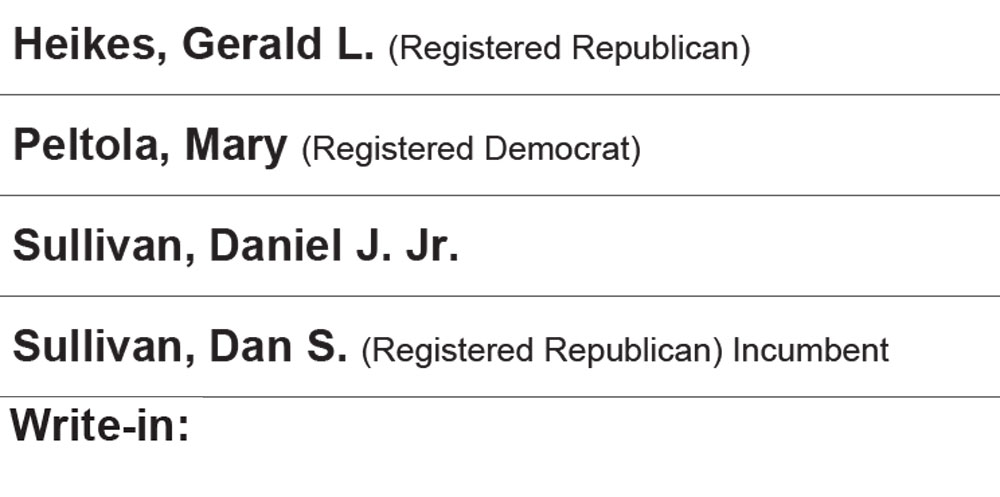
It was, for a while, considered one of those colorful quirks that crop up in the course of an election: the fact that not one but two candidates named Dan Sullivan will appear on the Nov. 3 ballot for U.S. senator from Alaska.
But now the situation seems to be getting more serious. At President Trump's direction, the Justice Department last week sued in federal court to block certification of the election if Sen. Dan S. Sullivan loses, alleging that retired teacher Dan J. Sullivan is a Democratic plant whose purpose is to siphon away votes.
'The Times has found, based on interviews and text messages, along with documents prepared for a potential lawsuit against the campaign, that not only did Ms. Peltola's team work with people trying to recruit Mr. Sullivan to run for Senate, but the effort was much broader,' the paper wrote. 'The group worked to coax other would-be spoilers into the race, to dilute the incumbent's support and help catapult the Democrat to victory.'
In response to the report, Trump called for both Peltola and the 'fake' Dan Sullivan to be removed from the ballot in a post on Truth Social.
Yahoo
The outcome of the legal dispute, if it moves forward, could have enormous national implications. Democrats need to win at least a few Senate races in historically Republican states to secure a majority in the chamber. Polls suggest Alaska is one of their best chances to turn a red seat blue. Given how close other races across the country appear to be, a legal ruling that erases a narrow Peltola victory could be the pivot point that allows the GOP to keep control of the Senate for the last two years of Trump's presidency.
How did this happen, and where do things go from here? Here's everything you need to know to catch up and make sense of the story.
How Alaska wound up with two Dan Sullivans on the ballot
Ballot-stacking — the process of recruiting a spoiler candidate to help your candidate win — isn't unheard of in politics, and the Times says it's 'generally considered legal.'
But it's a lot easier in Alaska than other states because of the unique way elections work there. When Peltola ran for reelection to the U.S. House in 2024, the state GOP backed an effort to help a second Democrat — an inmate who conducted his campaign from a New York prison — remain on the ballot. And during this year's primaries, super PACs aligned with both parties 'flooded the state with ads for fringe candidates' in an attempt to 'dilute support for the mainstream candidates opposed by the groups,' according to an October Alaska Beacon report.
How is any of this possible? The Last Frontier sends the top four primary candidates to the general election regardless of party — then asks voters to rank them on Election Day in order of preference. This means that candidates can claim any party affiliation on the ballot without being vetted by parties themselves. (Dan J. Sullivan initially claimed to be a Republican.) It also means that as ,long as they finish in the top four, primary candidates don't have to earn many votes to secure their very own ballot line on Nov. 3. (Dan J. Sullivan won 4,107).
For months, Republicans have questioned Dan J. Sullivan's intentions and tried to get him tossed off the ballot. In June, the Alaska Supreme Court dismissed their arguments, ruling that neither state law nor the U.S. Constitution provided any legal basis for removing Dan J. Sullivan's name.
How the Senate candidates will appear on Alaska's midterm ballot.
elections.alaska.gov
The more obscure Sullivan has 'maintained that he [is] running in good faith and of his own volition, as a moderate Republican and not a secret Democrat,' as a Times profile put it in August. He said he'd voted in the past for some Alaska Republicans, including Sen. Lisa Murkowski, even though he also 'acknowledged previous donations to Ms. Peltola and a handful of other Democrats,' and said he would prefer Peltola for Senate over the Republican incumbent 'if it was between those two.'
But according to this week's Times report, 'operatives aligned with' the Peltola campaign convinced Dan J. Sullivan to enter the race 'to help Mary.' The report cited as its sources 12 people 'who participated in or were told of the plan' as well as interviews with other would-be recruits and dozens of internal text messages.
For the record, both Peltola's campaign and the Democratic Senatorial Campaign Committee, which directs the party's campaign strategy in Senate races across the country, have denied any 'involvement,' and Dan J. Sullivan did not respond to the Times's repeated requests for comment. One of the Times's main sources — former Peltola campaign manager and longtime aide Elisa Rios, who had been planning to file a wrongful termination lawsuit — also tried to retract her statements to the paper ahead of publication.
The Times story described an elaborate endeavor — which was 'internally called the ballot composition project' — that 'involved secret trips to far-flung Alaskan communities and the appearance of a mysterious Midwestern operative, who traversed the state using a fake name and made his pitch to would-be candidates over beers at brew pubs.' The Times also reported that the 'Peltola campaign's lawyers, as well as senior aides at the Democratic Senatorial Campaign Committee' were 'involved' with the effort.
The Trump administration's lawsuit
Legal battles over the dual Dan Sullivan issue had been confined to state courts until last week. That's when Trump's administration filed its lawsuit aiming to have the certification of the results blocked if Peltola wins a close election that may have been affected by Dan J. Sullivan's presence on the ballot.
'Should Alaska certify any electoral results tainted by the inclusion on the ballot of Daniel J. Sullivan … the State and its officers will fail in its obligation to protect the integrity of its election,' the Department of Justice wrote in its legal filing.
The suit argues that a Democratic victory should be considered invalid if Peltola wins by a margin smaller than the total number of votes that Dan J. Sullivan receives — under the assumption that those votes may have come from confused voters who intended to vote for the incumbent Republican senator instead.
Democrats have asked the courts to dismiss the lawsuit, arguing that the administration lacks 'any statutory or constitutional authority to insert itself' into the state's electoral process. Alaska's state government, which is currently led by Republicans, has also filed to dismiss the administration's lawsuit. On Monday, a federal judge agreed to fast-track consideration of the dispute to potentially allow it to be resolved before Election Day.
Many legal experts say the lawsuit has a slim chance of success. First, it requires a very specific outcome in which Peltola wins by what would likely need to be a very thin margin. Even in that scenario, election law experts say, the appearance of confusion on the part of voters does not create legal grounds for the federal DOJ to have the results rejected.
'I believe that this lawsuit is abusive in its intentions and borders on frivolous in its arguments, and that it is destined for defeat in the courts should it reach the merits,' Walter Olson, a senior fellow at the Cato Institute, a libertarian think tank, told the Alaska Beacon.
Nicholas Stephanopoulos, a Harvard law professor, told the Harvard Gazette that the law the administration is relying on in its lawsuit — the National Voter Registration Act (NVRA) — does not give federal authorities any power to challenge state election procedures.
'The lawsuit has nothing to do with voter registration. There's no allegation that anybody is improperly registered in Alaska; there's no claim that Alaska isn't in compliance with the NVRA's requirements for voter registration,' Stephanopoulos said.
More generally, experts say the lawsuit runs against the Constitution's language granting states the power to run their own elections.
'This is purely a matter of state law, and the administration has absolutely no authority to tell Alaska when or how to certify the results of its Senate election,' David Becker, a former Justice Department attorney who worked on voting rights cases, told Alaska Public Media.
What's next?
The federal judge in Alaska considering Democrats' motion to dismiss the lawsuit is expected to rule on whether Peltola's campaign and other groups can join the case on Wednesday. If that motion is granted, the judge said the DOJ should be ready to respond to a motion to dismiss the case by Thursday afternoon.
That likely only matters in an extremely close race, which is not the recent norm in Alaska. The last time Dan S. Sullivan was on the ballot, he defeated his top challenger, independent candidate Al Gross, by 45,000 votes. The most recent Senate race, in 2022, was closer, but the top two finishers were both Republicans.
Things are expected to be much tighter this time around. Peltola has held a consistent lead in the polls since the summer, but her advantage has steadily shrunk in the months leading up to Election Day. The most recent surveys have her ahead by 2 points, well within the margin for Sullivan to win. The Cook Political Report, one of the nation's most respected election forecasters, lists the race as a toss-up. Another well-regarded forecaster, the Center for Politics, categorizes it as 'leans Democrat.'
This article originally appeared on Yahoo News at https://www.yahoo.com/news/politics/article/alaska-democrats-linked-to-secret-effort-to-recruit-2nd-dan-sullivan-to-tip-senate-race-report-200632493.html
WASHINGTON — President Donald Trump floated nominating Ted Cruz to the Supreme Court for a future vacancy on the nation's high court, joking that the Texas Republican senator's confirmation would earn unanimous Senate support because senators from both parties would like to see him gone.
Trump, who has mentioned Cruz previously for the Supreme Court, suggested the third-term senator again at an Oct. 27 midterm campaign rally in Lubbock, Texas as the president discussed what he might do if he gets to nominate a Supreme Court justice for a fourth time over his two White House terms.
'I said, 'I have an answer to not being able to get it past the Democrats or the Republicans together,'' Trump said, referring to the confirmation fight in the Senate. 'I would pick Ted Cruz to be the next Supreme Court justice, and I wouldn't have to worry about it. I wouldn't have to make a phone call.
'The Democrats will 100% vote for it because they hate the guy and the want to get rid of him,' Trump continued. 'And the Republicans would 100% vote for it because they can't stand him, they would like to get rid of him. So I'd get 100% of the vote, and he would be a Supreme Court justice and he'd do a great job.'
Cruz, who was in attendance at the rally for Texas Republican Senate nominee Ken Paxton, laughed and smiled from his front-row seat as Trump made the pitch.
A conservative firebrand in the Senate, Cruz has repeatedly said he's not interested in serving on the Supreme Court. “I don't want to be a judge,” Cruz told the Houston Chronicle in September.
Trump has openly expressed regret for nominating each of his three Supreme Court picks from his first term ‒ Neil Gorsuch, Brett Kavanaugh and Amy Coney Barrett ‒ after they sided against his administration in a series of high-profile rulings.
Trump called Cruz 'a brilliant guy, brilliant lawyer, brilliant all that.' As solicitor general of Texas from 2008 to 2013, Cruz argued multiple cases before the Supreme Court. After graduating from Harvard Law School, Cruz clerked for then-Chief Justice William Rehnquist.
Cruz, 55, has turned into one of Trump's strongest allies on the Senate after running against Trump for the Republican nomination for president in 2016.
Cruz has also made no secret about his interest in running for president in 2028. Other Trump allies Vice President JD Vance and Secretary of State Marco Rubio are also considered likely contenders to seek the Republican nomination. Were Trump to appoint Cruz to the Supreme Court, however, the field would start to narrow.
It is unclear whether Trump will have an opportunity to nominate a fourth justice to the Supreme Court. Justice Samuel Alito in August said he plans to remain on the bench through at least the next session, batting down speculation the conservative justice could step down to allow Trump to choose his replacement.
This article originally appeared on USA TODAY at https://www.usatoday.com/story/news/politics/2026/10/28/trump-floats-senator-ted-cruz-supreme-court-vacancy/92474646007/
People wait in line to participate in early voting for the midterm elections in Cary, North Carolina, on October 25, 2026. —Allison Joyce—AFP/Getty Images
Election Day is still a week away. But with early voting for the midterms underway in nearly every state, tens of millions of Americans have already cast their ballots, offering an initial glimpse into how the pivotal elections may play out.
As of Tuesday afternoon, nearly 33 million people have voted since early voting windows opened in some states over a month ago, according to tracking by the University of Florida’s Election Lab. Around half of those votes have been cast in person, while the other half were submitted by mail.
With days of early voting left to go before Election Day on Nov. 3, that figure already represents more than a quarter of the roughly 122 million Americans who voted in the 2022 midterms.
Michael McDonald, a political science professor at the University of Florida who runs the Election Lab, stresses to TIME that early voting data cannot in and of itself be relied on to predict the outcome of the elections. But he says it can reveal other informative aspects of voting behavior.
“Once you start seeing consistency across multiple days of voting and across multiple states, it starts giving us more confidence that whatever we're seeing in terms of relative engagement, that's likely going to carry through to election day,” McDonald says.
Here are some of the notable trends emerging in the early voting data as Election Day nears.
Democrats are outpacing Republicans in early ballots
Registered Democrats so far represent a larger share of early voters in the midterms than Republicans, having cast roughly 45% of early ballots compared to 31% cast by GOP voters, according to the University of Florida’s Election Lab data. Another 24% of Americans who have voted early are not registered with either party.
This data is only available for the 27 states that have a formal party registration system, and signifies only the party with which a voter is registered, not the candidates selected on their ballot.
Experts caution that Democrats’ higher turnout in the early vote does not guarantee they’ll maintain that edge, with tens of millions more Americans still expected to show up at the polls.
Republicans are anticipated to make up ground on Election Day, as they have in recent years. A Pew Research survey conducted following the 2024 elections showed that nearly 40% of registered Republican voters cast their ballot in person on Election Day, compared to 28% of registered Democratic voters.
“We expect the Democrats to build up a lead in the early vote, and Election Day tends to be a Republican day, so you can't just look at the early vote as it is now,” McDonald tells TIME.
Polling has shown, however, that Democratic engagement and enthusiasm is higher than it is for Republicans in the lead-up to the elections. According to a PBS News/NPR/Marist poll released on Tuesday, 52% of likely voters said they would back the Democratic candidate in their House district, while 44% would back the Republican candidate. Independent likely voters favored Democratic candidates by 13 points.
More Democrats than Republicans also said in the survey they were very enthusiastic about voting, at 71% and 61% respectively. Another poll from the Pew Research Center earlier this month similarly showed greater engagement and stated motivation from voters backing Democrats: 78% of voters who voiced support for the Democratic candidate in their House district said who controls Congress “really matters,” compared to 69% of voters who backed Republican candidates who said the same. Such polls have suggested a “blue wave” of Democratic support might determine the midterms, but Republicans have pushed back against the numbers.
Bernard Fraga, a political science professor at Emory University, tells TIME that the relative lack of Republican enthusiasm in polls and trailing GOP turnout in early voting shows that support within the party, and for President Donald Trump, has waned.
“This is a story about Democrats who voted in 2024 persisting, and Republicans who voted in 2024 so far at least staying home,” he says.
The midterms come as Trump’s approval rating has hit near record lows amid widespread dissatisfaction with his handling of the war in Iran and the economy. A Reuters/Ipsos poll released on Monday put Trump’s approval rating at 32%, up one percentage point from last week, when the same poll recorded the lowest approval rating of his second term.
Fraga says that Republicans are frustrated with what he describes as “failures” of the Trump Administration, which he asserts have decreased GOP voters’ support for their party and led them to stay home rather than casting ballots early.
“Even for steadfast Republican voters, they look at the state of the economy, for example, and say that they're not too enthusiastic about voting,” he says. “Reading the trends, it's clear that Democrats are enthusiastic and mobilized to a much greater degree than even the Republican voters.”
Simon Rosenberg, a long-time Democratic strategist, contends that independents are also more likely to be voting in favor of Democrats, givenrecentpolling, which has shown that more independent likely voters support Democratic candidates. One YouGov poll found that 54% of independents said they’d vote for Democratic candidates, versus 27% who said they’d vote for Republican candidates. Another PBS/NPR/Marist poll showed that independents favored Democrats by a margin of 25 points.
Given such polling, Rosenberg believes that the number of people voting for Democratic candidates is actually higher than the partisan breakdown in early voting data explicitly indicates.
Hispanic voters are turning out early in higher numbers than other recent elections
Rosenberg says that the most significant data coming out of early voting is the number of Hispanic people voting early.
So far, Hispanic early voting participation is outpacing its levels at the same point in the election cycle in 2022 and 2024. Presidential election years such as 2024 typically yield higher voter turnout, which Rosenberg says makes the 2026 figures to date all the more notable and surprising.
“It's almost certain that this heightened performance will carry over through Election Day, and that this will become one of the big storylines of the election,” he says. “It's a universal trend that we're seeing all across the country.”
This trend is most noticeable in states with high Hispanic populations, like Texas.
In one of the most closely watched—and expensive—Senate races this year, James Talarico is vying to become the first Democrat elected to the Senate from Texas since 1988 in a tightly contested battle against the state’s Republican Attorney General Ken Paxton.
Over 4 million votes have been cast early, or an estimated 41% of the total votes expected in the race, according to tracking by VoteHub. As of Monday, Talarico was forecast to hold a narrow two-point lead in the early vote.
The state's Hispanic population, one of the highest in the U.S. per capita, represents 24% of the vote as of Monday, according to VoteHub, a percentage point higher than the share it made up in the final vote tally in the 2024 election. Another analysis reported by The Texas Tribune showed that the Hispanic early vote in Texas has already surpassed the early vote numbers from 2024 and 2022.
“What we can see here is just eye-popping numbers for Hispanics,” McDonald said about the group’s early voter turnout not only in Texas, but around the U.S. “If Hispanics are showing up in force now, it's almost with certainty going to change the overall … diversity of the electorate in this election cycle.”
As a result, McDonald contends that “we're going to see larger swings to the Democrats in more diverse states.”
Pollinghas indicated that Hispanic and Latino voters, a demographic that helped propel Trump back to the White House two years ago, widely disapprove of the President and the Republican Party heading into midterms. Sixty-six percent of Latino voters surveyed in late September by an NBC News/Telemundo poll said that Trump’s deportation policies have gone too far, while 75% disapprove of his handling of the economy and the cost of living. The poll also found that more Latino voters hold a negative view of the GOP than at any point since 2016.
Another Reuters/Ipsos poll released on Oct. 5 showed that just 24% of Hispanic Americans approved of Trump’s performance in the White House, the lowest such rating the President has received across both of his presidential terms. And just 52% of Hispanic voters who responded to the poll planned to vote Democratic, double the level of support for Republicans among the demographic.
How predictive is early voting data?
Rosenberg cautions that early voting “can tell you a lot, but it can't tell you everything,” and that voter turnout can shift from day to day.
He notes that early voting returns showed Kamala Harris leading in the 2024 presidential election, and that she still lost after a strong gain in Republican turnout for Trump.
But he contends that “the lack of intensity that we're seeing in many rural and Republican counties around the country does not bode well for them for Election Day.”
Fraga says that in general, political scientists are skeptical of using early voting data to predict election outcomes. This has been especially true, he notes, in the aftermath of the COVID-19 pandemic, which saw Democrats cast early votes by mail at a significantly higher rate than Republicans, who were more likely to vote early at polls, a dynamic that made it harder to draw on the early vote to confidently predict outcomes on Election Day.
Now, though, “the partisan distribution of voters has become somewhat more stable,” he says. “So we can use that information to now have a better comparison, and as a result, early voting data sheds a lot more light on what's likely to happen in November.”
“It's not determinative. It's not going to predict what's going to happen,” Rosenberg says. “But every campaign in the country right now is living and dying on this early vote data.”
Richard Hall contributed reporting.
This article originally appeared on Time at https://time.com/article/2026/10/27/midterm-elections-early-voting-data-democrats-republicans-hispanic-voters/
The Warsh Fed's taciturn nature has already raised the stakes for each FOMC meeting. With fewer hints or forward guidance about what the Fed is thinking and planning comes more suspense.
And next year, those stakes will be even higher as the Fed removes a rate decision from its calendar, making each meeting even more important and potentially adding another layer of uncertainty and volatility to markets.
At the October policy meeting on Wednesday, Fed Chairman Kevin Warsh announced this major change to the Fed's calendar and added that 2028 might feature only six rate decisions. The meetings themselves will remain on the calendar, but instead of the Fed debating rates, broader monetary policy topics will be on the agenda.
Warsh said the reasoning behind the schedule change is to 'reserve the time and space as an intellectually diverse group for strategic deliberations, for thinking anew about big questions, looking out over longer time horizons.'
We've all been wondering how the newly installed chair would reshape the Fed. Already, he's been doing that by changing the nature of the Fed's public communication.
'I don't believe in forward guidance,' Warsh said on Wednesday. His remarks echoed his move earlier this year to end the years-long practice of offering forward guidance — removing an important signal for Wall Street and Main Street alike.
Warsh himself has not contributed a 'dot' to the central bank's quarterly chart showing where individual policymakers expect short-term interest rates to go, and he doesn't plan to do so.
Now the Fed will also have fewer decisions to discuss.
This article originally appeared on Yahoo Finance at https://finance.yahoo.com/economy/article/the-fed-just-removed-a-2027-rate-decision--making-the-remaining-7-even-more-important-194159258.html
The death of Hayden Panettiere has been ruled accidental, South Caroline police announced Wednesday.
Greenville Police Department said the investigation into Panettiere's death has been concluded 'based on the Medical Examiner's determination and the findings of the investigation,' and the actor's death was officially ruled accidental.
Last month, a South Carolina coroner confirmed Panettiere died from an accidental drug overdose that included fentanyl. There were no signs of trauma, the coroner's office said.
Emergency responders were called to a residence where Panettiere, 36, had been staying in Greenville, South Carolina, on the afternoon of Aug. 16. Despite 'advanced cardiac life support measures,' she was pronounced dead there, the Greenville County Coroner's Office said.'
Panettiere's on-again, off-again boyfriend Brian Hickerson and his brother Zach were at the scene of her death, according to a police report obtained by CBS News. The Hickersons made the 911 call that brought first responders to the apartment.
Authorities, including the Drug Enforcement Administration, were investigating the circumstances of Panettiere's death. Police previously said that a preliminary investigation 'has not indicated any signs of foul play or suspicious circumstances.'
This article originally appeared on CBS News at https://www.cbsnews.com/news/hayden-panettiere-death-ruled-accidental/
Two right-wing provocateurs, James O'Keefe and Cam Higby, are facing election-related charges in Minnesota after posting videos of an undercover stunt intended to expose alleged deficiencies in election security.
Hennepin County Attorney Mary Moriarty said each man faces a count of unlawful voting and identity theft.
'Elections are the bedrock of democracy and their protection is one of our highest priorities,' Moriarty said in a statement. 'Individuals engaging in unlawful conduct related to our elections will be held accountable.'
O'Keefe, a self-proclaimed 'guerilla journalist' infamous for his undercover videos, and Higby, a social media influencer, posted the video at the heart of the charges in August. It shows the two men approaching election judges at multiple voting precincts in Minneapolis wearing burqas, speaking in fake accents, and allegedly misrepresenting their identities, in an effort to expose what O'Keefe and Higby say are gaps in the rules that allow residents to vouch for the identity of other voters.
The video, which remains pinned on Higby's X account, is called 'I Wore Burqa To EXPOSE Election FRAUD In Minneapolis.'
No ballots were cast in the course of their efforts.
Tim Evans/AFP via Getty Images - PHOTO: People fill their ballots during the first day of early voting for the midterm elections in Minneapolis, Minnesota, October 16, 2026.
Prosecutors said Wednesday that O'Keefe and Higby deceived the election judges by using the identities of real Minnesota voters 'without those voters' knowledge or permission' in violation of state law. Each count carries up to five years in prison and a fine of up to $10,000. Neither man is in custody, according to charging documents.
In a statement shared on X, Higby said, 'No laws were broken. They want me in PRISON for exposing election vulnerabilities in their state.' O'Keefe did not immediately respond to a request for comment.
Steve Simon, the state's top election official, said in a statement that 'any attempt to disrupt or deceive our election workers will not be tolerated.'
The charges announced Wednesday in Minnesota are not O'Keefe's first brush with the law. In 2010, O'Keefe pleaded guilty in Louisiana to a misdemeanor charge of entering a federal property under false pretenses after he posed as a telephone repairman to gain access to a U.S. senator's New Orleans office.
This article originally appeared on ABC News at https://abcnews.com/US/2-wing-provocateurs-facing-election-related-charges-minnesota/story?id=137646933
Democrats have signalled a willingness to launch probes into both Donald Trump and Pete Hegseth's handling of the Iran war [Getty Images]
Democrats in the US Congress are already planning how they would use their power if they win a majority in the House or Senate in next week's midterm elections.
Success is by no means guaranteed, even if midterms can sometimes be brutal for the incumbent party that holds the White House.
Control of the chamber, however, would give the party power to issue subpoenas - summons to testify or produce documents - as well as additional funding to launch investigations early next year.
Democrats are weighing whether to investigate senior figures in the Trump administration - and possibly the president himself. Staffers have begun assembling a list of possible investigations and witnesses, according to people familiar with the discussions.
Here are a few potential Democratic targets if the party emerges victorious on 3 November.
1. Trump's family and finances
Democrats have made it clear that lucrative deals brokered by the Trump family's vast business empire will be primary targets of any initial investigations.
'We want to make sure that [American] taxpayer dollars are being used wisely and not being stolen or pocketed because of corruption,' Virginia Democratic Representative Suhas Subramanyam, a member of the House Oversight Committee, told the BBC.
Items under consideration for investigation include ties between the administration and corporate entities - particularly cryptocurrency firms - as well as the international business dealings of the president's son-in-law, Jared Kushner.
Other topics could include the $400m (£301m) aircraft gifted by Qatar to serve as Air Force One and multimillion-dollar defence contracts awarded to firms linked to the Trump family.
'What's shocking to me is not only that this administration, cabinet officials and even the president and his family have been corrupt and self-dealing, but they've been so brazen and open about it,' Subramanyam said.
The White House has repeatedly denied any allegations of wrongdoing.
'President Trump is focused on retaining Republican majorities in Congress and doubling down on the progress he has made to lower costs for families,' White House spokesperson Olivia Wales said.
'Democrats have no agenda to improve the lives of the American people, just plans to obstruct and baselessly target President Trump's commonsense agenda,' she added.
A White House official said the administration is 'always prepared' to respond to oversight requests regardless of who is in Congress.
Democratic lawmakers have vowed to look into Defence Secretary Pete Hegseth's handling of the war with Iran that began in February - including the number of civilian casualties, munitions shortfalls, spending and claims of poorly prepared troops and facilities.
Other topics, according to a source familiar with the discussions, could include boat strikes in the Caribbean that the administration says are aimed at stopping the flow of drugs into the US.
In April, a group of House Democrats filed rare articles of impeachment against Hegseth. They cited the war in Iran and accused him of 'high crimes and misdemeanours'.
Impeachment requires only a simple majority in the House, but conviction - and removal from office - would require a two-thirds vote in the Senate. No cabinet official has ever been removed this way.
Some experts believe that the negative publicity that would come from congressional hearings could ultimately lead to Hegseth being fired or resigning from the position.
'[If] it looks bad for the White House, and it's a drag on their media attention, President Trump might be likely to cut loose those officials, because he doesn't want that bad press,' said David Miller, a political science professor and expert on the presidency at American University in Washington DC. 'In a sense that could be a win for the Democrats.'
Richard Painter, the former chief White House ethics lawyer under George W Bush, told the BBC that the decision to launch the war should come under scrutiny.
'The bigger issue is this: this war was never authorised by the United States Congress, and I don't care who the secretary of defence is,' he said.
'The constitution says that Congress declares war,' he said, and lawmakers should 'haul these folks in' to answer questions.
In a statement, Pentagon Press Secretary Kingsley Wilson defended Hegseth's record, calling him a 'transformative leader' who has 'slashed bureaucracy, unleashed innovation, and delivered for our warfighters'.
'By every measurable metric, the Department of War is better under Secretary Hegseth's leadership than before,' she said, using the administration's preferred name for the defence department.
The aircraft gifted by Qatar to serve as Air Force One is also likely to be the target of Democratic investigations [Getty Images]
3. Immigration and ICE raids
Senior Democrats - including Robert Garcia, the California Democrat tapped to lead the House Oversight Committee should the party take back the chamber - have identified immigration enforcement as a key priority for potential congressional investigations.
These could examine allegations of misconduct by Immigration and Customs Enforcement (ICE) agents during immigration raids across the country.
But these investigations may prove difficult and politically tricky.
In 2024, Trump campaigned on a promise of mass deportations of undocumented migrants - a message that resonated with many of his supporters.
But recent polls suggest many Americans, including those who backed Trump in that election, are uncomfortable with some of the tactics used by ICE in American cities so far this year.
It means Democrats will have to walk a fine line between opposing ICE tactics and appearing to dismiss broader immigration concerns, Painter told the BBC.
4. A third Trump impeachment
Democrats are split on the possibility of attempting to impeach Trump for a third time.
Some, such as Representative Alexandria Ocasio-Cortez, have expressed support for an impeachment, citing what they view as an unauthorised war with Iran and other alleged impeachable offences.
Others have called for a more cautious approach, arguing that any impeachment is unlikely to end in the Senate voting to remove Trump - who has repeatedly denied any wrongdoing - from office.
It is also unclear whether the party could agree on a reason to launch impeachment proceedings.
'I can do whatever I want, if I want,' Trump told reporters in the Oval Office in October, adding that he sees the impeachment efforts in his first term and the later criminal cases brought against him as 'very illegal things'.
James Comer, the Republican chairman of the House Oversight Committee, told the Washington Sun news outlet in June that Democrats were 'one-trick ponies' who were 'going to go after Trump'.
There is no guarantee for Democrats that any potential investigation would end with a meaningful outcome.
But Subramanyam said their efforts would send a message.
'If we do not do something because we are scared of the optics, or we don't think it will be successful, or they stonewall us, that will be bad,' he said. 'Not just for the next two years, but for the next 20 years.'
[BBC]
Follow the twists and turns of Trump's second term with North America correspondent Anthony Zurcher's US Politics Unspun newsletter. Readers in the UK can sign up here. Those outside the UK can sign up here.
This article originally appeared on BBC at https://www.bbc.com/news/articles/cvglwg033027o?xtor=AL-72-%5Bpartner%5D-%5Byahoo.north.america%5D-%5Bheadline%5D-%5Bnews%5D-%5Bbizdev%5D-%5Bisapi%5D
President Donald Trump on Tuesday pulled back regulations on a major global warming pollutant — just days after a satellite discovered a large plume of methane pouring out of oil and gas wells near the Lubbock, Texas, campaign rally where Trump made his announcement.
Governments and the private sector are deploying a wave of new technology to pinpoint methane leaks like never before. But that technological revolution is colliding with political decisions in the U.S. and Europe to weaken regulations that are designed to curb the powerful driver of climate change.
“The methane problem,” Trump said Tuesday night. “I'm officially terminating Biden's expensive and unnecessary methane regulations to save consumers and energy producers $45 billion in costs, unlock vast quantities of Texas natural gas and produce 210 million barrels of oil.”
American and European regulators alike have argued that the methane rules should be ditched or delayed because they threaten to increase the price and availability of energy, even as new technology identifies gas leaks — and bad actors — with remarkable accuracy.
The backtracking could result in more methane emissions as nations around the world are failing to meet their commitments to contain climate change.
“You can't reduce what you don't monitor,” said center-left European Parliament lawmaker Thomas Pellerin-Carlin, who opposes steps to delay the bloc’s rules.
Methane has 80 times the warming impact of carbon dioxide over a 20-year period. Climate scientists say controlling methane, a byproduct of producing oil, gas and coal, along with agriculture and decomposing waste, is the fastest way to arrest rising temperatures.
But the U.S. Environmental Protection Agency has proposed weakening methane standards for oil and gas operators and is poised to eliminate penalties for so-called “super-emitters.” Meanwhile, the European Union is preparing to delay methane rules designed to prioritize energy imports with lower emissions.
The backsliding comes as a wave of new technologies has pinpointed the world’s largest sources of methane, making it easier than ever before to prevent the gas from escaping into the atmosphere. A sweeping study published in the journal Nature found that methane-sensing equipment on satellites detected leaks with 92% to 100% accuracy on clear days, underscoring leaps in progress.
Satellites are not the only improvement. Heat cameras can now spot leaks. Companies like Google are using artificial intelligence tools to map plumes from space. And firms are flying airplanes with a remote sensing technology that uses laser pulses, called LIDAR, to track methane.
“Ten years ago, the tools were not there. You couldn’t detect these things,” said Riley Duren, CEO of the environmental nonprofit Carbon Mapper, which uses satellites and other technologies to detect methane leaks worldwide. “Today we have more tools at our disposal than ever. It’s not a visibility challenge anymore.”
The group’s Tanager-1 satellite spotted methane leaks in a slice of the Texas Permian Basin on Oct. 10. Two days later, a new satellite named Tanager-2, which rode a SpaceX rocket into orbit this month, confirmed the Texas plume.
The bigger test is getting companies to take action.
Carbon Mapper this year has issued 460 notices to companies operating super-emitting sites in 13 U.S. states. It also works with California’s environmental regulator, the California Air Resources Board, on the only U.S. methane enforcement regime that uses satellite technology.
Only about half of the recipients responded, Duren said. When asked why, he said states have differing levels of incentives — or punishments — to fix leaks. Many lack personnel. The absence of national policy doesn’t help.
The story is similar across the world.
The United Nations Environment Programme’s Methane Alert and Response System, which issues alerts from 35 satellites to 24 nations and nine subnational governments, registered a 12% response rate in 2025.
The 141 governments that crafted methane reduction goals as part of the Paris climate agreement have done little to meet their targets: Just 20 countries have outlined steps to slash fossil fuel methane emissions, and only five have submitted quantified targets.
“It’s clear that there’s a gap between what is being committed and what is being implemented,” said Marcelo Mena-Carrasco, CEO of the Global Methane Hub, a philanthropy-backed organization working to reduce emissions. “We know this in a much better way — we know who and which companies are doing so, and so we have all the elements to maintain accountability.”
Except for enforcement regulations.
Shifting geopolitics and a growing focus on securing energy supplies have pushed climate action down many countries’ priority lists. Industry has argued that many methane policies were ill-designed, and there has been pushback to what some companies viewed as a naming and shaming approach when emissions around their operations were identified, said Antoine Halff, who co-founded Kayrros, a firm that tracks methane emissions.
The American Petroleum Institute, which represents U.S. oil and gas producers, praised Trump’s proposed rollback of the Biden-era methane limits.
“We look forward to working with the Trump administration on a more workable approach that supports American energy production, provides greater regulatory certainty and advances continued emissions reductions,” Dustin Meyer, the group’s senior vice president of policy, economics and regulatory affairs, wrote in a statement.
The current energy crisis resulting from the war in Iran has made governments anxious about taking any measures that could push up prices or curtail supply. Even though experts and the European Commission have said that the bloc’s incoming methane rules pose no risks to affordability or energy security, the fossil fuel industry, with the backing of the Trump administration, has seized on these worries to campaign for a delay — successfully.
The Commission earlier this month proposed a one-year delay to rules meant to ensure oil and gas companies monitor and report their emissions. The requirement was supposed to inform a subsequent move toward curbing imports from the most polluting gas fields. The Commission also allowed countries to suspend penalties under the regulation.
Then last week the European Parliament voted for a three-year postponement of the rules, and some EU governments are pushing for national capitals to adopt a similar delay, citing the energy crisis.
Proponents of regulation have pointed out that by patching leaks, companies retain more gas to sell on the market.
'We have independent scientific studies that show there is enough regulation-compliant gas on the market to supply the EU twice over. That means giving in to the lobbying right now is just a gift to the fossil fuel industry,” said German Green lawmaker Jutta Paulus. “After all, the gas that escapes unused is precisely what won’t end up on the market. In other words, we’re actually making the supply even scarcer rather than increasing it.”
Smaller gas producers have long argued that measures to curb methane are costly. In the current environment, even bigger players who put in place measures to address their methane footprint are less interested in pushing forward.
“The impetus toward certification of good methane and responsible gas and so on seems to be fading a bit,” said Halff. “I think this has to do with the extreme uncertainty in the market and concerns about energy security. … I think people are very comfortable pushing this discussion in the background to keep their options open in the future.”
Methane measures haven’t completely halted.
“There are definitely rollbacks in the U.S. In the EU, I would call it more of a delay than a rollback, but politically it is not the momentum that we would like to see. But I do think that in many other countries … we do have more positive success stories,” said Brandon Locke, director for global methane policy at the Clean Air Task Force, a nonprofit.
China, the world’s largest methane producer, has included methane emissions in its latest national climate plan and created standards, rules and measuring and verification systems to curb coal mine methane, its biggest source of emissions.
Japan and South Korea established a transparency initiative that asks liquefied natural gas suppliers to disclose their efforts to monitor and address methane leaks — though it’s based on self-reporting.
And Kazakhstan, one of the world’s super-emitters due to its aging Soviet-era equipment, has dramatically reduced its methane emissions and is creating national rules to monitor them. That program is based on the EPA super-emitter program, which was enabled by advancements that allowed satellites to track performance across wider basins, said Duren, of Carbon Mapper.
Canada’s enhanced methane regulations, which will take effect in 2028, prohibit flaring, put strict limits on venting and call for regular leak detection and repair. But they also allow oil and gas producers to determine how they’ll reduce their emissions, as long as they meet certain standards. The rules are weaker than those that were proposed during the Trudeau administration.
“Where there has been sustained long-term efforts by governments to work with industry to systematically reduce emissions, there has been significant reductions and there's lower emissions,” said Stephane Germain, president of GHGSat Inc., which operates 20 satellites that continuously monitor and orbit the Earth. “I'll point to my own backyard here — British Columbia [and] Alberta — two jurisdictions where we rarely see anything with our satellites.”
Those measures are all occurring at a time when energy demands are growing rapidly, and countries are using more coal and drilling for more oil to meet them.
The U.N.’s latest assessment of the gap between what countries have committed to do on climate and what their policies will actually deliver shows that methane emissions haven’t fallen in the five years since countries pledged to drive them down 30% by 2030.
That pledge, launched by the U.S. and EU, put methane on the map globally and mobilized billions of dollars in investment and a major new push on policy, including in China, said Rick Duke, a former deputy climate envoy at the State Department during the Biden administration.
But the results of all that attention and money have been underwhelming, said Paulus, the German member of the European Parliament who negotiated the methane law.
“We don’t need a Global Methane Pledge if no one's willing to do anything,” she said.
CORRECTION: A previous version of the story misstated the title of Marcelo Mena-Carrasco. He is the CEO of the Global Methane Hub.
This article originally appeared on Politico at https://www.politico.com/news/2026/10/28/methane-trump-climate-oil-gas-01137313
Wendy's (WEN) may be cooking up burgers for a billionaire soon.
Wendy's shares rose 15% in early trading. The company's market cap was $1.17 billion prior to the deal.
A Wendy's spokesperson didn't return a request for comment. A spokesperson for Trian Partners didn't return a request for comment.
Billionaire Peltz — while familiar with the operations — would essentially be buying a dumpster fire.
After nearly two years of struggles competing with the likes of behemoths McDonald's (MCD) and Yum! Brands' (YUM) Taco Bell, plus upstarts such as Shake Shack (SHAK), Wendy's is on the cusp of a large number of restaurant closures.
'With one of its largest franchisees filing bankruptcy in September (although contested by WEN given prior termination of franchise agreement), we think investors likely expect closures to tick higher than expected, but we admit visibility on our side remains somewhat limited and there could still be a range of outcomes,' veteran restaurant analyst Andy Barish warned in a recent note.
'That said,' he added, 'given our view that there are likely additional franchise operators in the system facing challenges with leveraged balance sheets, higher interest rates and profitability pressures from higher beef, labor & build costs (like many others in QSR), we think it is prudent to moderate our development estimates and bake in more potential closures over the next 6-12 months, as the company works to strengthen its system.'
Meritage Hospitality Group, one of Wendy's largest franchise operators, with more than 300 locations, filed for Chapter 11 bankruptcy protection in September following severe margin pressures and an escalating dispute with corporate headquarters. The company reportedly initiated plans to shutter at least 41 locations. Reports emerged this week that it could close up to 60.
The high-profile bankruptcy only added grease to the smoldering fire that is the Wendy's restaurant base.
Franchisees had already been closing their locations and heading for the hills.
Buried inside Wendy's brutal second quarter earnings call was a mention that 289 locations closed in the US during the first half of the year.
There are about 5,700 Wendy's in the US, and Barish estimated the Wendy's US store base will be around 5,600 by the end of 2027.
The decision on how many more locations will be closed falls on new CEO Bob Wright, who hasn't hidden his view that Wendy's needs to focus on more profitable locations.
Wright officially took over as CEO on May 21, adding to the yawning list of executive turnover at the fast food chain over the past two years. He is a seasoned fast food exec who spent the previous five years fixing Potbelly as CEO. Wright's appointment marked a return to Wendy's, where he previously served in several senior leadership roles, including COO.
Wright has his work cut out for him in saving Wendy's beyond tightening up the store base count.
Wendy's has posted six straight quarters of same-store sales declines, per Yahoo Finance AlphaSpace analysis.
Follow Brian Sozzi on X @BrianSozzi, Instagram, and LinkedIn. Tips on stories? Email him at brian.sozzi@yahoofinance.com.
This article originally appeared on Yahoo Finance at https://finance.yahoo.com/markets/stocks/article/billionaire-investor-nelson-peltz-makes-move-to-buy-struggling-wendys-121633943.html
Progressive Twitch streamer Hasan Piker filed a defamation lawsuit against conservative CNN commentator Scott Jennings on Tuesday, accusing him of falsely claiming Piker advocated for lynching Black Americans after airing an edited video of his remarks.
The 38-page lawsuit, filed in federal court in Washington, D.C., centers on an Aug. 11 episode of “The Scott Jennings Show,” in which Jennings shared clips of Piker claiming he had said, “the USA should resume lynchings against Black people.”
Piker, who threatened legal action in August over the claim and shared further context to the clips, alleges Jennings knowingly misrepresented sarcastic comments he made during his livestreams by turning it into an apparent endorsement of racial violence.
“Mr. Jennings did not merely mischaracterize something Mr. Piker said,” the complaint reads. “He took a false, fabricated, and manipulated video of Mr. Piker, added a made-up quotation that Mr. Piker never uttered, and then made accusations that went beyond even what the manipulated footage purported to show.”
During the August broadcast, Jennings warned Black voters to pay close attention before playing the clip, which included an on-screen caption attributing a statement, “Let’s go back to a better time when lynchings were happening,” to Piker.
Jennings later accused Piker of “calling for Black voters to be lynched” and referred to what he called “the Piker plan of returning our country to lynchings.”
The original footage came from an October 2024 Twitch broadcast in which Piker was reacting to a debate between two Black political commentators — one liberal and one conservative. After the conservative participant criticized “woke DAs,” Piker sarcastically suggested the commentator wanted to return to an era of racial discrimination and lynchings, according to the complaint.
“He said, ‘We need more Klansmen, OK? Can we go back to a better time when lynchings were happening?’” Piker said during the stream in reaction to the commentator’s argument.
Piker’s attorneys argue that the edited video removed the words “He said,” along with his laughter and surrounding commentary, to intentionally make it appear as though Piker was expressing his own beliefs rather than mocking someone else’s.
The dispute emerged amid the Michigan Senate race, where the edited video was circulated to criticize progressive Democratic candidate Abdul El-Sayed over his association with Piker.
When Jennings posted the segment on the social platform X, he referred to Piker as El-Sayed’s “best pal and campaign partner,” before accusing him of supporting racial violence.
The post has received roughly 2.5 million views as of Tuesday, according to the lawsuit, and Jennings allegedly refused to retract his statements despite receiving a written demand from Piker’s attorneys on Aug. 31.
Piker’s legal team also says the accusations damaged his reputation and threatened his ability to earn money through streaming, advertising and sponsorships.
Copyright 2026 Nexstar Media, Inc. All rights reserved. This material may not be published, broadcast, rewritten, or redistributed. For the latest news, weather, sports, and streaming video, head to The Hill.This article originally appeared on The Hill at https://thehill.com/regulation/court-battles/6176566-piker-defamation-lawsuit-jennings/
To know more about how we can meet your specific requirements, please drop us a message or mail us at 'contact [at] pegasusinfocorp.com'. Please click here to drop us a message.