Pegasus InfoCorp helps build customized web software and undertakes web development software solutions for clients internationally. We also build front end websites, and offline software that integrates with our web based software. Our services/ custom built software solutions include Web Development, web development, web software, small business web software development and enterprise scale business software development on web technologies.
WASHINGTON (AP) — The Pentagon has accused a newly ousted three-star general of leaking sensitive information to the media just hours after officials confirmed his removal from a top military planning post.
Defense Secretary Pete Hegseth fired Army Lt. Gen. Brett Sylvia as head of strategy, plans and policy for the Joint Chiefs of Staff, a defense official said late Wednesday. Typically, the general in the position and their staff are responsible for generating and coordinating military plans for both the chairman of the Joint Chiefs and the president.
No reason was given for the firing, the latest in a series of ousters or departures of military leaders under Hegseth. However, a Pentagon official, who was not authorized to comment publicly and spoke on condition of anonymity, later said in a statement that Sylvia was under investigation over allegations of sharing classified information about the Iran war, the Russia-Ukraine conflict and other topics with journalists.
The statement claims that Sylvia failed three polygraph tests about leaking classified information.
Chief Pentagon spokesman Sean Parnell said in a social media post that the department “took necessary personnel action to protect sensitive information” without mentioning Sylvia by name. He said the matter has been sent to the Justice Department for 'potential further legal action.'
It is not clear why the Pentagon would appear to be pursuing charges in civilian courts instead of trying the general in the military justice system.
Sylvia did not immediately respond to a voicemail, text messages, emails and a LinkedIn message on accounts and numbers that appear to belong to him.
When asked about Sylvia’s firing by reporters Thursday, President Donald Trump said, 'She’s gonna have big problems,” incorrectly identifying the male general as a woman.
“We’re very much looking for leakers,” Trump said.
In a confusing twist, the Joint Staff on Thursday also withdrew a statement from a day earlier that wished Sylvia well because “upon further review, we determined that the statement did not appropriately reflect the full circumstances.”
A spokesperson late Wednesday had said the Joint Staff extended its “deepest gratitude to Lt. Gen. Brett Sylvia and his family for their 32 years of distinguished service to our nation.”
The firing of Sylvia from the Pentagon's top military planning post comes as Trump weighs renewed strikes on Iran in the eight-month-long war following next week's midterm elections. The Pentagon official, however, insisted Sylvia was not a “central planner” on the Iran conflict and said that was the purview of U.S. Central Command.
Before arriving at the Joint Staff, Sylvia served as commander of the 101st Airborne Division at Fort Campbell, Kentucky, until May 2025, according to his official biography, which has now been taken offline. He also previously served as the vice director for the office he recently led.
His military awards include six Bronze Star Medals, including one for valor, and a Purple Heart, indicating he was wounded in combat.
Sylvia's case is Hegseth's latest accusation against top Pentagon officials of leaking to the media. He fired three aides from his inner circle last year as part of a broader leak investigation that included polygraph tests.
In a joint statement shared by senior aide Dan Caldwell, the trio protested the firing and said they were “incredibly disappointed by the manner in which our service at the Department of Defense ended. Unnamed Pentagon officials have slandered our character with baseless attacks on our way out the door.”
Hegseth never provided more information on what the three were accused of, and Caldwell would go on to be hired by the Office of the Director of National Intelligence.
Under Hegseth, the Pentagon also has carried out a series of moves restricting media access, including requiring that journalists be escorted while on Pentagon grounds and declaring that its press office was a classified space inaccessible to journalists.
___
Associated Press writer Seung Min Kim contributed to this report.
This article originally appeared on Associated Press at https://www.yahoo.com/news/politics/articles/pentagon-accuses-newly-fired-general-173642624.html
Speaker Mike Johnson’s (R-La.) recent hints that he intends to remain GOP leader even if Republicans lose the House have rattled the party’s leadership outlook and raised fresh new questions about the GOP’s future heading into the next Congress.
Most House Speakers in recent decades have stepped out of Congress after losing the gavel. And Reps. Steve Scalise (R-La.), the majority leader, and Jim Jordan (R-Ohio), a conservative icon, are both expected to launch bids to lead House Republicans if Democrats flip the chamber, according to GOP lawmakers, aides and strategists.
But Johnson recently muddled the leadership landscape by signaling his intention to keep his spot atop the party even if Republicans are knocked out of power. Then on Monday, President Trump offered a glowing endorsement of Johnson’s leadership chops, sparking further speculation that Johnson might, in fact, buck historic trends and try to remain leader even from the minority.
“Mike Johnson is a true friend, fighter, and WINNER,” Trump posted on social media, “and he has my Complete and Total endorsement for Re-Election.”
“Thank you, President @realDonaldTrump!” Johnson responded. “The best is yet to come as we save America!”
Much about the leadership race is expected to come into sharper focus after next Tuesday’s midterm elections. A Johnson spokesperson said the Speaker is “solely focused on protecting the majority,” noting that he “will campaign in 21 districts across 13 states between now and Election Day.”
But many Republicans are skeptical, predicting Johnson will follow the example of past GOP Speakers — including Newt Gingrich (Ga.), Dennis Hastert (Ill.), Paul Ryan (Wis.) and Kevin McCarthy (Calif.) — who all left Capitol Hill in short order after losing the gavel.
“I highly doubt that the Speaker will go for minority leader at this point,” a GOP aide said Wednesday. “I just don't see him having a desire. I don't think he's having a fun time as Speaker. I don't think he'd want to be minority leader.”
Former Speaker Nancy Pelosi (D-Calif.) defied modern tradition in 2011, when she clung to the minority leader seat after the party was clobbered in the 2010 midterms. Pelosi would win the gavel back eight years later, but she’s been the exception.
GOP strategist Amy Frederiksen said, “When you lose, and you're no longer Speaker …it's hard to go back to minority leader.”
“There’s certainly a lot less trappings and a lot less power, and also the caucus just tends to kind of want to clean some house. Like members just see it as an opportunity to just switch things up, and so it's not that it hasn't happened, of course. Speaker Pelosi went to be the minority leader, so it isn't unprecedented,” Frederiksen said. “It wouldn't be historic in any kind of way, and it's very possible. But it is — I don't think it's as simple as him just deciding. I think that the caucus is going to really want to weigh in on things.”
She added that Johnson was a “compromise candidate anyway” for Speaker.
“We went through a couple, two, three, four different potential Speakers, including Steve Scalise and Jim Jordan, when he was finally chosen as Speaker, so I, you know, I just think that there is that,” she said. “It was sort of a bargain struck anyway for him to be Speaker.”
Some Republicans predicted next year’s leadership roster will hinge on how the midterms play out. Although Trump is not on the ballot, the elections are shaping up to be a referendum on the president, whose historic unpopularity has created huge challenges for GOP candidates and made Democrats the favorite to control the House next year.
Still, some Republicans believe that if Democrats win by a wide margin, Johnson will bear much of the blame, lose support within the conference and struggle to secure the votes needed to become minority leader, even if Trump wanted him there.
“I would imagine there to be more of a push for someone else, just given that over, you know, a billion dollars has been spent on the midterms alone,” a second GOP staffer, who spoke on the condition of anonymity, told The Hill earlier this month.
Although both Scalise and Jordan have downplayed their interest in the top spot, many Republicans say they’re both angling for the position, setting the stage for a potentially messy internal fight when House lawmakers return to Washington the week after the midterms. (Minnesota Rep. Tom Emmer, the Republican whip, says he wants to remain in that seat).
There’s plenty of disagreement about who would have the advantage in such a race. Some say that if it’s a two-way race between Scalise and Jordan, Scalise would likely be better positioned than Jordan to step into the top spot given his current leadership position.
“I think for Scalise … it'd be an easy transition for him to step into that. But for Jordan, he's really — how do I phrase this? He's been a loyal soldier. He's rallied people well, and he's an effective politician. So I think both would do well in the role, but I think Scalise would have an easier transition just out of pure — his House leadership currently,” a third GOP staffer said.
The first Republican staffer, though, predicted Jordan has the edge.
“He's done a lot of work over the past couple years where he's kind of built his own coalition, [and] he does have, like, a cult following around the country when he goes on the campaign trail. So I do think it's his to lose at this point,” the first aide said. “When you're in the minority, you need somebody who can be a fighter and willing to go out there and go on TV and bomb some bombs. And I think he's the guy for it.”
The offices of Scalise and Jordan did not respond to requests for comment on Wednesday.
Johnson has faced a rocky tenure as Speaker, often marked by internal GOP fighting, a razor-thin margin and repeated challenges in keeping his conference united on government spending, the Iran war and other issues.
Even so, Johnson told CBS News’s Robert Costa this month that in the “unlikely scenario” Republicans lose the House, “I would expect my colleagues would ask me to continue leading this conference, even if we have divided government.”
“I’m going to continue to serve my highest best use to God and country, and I believe right now, as we’re sitting here, that’s the Speaker of the House,” Johnson said. “And if we lost the majority, I don’t think that that position that I have would change. I think I would stay right there.”
Some Republicans note that if Johnson were to jump into the minority leader race, he would have a strong case for the position.
The third GOP staffer noted Johnson’s “had to deal with a lot of curveballs” and that he’s handled them well.
“I think that the party recognizes that and will react accordingly,” the staffer said. “That doesn't mean there's not people gunning for the same spot, but I think Johnson has been a good leader, a team player amidst what is, you know — we could say honestly — has been some chaos at times.”
Copyright 2026 Nexstar Media, Inc. All rights reserved. This material may not be published, broadcast, rewritten, or redistributed. For the latest news, weather, sports, and streaming video, head to The Hill.This article originally appeared on The Hill at https://thehill.com/homenews/house/6179692-mike-johnson-house-gop-leadership/
This summer, Defense Secretary Pete Hegseth asked a Republican lawmaker what he thought the odds were that Congress would pass the Trump administration’s record $1.5 trillion defense budget request.
The chances, the lawmaker responded, were about the same as Hegseth getting confirmed again by the Senate.
“You have a problem, and you need to increase the amount and the quality of the communication” with Congress, the Republican lawmaker recounted in an interview, speaking on the condition of anonymity to describe the private exchange.
Months later, members of both parties said the Pentagon has not changed course.
For decades, defense issues have mostly remained insulated from Washington’s toxic partisanship. But Republicans and Democrats say they increasingly fear that fire wall no longer exists.
With just over 20 legislative days left in the year - and next week’s election likely to empower Democrats eager to confront Hegseth - lawmakers are deadlocked on their major defense policy and spending bills. Failure would leave the Pentagon with few options to replace the thousands of weapons spent during eight months of war with Iran and halt the administration’s ambitious military agenda.
To understand how the consensus collapsed, The Washington Post spoke with 30 people at the center of national security in Congress, including 20 lawmakers who sit on the committees that oversee the Pentagon and its budget.
Republicans argued that Democrats are stalling critical military funding to placate voters incensed at President Donald Trump. Democrats framed their opposition as a necessary check on an administration that the GOP-controlled House and Senate have refused to hold accountable for starting a war without the approval of Congress.
But most lawmakers who spoke with The Post described the impasse in more personal terms. Hegseth’s adversarial behavior - from withholding information to attacking Democrats and some Republicans - was straining the bipartisan dealmaking that has long ensured support for the military, members of both parties said.
“The people who have been around for a few days have seen what normal looks like,” Rep. Joe Courtney (D-Connecticut) said. “We’re not living in normal.”
In a statement, Pentagon spokesman Joel Valdez defended Hegseth’s approach, saying the secretary is “always willing to engage directly with any lawmakers who bring forward their concerns in good faith.”
“Lawmakers understand exactly how critical the National Defense Authorization Act and defense appropriations are to military readiness,” Valdez said, referring to the pending bills. “We do not expect them to deliberately cripple the force or our warfighting capability simply to score political points.”
The collapse of bipartisanship
The NDAA is widely considered a must-pass bill. The legislation, which covers issues from troop pay to weapons production, has advanced for 65 consecutive years.
A similar, albeit less reliable, coalition helps pass the annual defense spending bill, which provides the money to pay troops, buy weapons and conduct military operations worldwide.
The group of Republicans and Democrats who typically support the legislation has fractured this year. The NDAA failed to advance in the Senate and barely passed the House, where more Republicans voted against it than Democrats voted for it. The two chambers are negotiating a final version with votes expected later this fall.
At greater risk of failing, most lawmakers said, is the annual defense budget. The Trump administration’s $1.5 trillion plan would fund a range of advanced weaponry, from commercial-style drones to precision missiles depleted during the Iran war. It would direct billions more toward some of Trump’s personal projects for the military, including a Golden Dome missile defense shield, a fleet of battleships named after him and a renaming of the Defense Department as the “War Department.”
Hegseth has called the 40 percent increase in spending an “urgent, necessary injection of resources” to outpace America’s adversaries. He has also urged Congress to approve an additional $67 billion in funding to help cover the costs of the Iran war and other military operations around the world.
Nearly all Senate Democrats blocked the request in an extraordinary act of protesting the conflict. In a move that has frustrated some Republicans, the administration split the defense budget into two buckets: $1.15 trillion that will require some Democratic support and another $350 billion meant to pass with GOP votes alone.
Republicans have so far failed to agree on a strategy to pass the party-line share of funding.
The gridlock has left the military vulnerable, lawmakers said. U.S. Central Command, which oversees operations in the Middle East, estimated that as of mid-October the Iran conflict had cost more than $47 billion, forcing the Pentagon to delay trainings and maintenance projects just to cover its bills. After failing to reach a lasting ceasefire this summer, the president has threatened to restart strikes after the midterms.
“Russia and China are questioning whether or not we have the resources and the ability to quickly replace dwindling stocks and ammunition,” said Sen. Mike Rounds (R-South Dakota), who faulted Democrats for holding up the defense budget. “You’re mad at the president, but you’re taking it out on these men and women who are following orders.”
Excluding the Democrats
Democrats say the Trump administration is blaming them for problems of its own making.
“To come in and say, ‘Oh, by the way, we made this choice and we spent all this money and we need you to replenish it’ - it takes a lot of nerve,” said Sen. Angus King (Maine), an independent who caucuses with Democrats.
The Trump administration has excluded Democrats from several briefings on the $350 billion in defense spending it hopes to pass on a party-line vote. These meetings have broken a long-standing practice of sharing national security information equally with each party, lawmakers said.
Multiple Republicans noted that the administration has tightened the briefings in part because of concerns about leaks to the news media, which Trump officials have blamed on congressional Democrats. Many in the GOP said they had urged the Pentagon to include both parties.
“If we are asking them to make these country-altering decisions, I think we have to inform them,” said Sen. Kevin Cramer (North Dakota), one of multiple Republicans who noted they’d urged the Pentagon to share more information with Democrats.
The Republican lawmaker who offered Hegseth his blunt assessment of the $1.5 trillion request also said that Democrats are partly to blame for the lack of communication. Earlier this year, the lawmaker said, he brokered a private meeting between Hegseth and a small group of Democrats. All of the Democrats declined to meet with the secretary, the lawmaker said.
Other members of Congress faulted Hegseth for the distrust.
In April, while appearing before the House Armed Services Committee, Hegseth delivered a broadside in his opening remarks. “The biggest adversary we face at this point,” he said, “are the reckless, feckless and defeatist words of congressional Democrats and some Republicans.”
At one point during the hearing, Rep. Austin Scott (Georgia), a senior Republican on the committee, noted that the administration would need Republican and Democratic votes to secure its budget.
“The way Hegseth treats people is a problem,” Scott said in an interview.
‘Shockingly unprofessional’
During Hegseth’s first private meeting with the Senate Armed Services Committee, in June 2025, he opened with a warning, according to three people familiar with his remarks.
Though the hearing was classified, the secretary said, he didn’t know - and didn’t trust - everyone in the room and would watch what he said, these people recalled. They cited the exchange as an example of Hegseth’s combativeness.
“It’s as shockingly unprofessional as anything I see,” Sen. Lisa Murkowski (R-Alaska), who voted against Hegseth’s confirmation and has opposed the Iran war, said of the secretary’s tone.
Current and former officials familiar with Hegseth’s relationships on Capitol Hill disputed assertions that the Pentagon was withholding information from Congress or refusing to meet with Democrats. They said Hegseth’s private meetings had been professional and noted that Democrats had openly attacked him, accusing him of mismanagement and dishonesty.
The Pentagon did not directly address questions about this encounter or others detailed in this report.
The contentious relationship has led some Republicans to ask the Pentagon to instead send uniformed officers to brief Congress, lawmakers said.
Gen. Dan Caine, the chairman of the Joint Chiefs of Staff, has hosted private breakfasts with Republicans and Democrats at the Pentagon in an attempt to build more bipartisan support for the budget, according to lawmakers and others familiar with the sessions.
A spokesperson for Caine declined to comment.
Meanwhile, members of both parties voiced a sense of resignation that the defense-related committees were becoming more partisan.
“Democrats don’t want to work on anything in a bipartisan way that could be construed as giving Trump a win,” said Sen. Deb Fischer (Nebraska), a senior Republican.
Many Democrats said they are worried that the Pentagon’s shortfalls could hamstring military readiness for years, including in a future Democratic administration. But they argued that they need to use every tool they have to resist what they see as an unconstitutional war.
“We are taking serious risks with our national security and should not be,” said Sen. Chris Coons (Delaware), the top Democrat on the Senate panel on defense spending. “At the end of the day, the president’s responsible for the decisions he’s made.”
Multiple people familiar with the budget negotiations, some speaking on the condition of anonymity to provide their candid assessment, said that the Trump administration’s $1.5 trillion request was probably impossible with so little time left in the year.
A U.S. official familiar with Hegseth’s relationships with lawmakers asserted that the full budget request was still viable and that Republicans, if they lose control of Congress, would see this as their last chance to secure defense-related priorities without Democratic votes.
Doubts about the budget have come at a low point for Hegseth’s standing with congressional Republicans, who have signaled they will oppose his preferred picks to lead the Army and criticized him more openly in recent weeks. When the House returns in November, Hegseth will probably face an impeachment vote, led by Rep. Thomas Massie (R-Kentucky), over the Iran war.
Meanwhile, some Democrats felt emboldened heading into next week’s election - they appear likely to at least regain control of the House - and the prospect of launching aggressive oversight of the Pentagon.
Earlier this year, Hegseth held private breakfasts with the top Republicans and Democrats on the Armed Services committees, in an effort to improve his standing.
Rep. Adam Smith (Washington), the House Armed Services Committee’s top Democrat, recalled saying near the end of his meeting with Hegseth that, despite their disagreements, they didn’t have to be enemies.
In an interview, Smith said he wasn’t looking to partner with “this Pentagon.”
“I’m looking,” he added, “for ways to stop the awful things they’re doing with our military.”
Related Content
This article originally appeared on Washington Post at https://washingtonpost.com/national-security/2026/10/29/inside-breakdown-trumps-15-trillion-pentagon-plan/
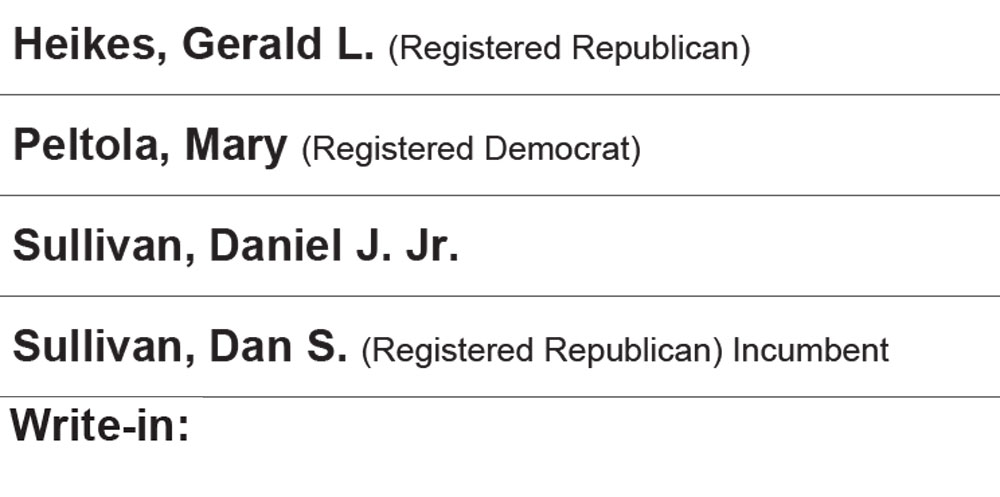
It was, for a while, considered one of those colorful quirks that crop up in the course of an election: the fact that not one but two candidates named Dan Sullivan will appear on the Nov. 3 ballot for U.S. senator from Alaska.
But now the situation seems to be getting more serious. At President Trump's direction, the Justice Department last week sued in federal court to block certification of the election if Sen. Dan S. Sullivan loses, alleging that retired teacher Dan J. Sullivan is a Democratic plant whose purpose is to siphon away votes.
'The Times has found, based on interviews and text messages, along with documents prepared for a potential lawsuit against the campaign, that not only did Ms. Peltola's team work with people trying to recruit Mr. Sullivan to run for Senate, but the effort was much broader,' the paper wrote. 'The group worked to coax other would-be spoilers into the race, to dilute the incumbent's support and help catapult the Democrat to victory.'
Matthew Salisbury, a former congressional candidate and Alaska insurance manager, told the Times that he was approached by a man claiming to represent wealthy donors who wanted him to run for Senate as an independent candidate. Salisbury said he met with the man over beers at an Irish pub in Anchorage, but ultimately declined after being unable to verify his identity.
'I'm not naïve,' he said.
In response to the report, Trump called for both Peltola and the 'fake' Dan Sullivan to be removed from the ballot in a post on Truth Social.
Alaska Gov. Mike Dunleavy, a Republican, said he was ordering an investigation to determine whether the alleged effort violated state law.
'Alaskans have a fundamental right to vote for the candidate they actually intend to support,' Dunleavy said in a statement. 'Deliberately tricking voters into casting their ballots for someone else strikes at the integrity of our elections.'
Sen. Lisa Murkowski, a Republican who has represented Alaska in the Senate since 2022, wrote in a statement that the people of her state deserve a full explanation.
'Run and win on your merits: your views, your policy ideas, and your accomplishments,' she wrote. 'By contrast, recruiting candidates to manipulate the field and influence voting outcomes is simply wrong.'
Sam Curtis, a spokesperson for the Alaska Department of Law, told CNN that the revelations in the Times report did not change the state's opposition to a Trump administration lawsuit seeking to potentially delay certification of the election.
'Placing candidates on the ballot is a matter of state law, not federal law,' Curtis said, adding that the report has 'no impact on the current litigation.'
Rep. James Comer, the Republican head of the House Oversight Committee, said Thursday that the committee is 'taking action' to launch an investigation into the matter, including an inquiry into whether any crimes may have been committed. ABC News also reported Thursday that the DOJ had issued a wave of new subpoenas as it probes whether the alleged recruitment scheme may have run afoul of federal conspiracy laws.
Yahoo
The outcome of the legal dispute, if it moves forward, could have enormous national implications. Democrats need to win at least a few Senate races in historically Republican states to secure a majority in the chamber. Polls suggest Alaska is one of their best chances to turn a red seat blue. Given how close other races across the country appear to be, a legal ruling that erases a narrow Peltola victory could be the pivot point that allows the GOP to keep control of the Senate for the last two years of Trump's presidency.
How did this happen, and where do things go from here? Here's everything you need to know to catch up and make sense of the story.
How Alaska wound up with two Dan Sullivans on the ballot
Ballot-stacking — the process of recruiting a spoiler candidate to help your candidate win — isn't unheard of in politics, and the Times says it's 'generally considered legal.'
But it's a lot easier in Alaska than other states because of the unique way elections work there. When Peltola ran for reelection to the U.S. House in 2024, the state GOP backed an effort to help a second Democrat — an inmate who conducted his campaign from a New York prison — remain on the ballot. And during this year's primaries, super PACs aligned with both parties 'flooded the state with ads for fringe candidates' in an attempt to 'dilute support for the mainstream candidates opposed by the groups,' according to an October Alaska Beacon report.
How is any of this possible? The Last Frontier sends the top four primary candidates to the general election regardless of party — then asks voters to rank them on Election Day in order of preference. This means that candidates can claim any party affiliation on the ballot without being vetted by parties themselves. (Dan J. Sullivan initially claimed to be a Republican.) It also means that as long as they finish in the top four, primary candidates don't have to earn many votes to secure their very own ballot line on Nov. 3. (Dan J. Sullivan won 4,107).
For months, Republicans have questioned Dan J. Sullivan's intentions and tried to get him tossed off the ballot. In June, the Alaska Supreme Court dismissed their arguments, ruling that neither state law nor the U.S. Constitution provided any legal basis for removing Dan J. Sullivan's name.
How the Senate candidates will appear on Alaska's midterm ballot.
elections.alaska.gov
The more obscure Sullivan has 'maintained that he [is] running in good faith and of his own volition, as a moderate Republican and not a secret Democrat,' as a Times profile put it in August. He said he'd voted in the past for some Alaska Republicans, including Sen. Lisa Murkowski, even though he also 'acknowledged previous donations to Ms. Peltola and a handful of other Democrats,' and said he would prefer Peltola for Senate over the Republican incumbent 'if it was between those two.'
But according to this week's Times report, 'operatives aligned with' the Peltola campaign convinced Dan J. Sullivan to enter the race 'to help Mary.' The report cited as its sources 12 people 'who participated in or were told of the plan' as well as interviews with other would-be recruits and dozens of internal text messages.
For the record, both Peltola's campaign and the Democratic Senatorial Campaign Committee, which directs the party's campaign strategy in Senate races across the country, have denied any 'involvement,' and Dan J. Sullivan did not respond to the Times's repeated requests for comment. One of the Times's main sources — former Peltola campaign manager and longtime aide Elisa Rios, who had been planning to file a wrongful termination lawsuit — also tried to retract her statements to the paper ahead of publication.
The Times story described an elaborate endeavor — which was 'internally called the ballot composition project' — that 'involved secret trips to far-flung Alaskan communities and the appearance of a mysterious Midwestern operative, who traversed the state using a fake name and made his pitch to would-be candidates over beers at brew pubs.' The Times also reported that the 'Peltola campaign's lawyers, as well as senior aides at the Democratic Senatorial Campaign Committee' were 'involved' with the effort.
The Trump administration's lawsuit
Legal battles over the dual Dan Sullivan issue had been confined to state courts until last week. That's when Trump's administration filed its lawsuit aiming to have the certification of the results blocked if Peltola wins a close election that may have been affected by Dan J. Sullivan's presence on the ballot.
'Should Alaska certify any electoral results tainted by the inclusion on the ballot of Daniel J. Sullivan … the State and its officers will fail in its obligation to protect the integrity of its election,' the Department of Justice wrote in its legal filing.
The suit argues that a Democratic victory should be considered invalid if Peltola wins by a margin smaller than the total number of votes that Dan J. Sullivan receives — under the assumption that those votes may have come from confused voters who intended to vote for the incumbent Republican senator instead.
Democrats have asked the courts to dismiss the lawsuit, arguing that the administration lacks 'any statutory or constitutional authority to insert itself' into the state's electoral process. Alaska's state government, which is currently led by Republicans, has also filed to dismiss the administration's lawsuit. On Monday, a federal judge agreed to fast-track consideration of the dispute to potentially allow it to be resolved before Election Day.
Many legal experts say the lawsuit has a slim chance of success. First, it requires a very specific outcome in which Peltola wins by what would likely need to be a very thin margin. Even in that scenario, election law experts say, the appearance of confusion on the part of voters does not create legal grounds for the federal DOJ to have the results rejected.
'I believe that this lawsuit is abusive in its intentions and borders on frivolous in its arguments, and that it is destined for defeat in the courts should it reach the merits,' Walter Olson, a senior fellow at the Cato Institute, a libertarian think tank, told the Alaska Beacon.
Nicholas Stephanopoulos, a Harvard law professor, told the Harvard Gazette that the law the administration is relying on in its lawsuit — the National Voter Registration Act (NVRA) — does not give federal authorities any power to challenge state election procedures.
'The lawsuit has nothing to do with voter registration. There's no allegation that anybody is improperly registered in Alaska; there's no claim that Alaska isn't in compliance with the NVRA's requirements for voter registration,' Stephanopoulos said.
More generally, experts say the lawsuit runs against the Constitution's language granting states the power to run their own elections.
'This is purely a matter of state law, and the administration has absolutely no authority to tell Alaska when or how to certify the results of its Senate election,' David Becker, a former Justice Department attorney who worked on voting rights cases, told Alaska Public Media.
What's next?
The federal judge in Alaska considering Democrats' motion to dismiss the lawsuit issued an order late Wednesday allowing their challenge to move forward. She gave the DOJ until Thursday afternoon to respond.
That likely only matters in an extremely close race, which is not the recent norm in Alaska. The last time Dan S. Sullivan was on the ballot, he defeated his top challenger, independent candidate Al Gross, by 45,000 votes. The most recent Senate race, in 2022, was closer, but the top two finishers were both Republicans.
Things are expected to be much tighter this time around. Peltola has held a consistent lead in the polls since the summer, but her advantage has steadily shrunk in the months leading up to Election Day. The most recent surveys have her ahead by 2 points, well within the margin for Sullivan to win. The Cook Political Report, one of the nation's most respected election forecasters, lists the race as a toss-up. Another well-regarded forecaster, the Center for Politics, categorizes it as 'leans Democrat.'
This article originally appeared on Yahoo News at https://www.yahoo.com/news/politics/article/alaska-democrats-linked-to-secret-effort-to-recruit-2nd-dan-sullivan-to-tip-senate-race-report-200632493.html
Patrick Stewart, a revered English actor best known for his work on Star Trek, has died. He was 86.
According to a post on his X account, Stewart died on Wednesday at his home in Los Angeles “in the loving care of his beloved wife Sunny, following a brief and poignant journey” with Alzheimer’s disease and Lewy body dementia.
“He has been held in the warm embrace of family and friends, surrounded by live music, prayer, tears, laughter and the kind of profound emotion that only he could inspire after a lifetime of devotion to us all,” the post read. “We will forever cherish the peaceful ease and reflection on his face, an enduring reminder of his invincible grace.
“His sonorous voice and singular talent will forever be synonymous with indelible performances in every genre. He explored the human condition in all its poetic complexity and brought hope not only to the far reaches of the Marvel Cinematic Universe, but into science fiction's most iconic final frontier aboard the Starship Enterprise,” it continued: “His professional accomplishments were humbly matched by his philanthropy and activism on behalf of human rights, survivors of domestic violence, global refugees, veterans' mental health services, and animal welfare, particularly his cherished foster puppies.
“He was a Knight, Chancellor, motor sport enthusiast, and lifelong Huddersfield Football fan,” the post added. “He will be remembered for the dignity, compassion, and humanity he brought to every role — in his art and life.”
In lieu of flowers, memorial contributions may be made to: Johns Hopkins Alzheimer’s Disease Research Center Fund https://t.co/luC5CdcWDy Alzheimer’s Foundation of America Caregiver Resources https://t.co/zvNptfyuNd
Born on July 13, 1940, in Mirfield, Yorkshire, England, Stewart dropped out of school at age 15 to work as a reporter at a local newspaper and then furniture salesman before enrolling in drama school in 1957.
He made his professional theater debut in 1959, eventually joining the Royal Shakespeare Company in 1966.
In the mid '80s, Stewart moved to Los Angeles to star on Star Trek: The Next Generation, which ran from 1987 to 1994, as Captain Jean-Luc Picard.
He later reprised the role on the big screen for a series of Star Trek films, including Star Trek: Generations (1994), Star Trek: First Contact (1996), Star Trek: Insurrection (1998) and Star Trek: Nemesis (2002).
Stewart had more than 160 credits as an actor, according to IMDB, most recently as the voice of Avery Bullock on the animated comedy series American Dad!.
He will also appear posthumously in the upcoming Avengers: Doomsday as Professor Charles Xavier, a role he played in several previous X-Men films.
In 2010, Stewart was knighted by Queen Elizabeth II and given the title of Sir in honor of his contributions to TV, film and theater.
'We lost one of the greats of stage and screen today,” Hugh Jackman, who starred alongside Stewart in X-Men, wrote in an Instagram post. “And, in my book, a tremendous friend and man. I learned so much from him. I will miss you, Patrick Stewart, all of my days.”
Patrick Stewart poses in his dressing room at the Lyceum Theater in New York in 2008 during a production of 'Macbeth.'
AP Photo/Rick Maiman
Stewart had a son, Daniel, and daughter, Sophie, with his first wife, Sheila Falconer, who he married in 1966. They divorced in 1990.
In his 2023 memoir, Making It So, Stewart revealed that he had an affair with his Star Trek: The Next Generation costar Jennifer Hetrick during his marriage to Falconer, which led to their divorce and his estrangement from their children.
'We don’t have relationships,' Stewart told the Irish Independent during his book tour. 'I never thought that this would happen, but both my children are in their 50s – they’re not children anymore, they’re adults. And my relationship with them is practically non-existent.”
Stewart and Hetrick dated and were later engaged, but never married.
In 2000, he married Wendy Neuss, one of the show's producers. They divorced three years later, after Stewart had an affair with actress Lisa Dillon, his costar in a stage production of The Master Builder. At the time, Stewart was 62 and Dillon was 23.
'And so, another divorce. I felt stupid and responsible,' Stewart wrote in his memoir. 'I had cheated on my wife with a younger woman – again.”
Patrick Stewart and his wife Sunny Ozell arrive at Vanity Fair's Oscar party in 2024.
AP Photo/Evan Agostini
In 2008, Stewart met singer-songwriter Sunny Ozell at a restaurant in Brooklyn, where she was working as a waitress. Stewart was performing in a sold-out production of Macbeth, and gave her his phone number so he could arrange tickets for her.
'[I] said 'Call me, I can get a ticket.' And that's what we did. And she came backstage afterward and we had dinner and here we are,' Stewart told People magazine.
This is a breaking news story. Please refresh this page for updates.
This article originally appeared on Yahoo Entertainment at https://www.yahoo.com/entertainment/celebrity/article/patrick-stewart-star-of-x-men-and-star-trek-dies-at-86-195431969.html
Abdul El-Sayed, the Democratic candidate in Michigan’s critical Senate race, responded to President Trump’s frequentmockery of his name in a style that’s become a signature of his campaign.
“I don’t care how he pronounces my name,” he said during a rally in Grand Rapids on Sunday. “Because he can just go on and call me ‘senator’ after November. I will be Senator Mohamed to you, bro.”
El-Sayed, whose middle name is Mohamed, has emerged as one of the biggest names of the 2026 midterm cycle as he tries to defend a vulnerable Senate seat in one of the country’s few truly purple states. Michigan is key to Democrats’ hopes of flipping control of the Senate, which requires them to defend their vulnerable seats and secure wins in several historically red states.
On paper, El-Sayed doesn’t fit the profile of a “safe” choice for a swing state Democratic candidate. He’s an unapologetic progressive who supports policies like Medicare for All and ending U.S. military aid to Israel. He’s willing to be confrontational with his critics and publicly critique his party’s establishment. He’s vying to be the first Muslim ever elected to the U.S. Senate.
El-Sayed became the Democratic nominee in August, after narrowly defeating U.S. Rep. Haley Stevens, a relative moderate, in one of the most closely watched party primaries of the midterm cycle. His Republican opponent in the general election is Mike Rogers, a former congressman who lost an extremely close Senate race to Democratic Sen. Elissa Slotkin two years ago.
Yahoo
Here's everything you need to know about one of the key figures of the 2026 midterms.
Who is El-Sayed?
El-Sayed, 41, was born on Halloween 1984 in Rochester Hills, Mich. — a northern suburb of Detroit. His parents were immigrants from Egypt, and his first language was Arabic. He captained his high school's wrestling, football and lacrosse teams, then continued to play club lacrosse at the University of Michigan, where he majored in biology and political science.
El-Sayed went on to study medicine at Michigan, Oxford University (as a Rhodes Scholar) and Columbia University, where he received his M.D. Before politics, he pursued a career in public health epidemiology as a tenure-track professor, and later led the Detroit health department.
In 2018, El-Sayed, then just 32, resigned as Detroit's health director to run for governor. He said at the time he was inspired byhis work on the Flint water crisis. He was endorsed by prominent progressives — Bernie Sanders, Alexandria Ocasio-Cortez — but lost the Democratic primary to Gretchen Whitmer by more than 20 points. 'It was just like, 'Everything's moving really fast. I don't know what to pay attention to,'' El-Sayedrecently recalled, likening his rookie bid to playing up an age level in lacrosse for the first time.
After a stint as Wayne County health director, El-Sayed decided to try again in 2026. At first, the Democratic primary pitted El-Sayed and Stevens against Michigan State Sen. Mallory McMorrow, and pollsshowed the three candidates splitting the vote fairly evenly. But after El-Sayed started to gain momentum over the spring and summer, McMorrow announced in early July that she was suspending her campaign.
In the lead-up to primary day, polls showed El-Sayed with a sizable lead in his head-to-head matchup against Stevens. The race was much closer than expected. He ended up winning by a single percentage point.
What does he stand for?
El-Sayed has made headlines for his outspoken criticism of Israel; the leading pro-Israel lobbying group, AIPAC; and U.S. political candidates who accept AIPAC money.
'Killing tens of thousands of people makes you pretty damn evil,' El-Sayedtold CNN in April. 'It's not how evil is this one versus that one. Hamas: evil. Israeli government: evil. We can say both.'
El-Sayed has also called for ending all unconditional U.S. aid to Israel. His argument is that 'we should be using our tax dollars here to invest in health care here and education here, rather than sending it over there to buy bombs and tanks that get used to drive apartheid and genocide.' During the primary, he frequently dismissed Stevens — who does not believe there has been a genocide in Gaza and who has received a record $30 million from AIPAC — as 'a suit with a large AIPAC bank account.'
Beyond Israel and Gaza, El-Sayed has aligned himself with the Sanders wing of the Democratic Party. He has endorsed Medicare for All, promised to end Citizens United, backed targeted tariffs and bemoaned corporate monopolies. El-Sayed also wants to abolish Immigration and Customs Enforcement (ICE) and replace it with something like the former Immigration and Naturalization Service.
El-Sayed does not identify as a democratic socialist, even though many of his supporters do. The Democratic Socialists of America have not endorsed him.
'If perfectly inoffensive won elections, then Donald Trump would never have been president,'El-Sayed said in April when reporters questioned his choice of allies.
Democratic anxiety is also a factor. El-Sayed has clearly benefited from rising anger on the left toward Israel; nearly 60% of Democrats now believe their party is too supportive of the Jewish state, according to aJune AP-NORC survey— a 15-point increase over the last two years.
But some Democrats also worry about alienating the broader electorate, especially in a swing state like Michigan. As a result, El-Sayed's primary battle against Stevens morphed into a proxy war between 'progressives pushing the party to rethink its relationship with Israel,' asthe New York Times recently put it, and 'establishment Democrats feeling queasy about El-Sayed's electability' — as well as 'some Jews fearing where he could take the party.'
The biggest reason El-Sayed is attracting so much national attention, however, is the same reason he won the Democratic primary: charisma. After El-Sayed delivered the student speech at his 2007 Michigan commencement ceremony, the other speaker, former President Bill Clinton, told him he had 'a natural gift.'
'Dear Abdul,' Clinton wrote to El-Sayed three days later. 'Your commencement speech was terrific — I wish you well and will try to live long enough to need you as my doctor.'
In general, El-Sayed has been less focused on Israel than on economic populism. To gin up enthusiasm among disaffected progressives, El-Sayed directs some of that 'fighter' energy at the Democratic establishment. But most of it he directs upward, at the corporate elite.
'So when they tell us that we cannot have health care?' he asks his supporters at the end of his speeches.
'We don't back down!'
'When they tell us that their money is unbeatable?'
'We don't back down!'
'When they tell us we can't have a union in our workplace?'
'We don't back down!'
El-Sayed’s background has also made him the target of persistent attacks from Republicans. Beyond mocking his name, Trump has called him a “jihadist” and accused him of being “on the side of the terrorists.” Vice President JD Vance recently said El-Sayed had “zero attachment” to the United States. Rogers has falsely claimed that El-Sayed has supported the Muslim Brotherhood, one of the Arab world's oldest and most influential Islamist groups.
In a recent exchange at a town hall with a critic who asked him whether he denounced the Muslim Brotherhood, El-Sayed highlighted what he called the “implicit” suggestion of the question: The assumption that he’ll have “dual loyalties” because of his faith.
“I’m not running to be a Muslim senator,” he said. “I’m running for the U.S. Senate and happen to be Muslim.”
What are his chances of winning?
After initially trailing, El-Sayed overtook Rogers in the polls in mid-August and has maintained a steady lead of 3-4 points on average in the months leading up to Election Day. Still, the race is considered a toss-up by the Cook Political Report, one of the nation’s most respected election forecasters.
This article originally appeared on Yahoo News at https://www.yahoo.com/news/politics/article/who-is-abdul-el-sayed-a-guide-to-the-michigan-democrat-in-one-of-the-midterms-biggest-senate-races-170731026.html
Federal law enforcement authorities have launched a nationwide crackdown dubbed, 'Operation Ghostbusters,' to dismantle an international student aid scheme that investigators estimate has been operating since 2021, 'potentially reaching several hundred million dollars' in taxpayer losses.
Announcing the first wave of enforcement actions, Assistant Attorney General Colin McDonald revealed that organized syndicates have systematically stolen the identities of working Americans who never applied to college, using their information to enroll fictional 'ghost students' at institutions nationwide and siphon federal financial aid directly into offshore accounts.
'These are not isolated errors,' McDonald said at a news conference Thursday. 'This is organized fraud at scale.'
Assistant Attorney General Colin McDonald announces the first enforcement actions from 'Operation Ghostbusters,' a nationwide crackdown on student-aid fraud, at a news conference on Thursday.
The sprawling operation currently spans more than 40 open cases across 26 FBI field offices and has already produced indictments against five defendants, as well as the international seizure of more than $750,000 in laundered cryptocurrency tied to networks in Kenya.
'If successful at duping the Department of Education, Ed then sends the aid money to the college where the ghost student is enrolled,' McDonald said in his opening remarks. 'After tuition and fees are deducted, the leftover federal funds are deposited directly into bank accounts controlled by fraudsters, and in a flash, the money vanishes, often overseas to places like Kenya.
'The methods used in these schemes are increasingly sophisticated.
'Some use super intelligence to fill out college applications and complete coursework, so it looks like the ghost student is actually completing the class.
'Some even create the appearance of a fake student in an online classroom to trick schools into believing a real person is present. The goal is to keep the ghost student in school for as long as possible, semester after semester after semester, stealing money from the taxpayer.'
Prosecutors allege that after tuition and fees were settled, leftover grant and loan disbursements were siphoned through domestic 'money mules' and funneled abroad – including through fronts like a Nairobi safari company.
'We have already sent a team to Kenya to be on the ground for purposes of rooting out this fraud scheme and figuring out how it works on the ground in Kenya,' McDonald said in the question and answer portion of the news conference.
And, unsuspecting victims facing ruined credit and bills for an education they never received, they warned.
'The complete story includes the plight of an American citizen who graduated high school and went straight to work to provide for his family,' McDonald said. 'He never applied to college, he never enrolled in classes, and he never asked for federal student aid. But one day, he finds his name attached to a loan from a school hundreds or thousands of miles away.
'His credit is now at risk and his name is on the bill.'
McDonald's timeline for the investigation began in earnest in April and includes alleged fraud that began in 2021 under the Biden administration, according to McDonald.
'If you steal American identities, if you steal taxpayer dollars, if you exploit programs meant to help students build their future, we are resolved to find you and prosecute you,' he said. 'Whether you're in Nebraska, New Jersey, Virginia, or Nairobi, we will pursue you and bring you to justice.'
'When we walked in the door last January, we were extremely troubled to find that the Biden administration had turned off nearly every fraud detection measure, allowing critical funds to become the target of large-scale fraud,' Kent said. 'The federal student aid programs result in about a $1.7 trillion federal student loan portfolio. That's like turning off fraud detection efforts at Wells Fargo, which is just crazy.'
This article originally appeared on Fox News at https://www.foxnews.com/us/dojs-operation-ghostbusters-aims-crush-massive-student-aid-fraud-scheme-involving-fake-students
Federal investigators found evidence during the Obama administration suggesting that Rep. Ilhan Omar's 2009 marriage to a man suspected of being her brother was intended to help him obtain a green card, but the case stalled chiefly because prosecutors concluded the suspected offense fell outside a five-year statute of limitations, according to a new report.
The FBI and Department of Homeland Security investigated the marriage in the summer of 2016, current and former officials told The New York Times in a report published Thursday.
The officials' account challenges Omar's characterization of the earlier inquiry as having debunked allegations that she married her brother to help him obtain a green card.
The newspaper said it remains unclear what evidence investigators had establishing that Omar and her former husband, Ahmed Nur Said Elmi, are siblings.
Marrying a person to help them obtain a green card is illegal under federal law, while marrying a sibling is illegal under state law.
However, the newspaper noted that it remains unclear whether federal prosecutors could pursue charges against Omar despite the statute of limitations for marriage-based immigration fraud.
Omar has repeatedly denied the allegations about her and her ex-husband.
'Rep. Omar has repeatedly and unequivocally denied this baseless, disgusting conspiracy theory,' spokeswoman Jackie Rogers said in a statement. 'This is a desperate political smear designed to distract from Trump's failed presidency and two years of Republican failure in Congress.'
Six current and former officials familiar with the 2016 investigation told the Times that agents found evidence suggesting Omar and Elmi were siblings. The officials said investigators had limited tools to develop the case because prosecutors did not pursue it.
Omar was already a U.S. citizen when she married Elmi, a British citizen, in 2009. They divorced in 2017.
Two former officials said Elmi obtained a conditional two-year green card through the marriage. When immigration authorities requested additional evidence before granting him permanent status without conditions, he left the United States and abandoned his petition, they said.
The earlier inquiry involved an FBI agent specializing in public corruption and civil rights cases and two Homeland Security Investigations agents, according to the report.
The allegations surfaced publicly in 2016 as Omar campaigned for a seat in the Minnesota House of Representatives. After a local television station reported that the U.S. attorney's office had opened an investigation, her campaign sought a letter from Andrew Luger, then the U.S. attorney for Minnesota.
In the Aug. 22, 2016, letter, Luger wrote that 'my office is not investigating, nor have we requested an investigation into Ms. Omar.'
Omar portrayed the letter as an exoneration that put to rest 'flat-out falsehoods.'
Luger, however, told the Times last week that the letter 'was never meant to say anything about the substance of the claims.' He said it was intended only to rebut an erroneous report that he had asked ICE to investigate Omar.
Luger said federal agents could have been pursuing the matter without his knowledge and denied shielding Omar from scrutiny.
The Trump administration has reopened scrutiny of the marriage as part of a broader investigation into the Omar family's immigration history. Federal agents searched the congresswoman's Washington home Oct. 12, weeks before she seeks a fifth term in the House.
Investigators are also examining whether Omar's late father submitted false or incomplete information during the immigration process and whether Omar was too old to qualify for citizenship through him in 2000, the Times reported.
Democrats have condemned the inquiry as political persecution and said the search violated Justice Department policy intended to prevent investigative actions from influencing elections.
President Donald Trump repeated the allegation that Omar married her brother last week. Homeland Security Secretary Markwayne Mullin has said the broader investigation could lead to Omar's deportation if authorities establish that she should not have been admitted to the country.
Page, Arizona — Doug Herrera still lives in the house his father built, though his dad died some time ago from cancer. Herrera wonders if that illness could have been linked to pollutants from nearby uranium mining. Now, he worries that a possible new neighbor — a proposed $10 billion mega data center — could imperil his health.
'I'm a patriot, but I'm highly against the data center,' Herrera, 64, said from his front porch near a yard sign that reads 'No Data Centers.'
'There is light pollution, sound pollution. The temperature is going to rise,' he said.
Page is a gateway to iconic Southwestern landscapes of arid desert studded with Joshua trees and towering red-rock formations. While the City Council approved the sale of land for a data center, the developer needs zoning and other approvals. Residents concerned about possible health effects have signed petitions and mobilized to oppose construction.
The boom in data centers is dividing communities such as Page and turning future construction into a flash point in the midterm elections. The leading candidates in the close race for Arizona's 1st Congressional District are at odds over any new centers there, and the state's attorney general has called for a pause on new approvals and building.
Emerging research into data centers' possible health effects is adding grist to the various state fights, giving ammunition to Democrats and some Republicans who've broken party ranks to oppose the sprawling complexes.
It has also put some incumbent politicians who have supported data center expansion in unexpectedly vulnerable positions in reliably red states like Ohio and Texas, where the megabuildings now operate by the hundreds.
'Two years ago, a lot of these data centers went up and there was not an organized, watchful opposition,' said Lee Hannah, a political science professor at Wright State University in Dayton, Ohio.
'That opposition has come up in a grassroots way so quickly that decisions made a year ago by local officials or state governments to get behind a data center are suddenly career-ending.'
The hyperscale centers house infrastructure to power AI, with servers that sprawl over tens of thousands of square feet or more. The city of Page approved the sale of 500 acres for the proposed data center, though the location within that acreage hasn't been decided. The area sits on open land studded with blackbrush and native grasses near Horseshoe Bend, an iconic curve of the Colorado River that has long been popular with tourists.
Data centers gobble up electricity and rely on backup gas generators during times of peak energy demand. The resulting air pollution has been linked to heart conditions, respiratory issues, and elevated cancer risks, according to a number of environmental studies.
Emissions from the centers could cause nearly 1,300 deaths annually by 2030 and an annual public health burden of more than $20 billion in 2028, based on modeling led by researchers at the University of California-Riverside.
Cooling components can contain what are called forever chemicals, synthetic substances that accumulate in human tissue, according to advocacy and environmental groups. And the hum and whir of generators and heating and air conditioning systems can exceed 90 decibels, which can harm hearing.
Data centers are lit up for operations and security, creating light pollution that can increase the risk of chronic disease, the groups say. The megafacilities also create what are known as data heat islands, which are higher-temperature zones caused by intense energy demands.
'We're just starting to see the very early edge of the wave of the research into health impacts of data centers,' said Alison Steele, executive director of the Environmental Health Project, a nonprofit public health organization. 'By the time we have a substantial volume of research it's going to be too late, because the decisions are being made now.'
A trade group for the data center industry said a review of the largest data center market — Virginia — found that use of backup power sources, including diesel generators, is minimal, and that existing state and federal regulations limit potential emissions or impacts.
'Data centers are committed to being responsible partners where they operate,' said Dan Diorio, executive vice president of state policy and government affairs at the Data Center Coalition.
Two in 3 Americans oppose the construction of new data centers in the U.S., according to an October Washington Post-ABC News-Ipsos poll.
Such political standoffs are happening largely in states that Mr. Trump won in 2024, where most new data center capacity has been proposed. About 1,400 data centers operate in the U.S., and an additional 2,000-plus are planned.
Sixty percent of data center capacity under construction is in states Mr. Trump won by five percentage points or more, according to Cleanview, a market intelligence company. Excluding Virginia, 92% is in states the president won.
Hannah said the uptick in construction has put Mr. Trump's coalition at particular risk because data centers are often built in rural areas, where the president has often enjoyed insurmountable margins of support.
'This is where most of the data centers go,' Hannah said. 'They go into red states, because Republicans are less critical of economic opportunity. If it promises jobs and money, they're all in.'
In Page, signs opposing construction pepper front yards.
The opposition to more data centers in the state could pose political risks for GOP House candidate Jay Feely, who won his primary with an endorsement from Mr. Trump. He says they are key to keeping up with China. Democratic opponent Amish Shah wants a pause on new construction in their district.
The House seat they're vying for is considered competitive, and the contest could be pivotal in determining which party gains House control after the Nov. 3 midterms.
In Arizona, 57% of registered voters oppose construction of more large data centers, according to an August opt-in online poll of 1,040 registered voters by Noble Predictive Insights.
More than costs
Photos from across the nation featuring politicians at groundbreaking ceremonies for data centers held only a year or two ago are now campaign fodder.
That has become a big problem for some elected leaders in Ohio, where more than a dozen local referendums or initiatives related to construction of the facilities will appear on ballots — the most of any state.
The issue has forced its way to the forefront of the state's marquee U.S. Senate race. Former Sen. Sherrod Brown, a Democrat, is hoping to return to Congress with pointed attacks against Republican Sen. Jon Husted over the matter.
Roughly $2.5 billion in state and local tax breaks over the last decade have prompted Meta, Amazon, Google, and other tech companies to erect dozens of data centers across Ohio. That boom has spurred protestsacross the state, organized by local residents who are worried about the health, environmental, and financial impact of the structures.
Brown has pinned the blame on Husted directly with ads airing widely across Ohio that call him 'the face of data centers.'
'They're devouring our farmland, sucking up our water, and using our energy,' Brown says in one recent video.
A memo circulated by the National Republican Senatorial Committee in August and obtained by Politico described Brown's critiques as a big problem for Husted.
'More than any other thing in this race, data centers are the anchor hanging around Husted's neck,' warns the Aug. 18 memo, which was shared with artificial intelligence companies.
Husted has rebuffed these critiques by framing the construction of data centers as a local issue. More recently, he has said he wants to make sure that the companies building data centers pay for infrastructure costs, including energy.
In a statement, Husted spokesperson Tom Evans reiterated that point, saying the senator believes 'data centers should remain a local decision.'
It's not just costs that voters care about. An early-October opt-in survey of 1,650 Ohio adults by Ohio Northern University and SurveyUSA found that 55% were opposed to data center construction. About two-thirds had a negative opinion of data centers' impact on their community's environment, and about half said the same about their impact on quality of living.
Opponents of data centers cite noise, air, and water pollution as a concern, according to a Gallup poll. Americans are more opposed to data centers in their area than nuclear power plants.
The air pollution comes from gas turbines and diesel generators that have been linked to cardiovascular problems, asthma, and other health risks. Cooling system chemicals, heavy metals, and construction runoff can enter the water supply or rivers.
'When they are fired up and powered by diesel, they emit a lot of air pollution like nitrogen oxide, and this pollutant can travel around the community and to those downwind,' said Shaolei Ren, an electrical and computer engineering professor at the University of California-Riverside.
In Page, residents in July voted out the mayor amid backlash over the Council's approval of the land sale for the data center. Opponents of data centers say it's a warning to candidates in the midterm elections who back new construction.
Some residents in this picturesque town of about 7,000 people remain worried that the health effects could plague them if the project goes forward. Jan Boehme lives in a neighborhood close to the proposed site. From her front lawn with its 'No Data Center' sign, she said she is concerned that a data center could become her new neighbor — and cause harms such as hearing loss.
'We're against it,' she said. 'In this area, there are a lot of houses, and I'm concerned about all the noise.'
KFF Health News is a national newsroom that produces in-depth journalism about health issues and is one of the core operating programs at KFF — the independent source for health policy research, polling, and journalism.
This article originally appeared on CBS News at https://www.cbsnews.com/news/data-center-health-risks-midterm-elections/
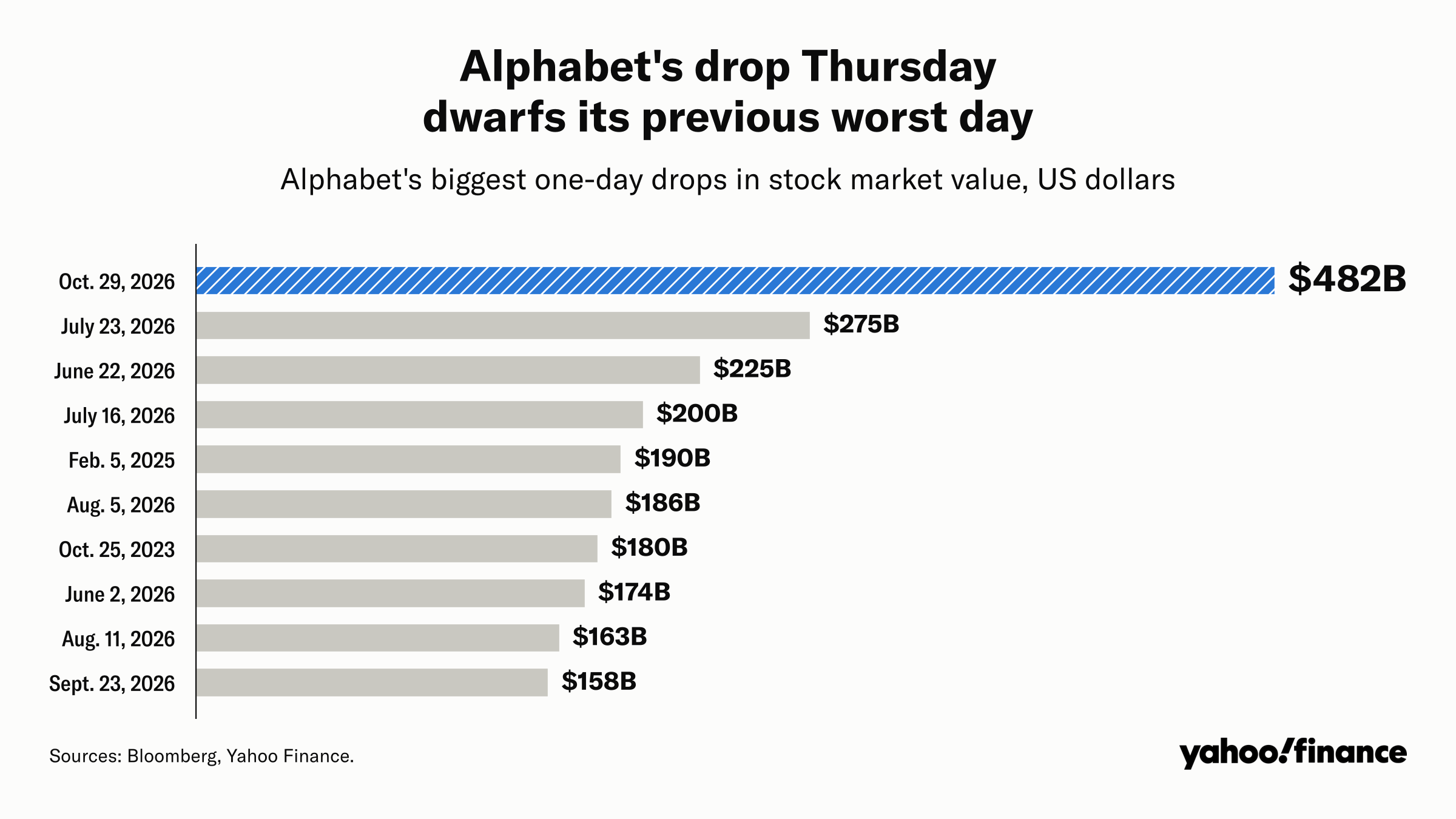
Alphabet (GOOGL) had its worst day ever on Thursday. The stock fell nearly 13% after its third quarter results, steeper than any session since it went public in 2004, including its drops of more than 10% in March 2020 and September 2008.
Alphabet lost $482 billion in stock market value, the second-biggest one-day loss ever for a US-listed company, by Yahoo Finance calculations. Only Nvidia (NVDA) has lost more, about $593 billion on Jan. 27, 2025, the day China's DeepSeek rattled AI investors.
Bloomberg, Yahoo Finance
That blew past the $400 billion SpaceX (SPCX) lost on June 22, the previous No. 2.
In dollars, it was Alphabet's worst day by far. Its previous worst was about $275 billion on July 23. It was also the stock's steepest drop after an earnings report since the company went public, according to Bespoke Investment Group. The previous low was a slide of nearly 10% in July 2008.
Bloomberg, Yahoo Finance
The quarter gave both sides plenty to argue over. Google Cloud revenue more than doubled to about $31 billion, and the Gemini app passed 1 billion users. But search revenue grew 12% to about $63 billion, short of Wall Street's roughly $65 billion estimate. Free cash flow — the cash left after paying for things like data centers — swung to a loss of about $9 billion as AI spending climbed. The company's stakes in AI labs cost it too.
'The bears will argue this is the first quarter that AI is starting to seriously hurt their search business,' Pivotal Research CEO Jeffrey Wlodarczak said in a rundown of why investors hated the quarter.
CFRA's Angelo Zino was more patient, telling Yahoo Finance the pullback 'probably represents a buying opportunity.'
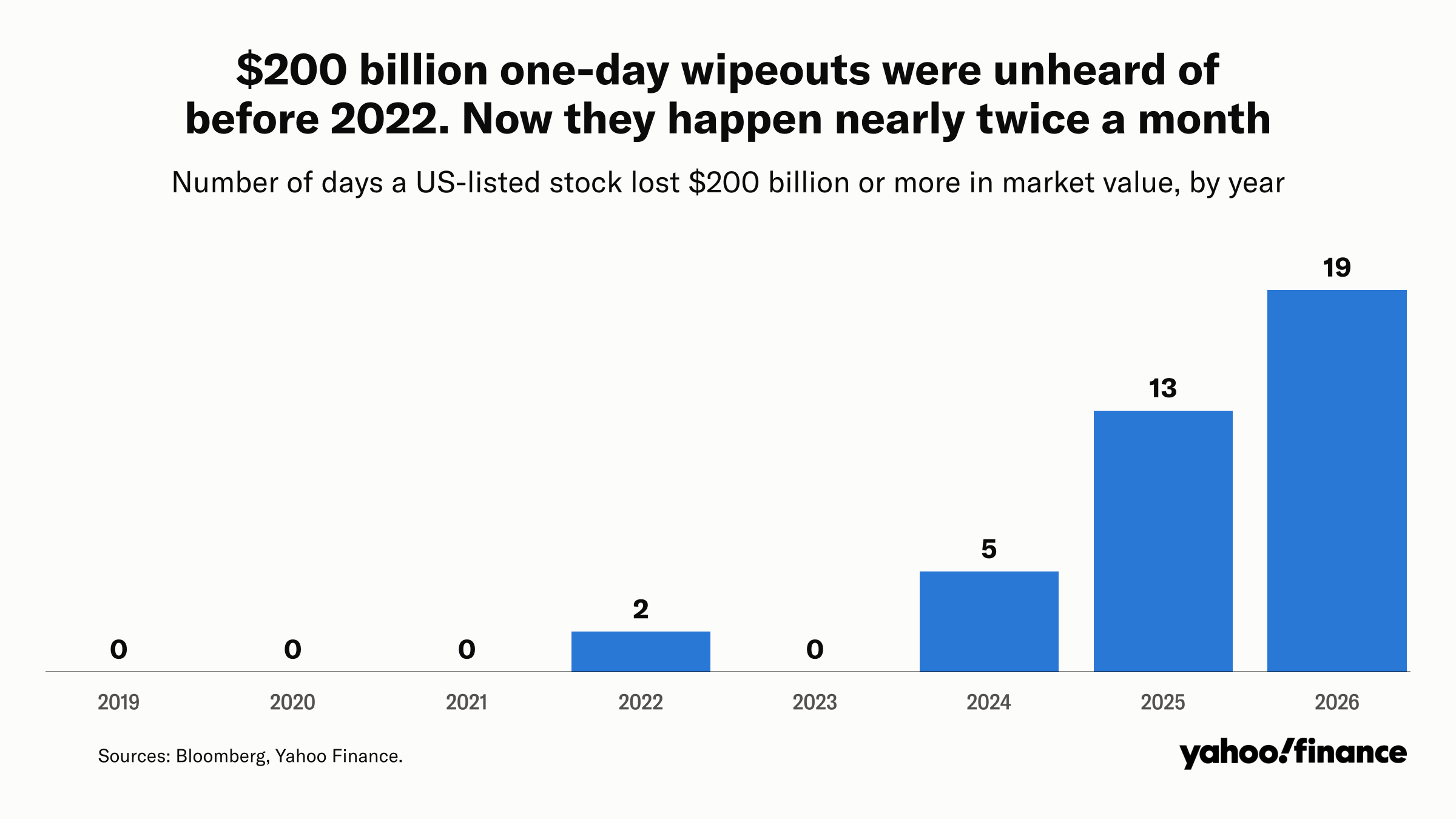
Losses this size used to be unheard of.
US-listed stocks have shed $200 billion or more in a single session 18 times this year through Wednesday. That's up from 13 in all of 2025 and none before 2022, according to Yahoo Finance calculations from Bloomberg data. Alphabet alone has lost about $1.4 trillion since its record in May.
Bloomberg, Yahoo Finance
Amazon (AMZN), the last of the big three cloud providers to report this week, posted faster growth and a record cash burn after Thursday's close. Amazon Web Services grew 39%, its fastest in nearly five years, while its 12-month free cash flow sank to a record outflow of more than $42 billion. Its stock fell after hours, a sign the pressure on AI spenders reaches well beyond Google.
Internal AI tools helped analyze interview transcripts, research, and draft this post. Humans reviewed, edited, and fact-checked this post before publication.
Jared Blikre is the global markets and data editor for Yahoo Finance. Follow him on X at @SPYJared or email him at jaredblikre@yahooinc.com.
This article originally appeared on Yahoo Finance at https://finance.yahoo.com/markets/article/alphabet-heads-for-a-500-billion-drop-in-market-value-the-biggest-in-its-history-134824763.html
The final vote count from Tuesday's parliamentary election showed that Prime Minister Benjamin Netanyahu's bloc maintained its lead, securing 53 seats in the next Knesset, but no coalition secured a 61-seat majority.
The opposition bloc seeking to replace the premier won 48 seats, according to official Central Elections Committee figures released on Thursday after all votes had been counted.
Despite some claims of electoral interference, Israel's Election Committee also says the Knesset elections were conducted lawfully, adding there is no basis for claims of systematic interference with the integrity of the vote.
Maya Levin,jewel Samad/AFP via Getty Images - PHOTO: This combination of pictures created on Oct. 28, 2026, shows Yashar party leader Gadi Eisenkot (L) addressing supporters at a rally in Tel Aviv and Prime Minister Benjamin Netanyahu addressing his supporters at an election night rally in Jerusalem.Israel awaits election results as exit polls suggest close race for Netanyahu
The two coalitions led by Netanyahu and Gadi Eisenkot may need the backing of the Arab-Israeli parties to have any chance of a majority in the Knesset.
Both Netanyahu and Eisenkot have previously ruled out forming a coalition with the Arab parties. In his post-election speech, Netanyahu suggested that any government that included Arab parties would 'endanger Israel.'
Arab party leaders have indicated willingness to work with the anti-Netanyahu opposition. The Arab-led Joint List -- a collection of three parties which between them were on course to win 12 seats as of Wednesday -- said in a statement that they were ready for 'political cooperation to oust the Netanyahu government.'
'The Joint List will work with all its strength to bring an end to Netanyahu's rule. We are ready for political cooperation to establish an alternative government, which will present a true alternative and commit itself to a true change of the current government's racist policy,' it said in a statement.
Mansour Abbas, the leader of the United Arab List -- also known as Ra'am -- which was projected to win seven seats, said he had been in touch with representatives of both the Netanyahu and Eisenkot coalitions.
Opposition leaders condemned the prime minister's remarks, maintaining that the elections in Israel were free and fair and there was no evidence of election fraud. The Israeli police said they will investigate any credible allegations of wrongdoing.
Jalaa Marey/AFP via Getty Images - PHOTO: Israeli Prime Minister Benjamin Netanyahu gestures to his supporters at the election night rally after the first exit polls were announced, in Jerusalem on Oct. 28, 2026.
Dean Livne, the acting director general of the CEC said on Wednesday that there was 'no basis for allegations of election theft,' as reported by Israel's Kan radio station.
Eisenkot, meanwhile, said on Wednesday night that he had undertaken 'a long day of meetings, conversations, and preparations to realize the will of the voter.'
'We are focused on the heavy task entrusted to us -- bringing change to Israel,' he wrote in a post to X.
ABC News' Nasser Atta and Joe Simonetti contributed to this report.
This article originally appeared on ABC News at https://abcnews.com/International/israel-election-partial-results-deadlock-netanyahu-alleges-fraud/story?id=137665276
A U.S. military intelligence agency has released an incredible new photograph of China's secretive space plane, showing it docked to another spacecraft in orbit.
The photograph was taken in 2024 by Vantor's WorldView 3 satellite, from a distance of 56 miles (90 kilometers). Ground-based observers have previously photographed Shenlong in orbit, but this new photo from Vantor, taken from space, reveals new details about the mysterious spacecraft in stunning clarity, with a resolution of 4.5 centimeters (1.8 inches) per pixel. The image was included in a new reportreleased by the Defense Intelligence Agency (DIA) assessing the scope and breadth of adversary threats in space.
In the image, the robotic Shenlong space plane can be seen docked to another satellite that has its solar panels deployed. It's not yet known which satellite that may have been. Shenlong's payload bay doors can also be seen in the photograph, in an open position.
Those payload doors may offer clues about what Shenlong is doing on its fourth mission, which launched in February 2026. China's space agency has stated only that Shenlong helps test technologies that 'will pave the way for more convenient and affordable round-trip methods for the peaceful use of space in the future.'
But observers have seen Shenlong release other objects while in orbit, such as in June 2026, when American space intelligence company LeoLabs reported that itdetected a new object in the vicinity of the space plane.
'Following additional observations across our global network and analysis via LeoLabs Delta, we have independently cataloged this object and assessed with high confidence that it was released from the Chinese space plane,' LeoLabs stated at the time. 'This activity is consistent with sub-satellite deployments conducted by the space plane in previous missions.'
A similar event happened during Shenlong's third mission, which ended in 2024. On its second mission in 2023, the space plane also released an object and may have conducted what are known as proximity and rendezvous operations, in which two spacecraft maneuver close to one another.
It may have been that the spacecraft was releasing unnecessary hardware before landing, however. Like all things military space, few details have been released to the public about Shenlong's operations.
The United States, similarly, operates a secretive robotic space plane, the Boeing-built X-37B, and rarely releases concrete details about its capabilities or its missions. In February 2025, the U.S. Space Force released its first photo of the X-37B in space, offering a rare glimpse at the space plane in operation. The photo appeared to show it in a high Earth orbit with what appear to be its payload bay doors open.
In 2023, Space Force released its first official painting, depicting an X-37B-like space plane in orbit above Earth, intercepting another satellite.
With China and the United States currently jockeying for the lead in what many observers have called a new Space Race, rare glimpses like these images may be a way of militaries and intelligence agencies of teasing capabilities without fully revealing them to the public.
This article originally appeared on Space at https://www.space.com/space-exploration/launches-spacecraft/chinas-secretive-space-plane-caught-on-camera-in-incredible-new-photo-released-by-us-military
To know more about how we can meet your specific requirements, please drop us a message or mail us at 'contact [at] pegasusinfocorp.com'. Please click here to drop us a message.