Pegasus InfoCorp helps build customized web software and undertakes web development software solutions for clients internationally. We also build front end websites, and offline software that integrates with our web based software. Our services/ custom built software solutions include Web Development, web development, web software, small business web software development and enterprise scale business software development on web technologies.
Millions of Americans hitting the road and skies for Thanksgiving could run into storms on both coasts, including one that could last through Thanksgiving Day. Record-challenging king tides are forecast on both coasts, threatening coastal flooding from California to Florida.
'A strong coastal storm will bring heavy rain, strong winds, and instances of coastal flooding for much of the East Coast during Thanksgiving,' according to a Tuesday afternoon update from the National Weather Service Prediction Center. The coastal storm could also bring winter precipitation in the Mid-Mississippi Valley.
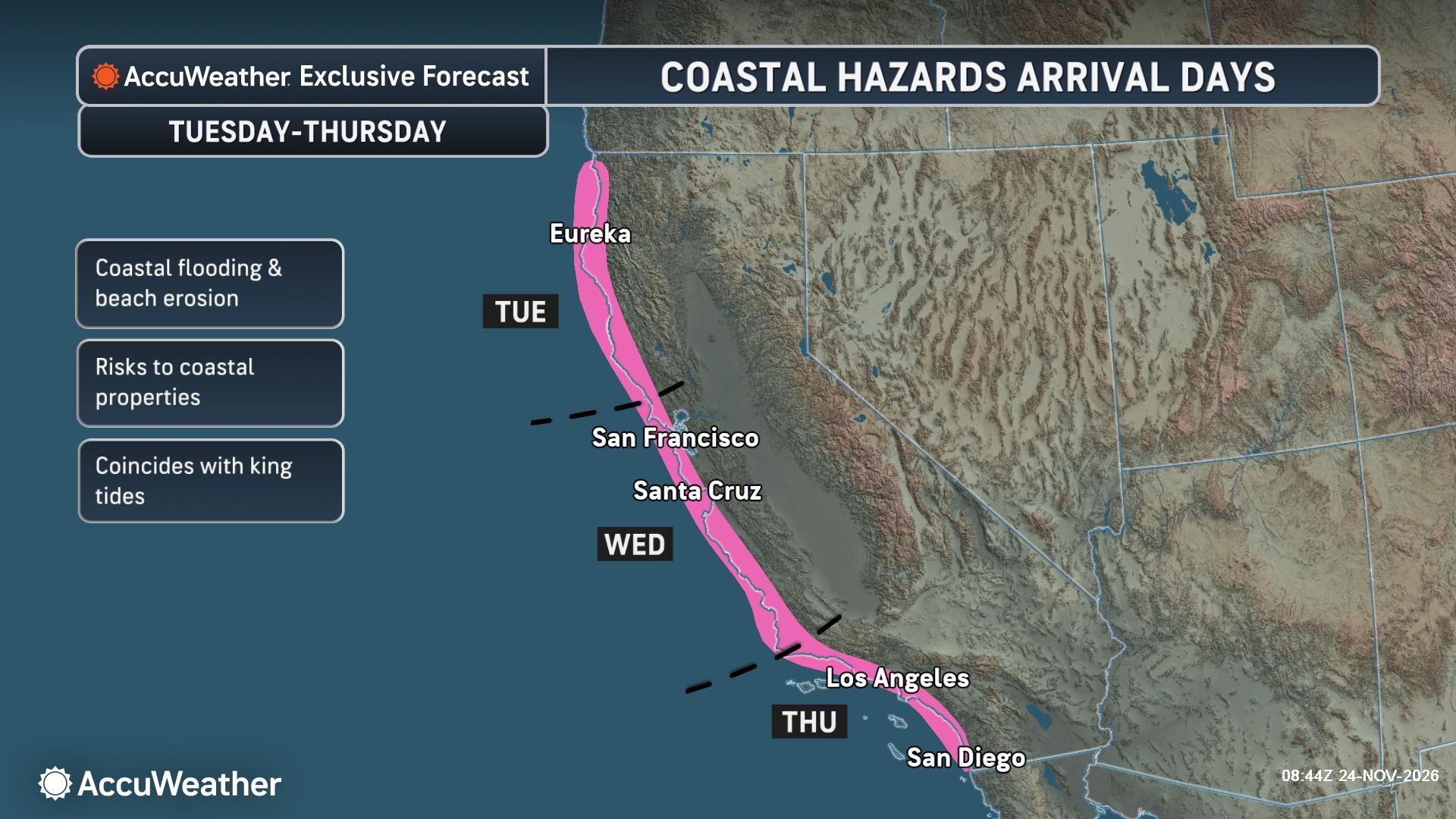
On the West Coast, king tides combined with a bombardment of Pacific storm systems could cause flooding on low-lying California coastal roads and increase beach erosion through Thanksgiving.
Weather hasn't been the only problem facing travelers. Delta Air Lines resolved an outage that caused delays nationwide Sunday, marking the third major disruption to U.S. air travel in nine days.
AAA projects that 81.5 million Americans will travel at least 50 miles from home between Tuesday, Nov. 24, and Monday, Nov. 30, including 72.9 million by car and 5.96 million on domestic flights.
Tuesday and Wednesday: Atmospheric river in the West, storms in the Southeast
AccuWeather's Pacific Coast hazards.
AccuWeather
In the Pacific Northwest and Northern California, a barrage of storm systems will bring rain and wintry precipitation to higher elevations on Tuesday, then move into Washington and Oregon on Wednesday and Thursday, according to the NWS.
'Near the coast, there are Marginal Risks (level 1 of 4) of excessive rainfall today in Northern California, and on Wednesday and Thursday through portions of the coastal Pacific Northwest,' the NWS said Tuesday.
According to AccuWeather meteorologist Alyssa Glenny, 'People heading to the coast for Thanksgiving should check high tide times and local road conditions. Storm-driven increases in water levels and wave action can make flooding worse when they overlap with high tide.'
Glenny also said that coastal flooding can happen even when it's not raining. In other words: sunshine doesn't necessarily mean the roads will be dry.
In the San Francisco Bay Area, the storms coincide with potentially record-breaking king tides, the year's highest tides. The National Weather Service has a coastal flood warning in effect until 4 p.m. PT Thursday and calls Tuesday and Wednesday an 'extreme' risk for flooding along the bay shoreline, and a high surf warning covers Wednesday on the Pacific coast. The agency said the storm will coincide with the king tides, potentially making flooding worse during Thanksgiving travel.
San Francisco Mayor Daniel Lurie wrote in a Tuesday X post, 'On Wednesday, 11/25, we are expecting high tides and big swells around 11 am so stay away from Ocean Beach and the waterfront. Look out for each other, stay alert, and don't drive through floodwaters.'
In Marin County, Southern Marin Fire District has urged residents and businesses to 'take action now' and prepare for possible road closures and travel disruptions.
Further north, in Humboldt County, Sheriff William Honsal declared a local emergency and ordered residents of the King Salmon area on Humboldt Bay to leave by 7 a.m. Tuesday, after seawater flooded streets there during Monday's high tide, according to the sheriff's office.
In the Southeast, heavy rain and thunderstorms could hit Atlanta and Charlotte on Wednesday, one of the busiest travel days of the year. AccuWeather said Wednesday could bring some of the most widespread weather-related travel disruptions before Thanksgiving, particularly in the Southeast, with airline delays expected to expand in Orlando and Miami from Tuesday to Wednesday and in Atlanta and Charlotte on Wednesday. The National Weather Service's Weather Prediction Center has warned of flooding rain along the coastal Carolinas on Wednesday. Delays at those hubs could ripple across the country.
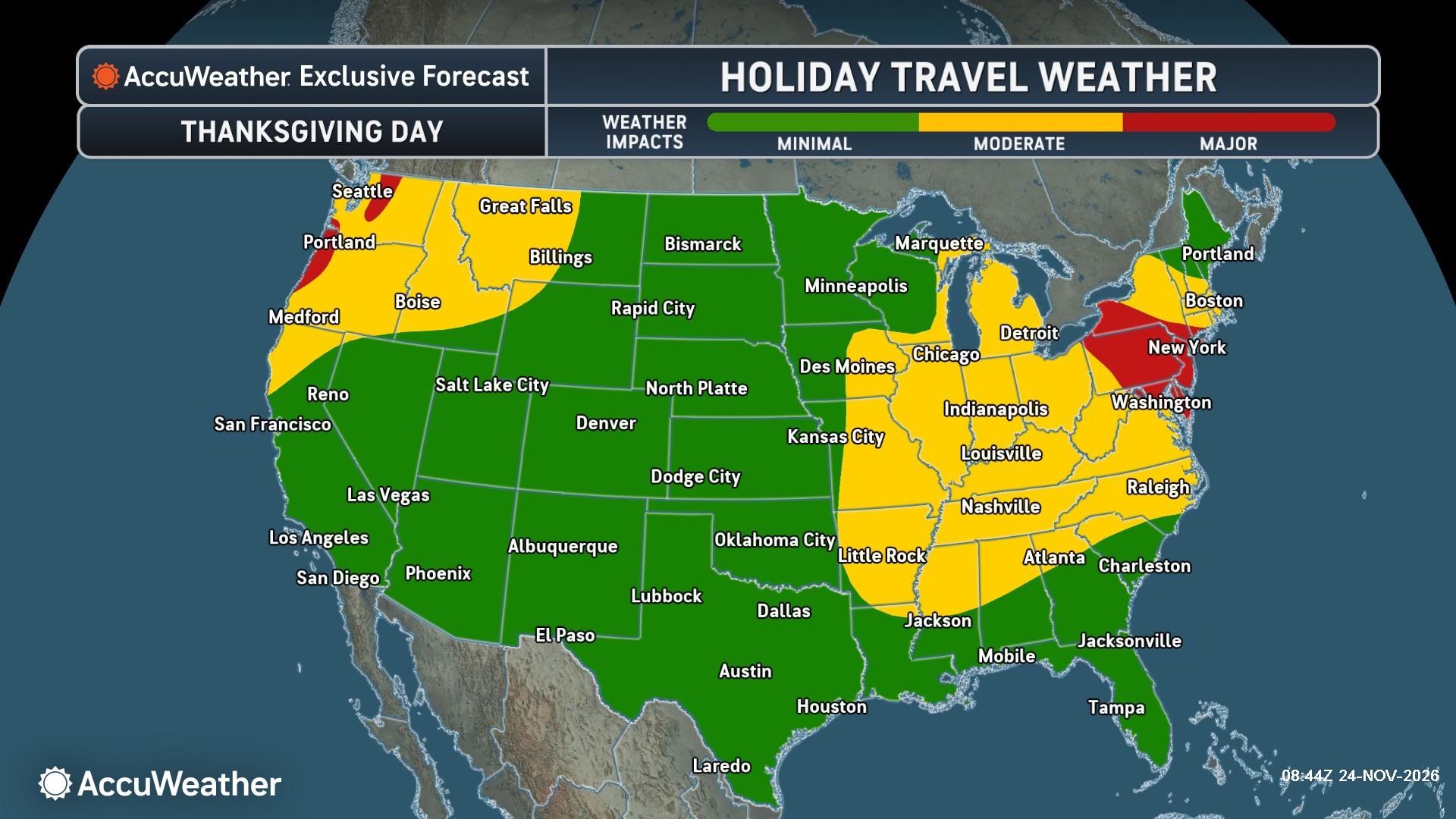
Thanksgiving Day: Possible major storm in the Northeast
AccuWeather's holiday travel outlook.
AccuWeather
Forecasters are monitoring another storm that will form off the Southeast coast late Wednesday and move up the East Coast through Thanksgiving, bringing heavy rain and strong winds from the Mid-Atlantic to New England.
'Significant coastal flooding and beach erosion are the primary concerns from Georgia to the Northeast, especially on Wednesday and Thursday; driven by strong onshore winds, high surf, and astronomical tides,' according to the NWS.
'The greatest impacts and flooding potential are expected along the Mid-Atlantic coast from the northern Outer Banks to New Jersey. Heavy rainfall is expected from the Southeast on Northward through southern New England.'
The National Weather Service in Boston called it a 'potentially significant coastal storm' for Thanksgiving into Friday, with gusts along the coast possibly topping 50 mph. Very high tides could also bring coastal flooding, the agency said. The storm arrives as king tides continue on both coasts around Tuesday's full moon, which could worsen coastal flooding, the Weather Channel said.
Interior parts of the Northeast and the Appalachians could see some snow or ice. AccuWeather said a brief period of wet snow or sleet is possible in northern New York and New England later Thursday.
That could be a problem for the 100th Macy's Thanksgiving Day Parade in New York, which is set to start at 8:30 a.m. Thursday. The parade's giant balloons can't fly if sustained winds top 23 mph or gusts top 34 mph, Fox Weather reported. Rain is forecast to begin around midday, possibly before the parade ends, with conditions deteriorating significantly in the afternoon, AccuWeather reported.
The weekend after Thanksgiving
The National Weather Service expects the East Coast storm to weaken and move away, though windy conditions and some rain or snow showers could linger in parts of New England and the eastern Great Lakes into the weekend.
Another storm could form in the East during the busy return weekend, while more Pacific storms could hit the West Coast. The Sunday after Thanksgiving is typically one of the busiest travel days of the year.
Washington State Ferries has canceled several sailings because of high tides from Tuesday into the weekend, with about 300,000 people expected to use the ferry system over the holiday period.
Forecasters advise travelers to check forecasts for both their departure and arrival cities, and to keep an eye on flight status before heading to the airport.
This article originally appeared on Yahoo News at https://www.yahoo.com/news/weather-news/article/thanksgiving-travel-and-weather-forecast-storms-on-both-coasts-could-snarl-busiest-travel-days-san-francisco-braces-for-potentially-record-king-tides-222342659.html
The main entrance of CIA headquarters in Langley, Virginia, on July 8, 2022. - Kevin Lamarque/Reuters/File
The CIA and Office of the Director of National Intelligence suffered an apparent hack affecting unclassified information, four sources familiar with the matter told CNN.
The intrusion hit a system the agencies draw on for open-source intelligence analysis, one of the sources said.
The full extent of the breach was unclear, but officials emphasized that no classified information was affected. “There have been no disruptions to critical capabilities or classified systems,” an ODNI official told CNN.
The CIA declined to comment.
It is not immediately clear when the hack occurred, who was responsible for it, or if it has been resolved.
The Office of the Director of National Intelligence (ODNI), which oversees 17 US intelligence agencies, including the CIA, has in recent years invested in open-source intelligence work, which is often unclassified.
The apparent intrusion, which the New York Times first reported, is the latest in a string of cybersecurity incidents or tech outages that have rattled the US government and private sector.
The incident does not appear to be related to an apparent hack of the FBI’s nationwide criminal information database, two of the sources said, which CNN first reported on Friday.
The hacking incidents have coincided with a series of unrelated high-profile tech outages affecting banks, the National Security Agency and the FAA’s air traffic control system that have rattled Americans’ confidence in the technology that underpins their lives.
All flights nationwide were grounded for hours earlier this month after a massive systems failure, leading to thousands of flights being delayed or canceled. The Federal Aviation Administration traced the problem to a single router in Arkansas.
Separately, an outage affecting Microsoft products left people around the world unable to access staples of work life like Outlook email accounts and Teams meetings.
But it’s the disruption at the NSA, the US’ signals intelligence spy agency, and intrusions at the FBI and CIA that have national security officials on alert.
The highly classified network that the NSA uses for its internal communications went down for multiple days last week, CNN first reported. The apparent cause was a software update gone wrong and not a cyberattack, the nation’s spy chief Jay Clayton said. A critical Georgia facility that supports signals intelligence and cybersecurity operations focused on the Middle East, where the US is currently engaged in a war with Iran was also impacted, CNN reported.
The NSA’s most sensitive and important intelligence-gathering systems were unaffected by the outage, and by Friday, the outage was resolved.
The software vulnerabilities that the NSA was addressing are just a handful in a slew of new vulnerabilities that artificial intelligence has been able to locate. Cybersecurity experts say government agencies and companies alike are discovering a spate of new software bugs in their systems thanks to AI, prompting a rush to fix them and sometimes mistakes along the way.
For more CNN news and newsletters create an account at CNN.com
This article originally appeared on CNN at https://www.cnn.com/2026/11/24/politics/cia-odni-hack-unclassified-information
Kilmar Abrego Garcia, the El Salvador native who was mistakenly deported last year and sent to a notorious prison in his home country, is planning to leave the U.S. for Spain on Tuesday, according to multiple U.S. officials familiar with the matter.
Abrego Garcia, whose case became an early flashpoint in the debate over the Trump administration's deportation crackdown, is set to fly to Spain on a commercial flight Tuesday, according to the sources, who requested anonymity to talk about an arrangement that has not been disclosed publicly.
The exact nature of his arrangements and the conditions of his departure from the U.S. were not immediately clear. But the federal judge in Maryland overseeing his civil legal case issued an order Friday that remains sealed.
CBS News has reached out to an attorney and representatives for Abrego Garcia.
The move by Abrego Garcia comes after the Trump administration spent months trying to deport the man, who came to the U.S. illegally 15 years ago and had been living in Maryland with his wife and children when he was detained by immigration authorities in March 2025. He was then deported to El Salvador and held for months in the country's CECOT prison, despite a previous court order barring him from being sent back to his home country. He was brought back to the United States last year to face criminal charges.
Abrego Garcia has maintained for more than a year that if he had to leave the U.S. again, he would be willing to go to Costa Rica, and designated the Central American nation as his preferred country of removal.
But the Trump administration had resisted that suggestion and instead unsuccessfully sought to deport Abrego Garcia to numerous African countries, including Uganda, Eswatini and Ghana. In more recent months, the Department of Homeland Security said it was ready to deport Abrego Garcia to Liberia — part of a broader practice of sending deportees to countries in Africa.
Abrego Garcia's departure from the U.S. came weeks after a hearing before U.S. District Judge Paula Xinis, who has been presiding over a civil case stemming from his deportation last year, was abruptly cancelled. The judge ordered Immigration and Customs Enforcement last year to release Abrego Garcia from immigration custody and has continued to bar immigration authorities from detaining him while litigation continued.
But the Trump administration had sought to lift Xinis' orders, which it said were the only impediments to Abrego Garcia's 'prompt removal.' The Justice Department said in March that the government was 'ready, willing, and able' to deport Abrego Garcia to Liberia in West Africa.
Abrego Garcia's case gained national prominence last year after a top administration official acknowledged that his removal to El Salvador was an 'error.' Following his arrest by immigration authorities in March 2025, Abrego Garcia was among the more than 200 immigrants who were sent to El Salvador and detained at its notorious supermax prison, the Terrorism Confinement Center, or CECOT.
But Abrego Garcia had been granted a withholding of removal by an immigration judge in 2019, which prevented immigration authorities from deporting him to his home country of El Salvador because he was at risk of persecution by local gangs.
In April 2025, Xinis ordered the Department of Homeland Security to bring Abrego Garcia back to the U.S., and the Supreme Court said the government had to facilitate his release from Salvadoran custody.
The Trump administration ultimately brought Abrego Garcia back to the U.S. in June 2025, but only after he was indicted on federal charges of human smuggling stemming from a 2022 traffic stop in Tennessee. Abrego Garcia pleaded not guilty and in May, a federal judge in Tennessee dismissed the criminal charges on the grounds that his prosecution was vindictive.
The Justice Department has appealed that decision, and arguments before the U.S. Court of Appeals for the 6th Circuit are scheduled for February.
This article originally appeared on CBS News at https://www.cbsnews.com/news/kilmar-abrego-garcia-leaving-us-europe/
By Karen Freifeld
NEW YORK, Nov 24 (Reuters) - Chinese telecommunications equipment maker Huawei was convicted by a jury in New York City on Tuesday in a sprawling US criminal case on charges that it deceived banks about its business in Iran and stole trade secrets from American companies.
The verdict came in a criminal case that began in 2018, with the US government the following year placing Huawei on a trade blacklist that restricted its access to US technology amid American concerns that Huawei posed national security risks.
The jury in Brooklyn federal court found Huawei guilty on 10 of the 12 criminal counts the company faced, including bank fraud, wire fraud, sanctions violations and conspiring to steal trade secrets. The jury acquitted Huawei of conspiring to obstruct justice and racketeering conspiracy, a charge alleging the company had acted as a criminal enterprise.
The trial lasted more than two months, with prosecutors calling more than 60 witnesses and the defense calling 15. It was not immediately clear what penalties Huawei will face when US District Judge Ann Donnelly sentences it on September 14, 2027.
Reuters stories in 2012 and 2013 helped expose Huawei's activities in Iran and were discussed during the trial.
'After the media started questioning Huawei's operations in Iran, so did Huawei's banks,' prosecutor Meredith Arfa told jurors during closing arguments in the case last week.
Brian Heberlig, a lawyer for Huawei, said the company was disappointed by the convictions but said the acquittal on the racketeering conspiracy charge vindicated its 'good-faith compliance culture.'
'We fully expect to appeal,' Heberlig told reporters.
US Attorney Joseph Nocella said in a statement: “Few crimes are as serious as Huawei’s decades-long pattern of endangering US national security, violating the sanctity of US commerce, and impeding the enforcement of US laws.” China's embassy in Washington did not immediately respond to a request for comment.
Asked how much the company may have to pay in penalties, Heberlig said it was premature to comment, but said the acquittal on the racketeering conspiracy charge could make a significant difference.
Experts have said the case did not undermine Huawei's business, as the company diversified and emerged as a key player in China's push for artificial intelligence.
FOUNDER'S DAUGHTER WAS DETAINED
In December 2018, Meng Wanzhou, Huawei's chief financial officer and daughter of the company's founder, was detained in Canada on a US warrant, prompting a diplomatic crisis involving the United States, China and Canada.
Meng had been secretly indicted on US charges of misleading an HSBC banker about Huawei's business in Iran, so the company could move dollars in and out of Iran in violation of American sanctions. Meng fought extradition to the US for nearly three years, before entering a deferred prosecution agreement and flying home to China to a hero's welcome. The charges against her were dropped.
Meng did not testify at trial, though an HSBC banker she met with in 2013 did testify.
The 2018 indictment alleged that Huawei misled HSBC, Standard Chartered and BNP Paribas about its business dealings in Iran. Prosecutors added new charges in 2020, including allegations that Huawei conspired to steal trade secrets from US technology companies over two decades.
THE PROSECUTION CASE
During the trial, prosecutors sought to prove that Huawei stole source code from Cisco Systems for its routers, stole wireless telecommunications company Quintel's antenna technology, and hired a professor to gain access to a circuit board developed by semiconductor company CNEX.
Jurors watched a video that, according to prosecutors, showed a Huawei employee slipping a piece of a T-Mobile testing robot into his backpack, and heard about a Huawei engineer sneaking into a Fujitsu booth at a trade show to photograph a device.
Prosecutors gave jurors a statement attached to Meng's deferred prosecution agreement in which she acknowledged that the company illegally conducted business in Iran.
The defense argued that HSBC and the other banks knew about Huawei's business in Iran and were competing for Huawei's business.
Heberlig accused prosecutors during his closing argument of having 'cherry-picked' a handful of disparate incidents to support their claim of a 20-year conspiracy. Heberlig said Huawei succeeded through 'hard work, innovation, and investment in research and development.'
The company has more than 200,000 employees and operates in approximately 170 countries.
(Additional reporting by Luc Cohen and Jonathan Stempel; Editing by Jonathan Spicer, Noeleen Walder and Will Dunham)
This article originally appeared on Reuters at https://www.yahoo.com/news/us/articles/chinas-huawei-convicted-us-criminal-201624138.html
Democrats' House majority grew to at least 259 seats on Tuesday — the party's largest since 1992 — after Victoria Broderick narrowly defeated Republican incumbent Scott DesJarlais in Tennessee's 4th Congressional District.
Broderick's victory comes two days after Democrat Chuck Hubbard defeated Republican incumbent Rep. Virginia Foxx in North Carolina's 5th District. Foxx has held the seat since 2005.
The final balance of power in the Senate was settled on Nov. 17, when Mary Peltola's victory in Alaska gave Democrats their ninth flipped seat of the 2026 midterm elections, the most in nearly 70 years. When the next Congress takes office in early January, the party will hold its largest Senate majority since 2011, with 56 seats to the GOP's 44.
The question now is what Democrats plan to do with their newfound power. Last week, the party nominated New York Rep. Hakeem Jeffries for House speaker, putting him on track to be the first Black American to wield the gavel. With a majority that could top out at 260 seats, Jeffries will have enormous leeway to send new legislation to the Senate while also blocking parts of President Trump's agenda, investigating his administration and possibly even impeaching him (again).
On the Senate side, Chuck Schumer of New York faces a challenge from Maryland Sen. Chris Van Hollen for majority leader. Senate Democrats will vote by secret ballot on Dec. 1, and the winner needs 28 votes. Schumer has 15 public backers to Van Hollen's five, with 34 senators undeclared, according to The Hill's count. Schumer says he has the votes. Van Hollen said Sunday on NBC's 'Meet the Press' that 'we're north of 15 and momentum is in our direction.'
Trump weighed in Sunday morning. 'It is going to be very hard for me to work with Chuck Schumer should he become Senate Majority Leader,' he wrote on Truth Social, two days after saying he could make deals with Schumer and Jeffries. Whoever wins will control which bills reach the floor, when votes occur and which judges and appointees are confirmed.
Among the priorities under discussion on both sides of the aisle: reinstating Affordable Care Act subsidies that expired under the previous Republican Congress; reversing nearly $1 trillion in recent GOP Medicaid cuts; expanding Medicare by lowering the eligibility age and adding vision, hearing and dental coverage; addressing the high prices of groceries and other goods by blocking Trump's global tariffs and restoring congressional power over trade policy; cutting off Iran war funding; and launching investigations of ICE, presidential pardons, political pressure on federal law enforcement, the Epstein files and the Trump family's business dealings.
As for impeachment, Rep. Jamie Raskin, a Democrat from Maryland who is set to chair the House Judiciary Committee, told Punchbowl that it's a 'critical tool in the constitutional toolbox' — but far from a sure thing. 'We will not hesitate to use it if we think that the benefits exceed the costs,' Raskin said. 'But the one thing everybody's well aware of is that impeachment trials and impeachment motions soak up a lot of energy and oxygen.'
Despite their sizable House and Senate majorities, Democrats will be limited in what legislation they can pass into law. Trump still has veto power, and Senate Republicans still hold enough seats to filibuster most bills. Meanwhile, many incoming Democratic lawmakers (like Peltola) are relative moderates representing red states and districts — meaning the party will have to calibrate its approach carefully to keep them on board and maximize its chances of winning the 2028 elections.
Beyond Washington, D.C., Democrats will now control the governorship and both legislative houses in six new states: Arizona, Wisconsin, Pennsylvania, Nevada, Michigan and Minnesota. They will also hold the majority in a dozen new statehouse chambers. As a result, the party will have more opportunities to experiment with new policy ideas, approve congressional maps, influence election procedures, fill Senate vacancies and help a new generation of governors build executive experience ahead of future presidential elections.
Democrats came into the midterms needing a net gain of four seats to win back the Senate. To do that, they had to defend a handful of potentially vulnerable swing-state seats while also flipping at least a few seats in historically red states.
That's exactly what happened. Republican efforts to flip blue seats in Michigan, Georgia, Minnesota and New Hampshire all came up well short. Meanwhile, Democrats won nine GOP-held seats in Mississippi, Maine, Texas, South Carolina, Ohio, North Carolina, Iowa, Kansas and Alaska.
Only two incumbent Republican senators in competitive races were able to win reelection: Florida's Ashley Moody and Nebraska's Pete Ricketts.
The last undecided race was called Nov. 17, as Mary Peltola defeated incumbent Republican Dan Sullivan to become the first Alaska Democrat elected to the U.S. Senate since 2008.
Peltola secured just over 50% of the vote, narrowly clearing the threshold required to win without triggering Alaska's unique ranked choice voting system.
So far, Democrats have won at least 258 U.S. House seats, far more than the 218 they needed for a majority. That includes 48 red-to-blue flips, for a net gain of 45 seats. That is four more than the 40 they picked up in Trump's first midterm in 2018. Democrats' 14-point victory in the House popular vote is the largest in any midterm since 1974.
Races that were too close to call on Election Night have been decided in the days that followed.
On Sunday, the AP called North Carolina's 5th District for Democrat Chuck Hubbard, a former journalist, over Rep. Virginia Foxx, who has held the seat since 2005. Cook Political Report had rated the seat likely Republican, and Foxx won it by nearly 19 points in 2024. Foxx, who requested a recount last week, said in a statement that she had called Hubbard to congratulate him. She has already filed to run for the seat again in 2028, WFMY reported.
Democrats picked up another flip on Tuesday when Broderick was named the winner in Tennessee's 4th District, defeating DesJarlais by just a few hundred votes. Broderick will be the lone Democrat among the Volunteer State's House caucus.
Where things stand in the undecided House races
Three U.S. House races remain unresolved.
Two are in Louisiana, where the top two finishers in the 5th and 6th Districts will meet in a Dec. 12 runoff.
The last remaining House race that will be decided based on votes cast on Election Day is in Minnesota's 1st District, where Democrat Jake Johnson leads GOP Rep. Brad Finstad by just over 300 votes. Finstad requested a recount, which runs Nov. 30 to Dec. 3. The state canvassing board will certify the race Dec. 8.
How many governorships did Democrats win?
Republican governors have outnumbered their Democratic counterparts for the last 15 years straight (and for 26 of the last 30 years overall). But this year, Democrats have reversed the 'governor gap,' flipping six governorships in Iowa, Texas, Ohio, Nevada, Alaska and Georgia to bring their total to 30 — the party's first gubernatorial majority since 2011.
On Thursday, Democrats also held onto Kansas, where voters elected Democratic state Sen. Cindy Holscher to become the Sunflower State's fourth woman governor ever. She defeated Republican Ty Masterson, the state's Senate president.
'Kansans have sent a clear message that they want to keep our state moving forward,' Holscher said in a video posted online Tuesday. 'The work of preparing to lead has already begun.'
The AP called Alaska's governor race for Democrat Jonathan Kreiss-Tomkins early Saturday. He won a majority of first-choice votes, so no ranked-choice count was needed. He will be the state's first Democratic governor since Tony Knowles left office in 2002, and he takes office Dec. 7.
That includes three states where they flipped both chambers: Arizona, New Hampshire and Wisconsin. After Election Day's results, Democrats will control the House, Senate and governorship in Arizona for the first time since 1966. Democrats also secured a 'trifecta' in Wisconsin. They'll hold both legislative chambers in New Hampshire, but the governorship in the Granite State will remain in Republican hands.
Democrats regained trifectas in Minnesota, Michigan and Pennsylvania by clinching majorities in the lone GOP-led chamber in their states. They flipped a single chamber in Georgia, North Carolina and Texas, ensuring that Democratic governors in those states won't face unified Republican opposition within their state legislatures.
Where things stand in the undecided state legislative races
As of Monday morning, only three state legislative chambers — the North Carolina Senate and both chambers in Alaska — remained undecided, according to the AP. A recount is possible in North Carolina, where Senate control hinges on one race.
This article originally appeared on Yahoo News at https://www.yahoo.com/news/politics/article/final-2026-midterm-election-results-democrats-reach-258-house-seats-their-most-since-1992-as-foxx-concedes-in-north-carolina-what-they-can-and-cant-do-next-182515399.html
The Trump administration will propose new tariff hikes Tuesday night on the European Union, China, Mexico, Japan and 12 other trading partners, a major step towards recreating the president’s global duties the Supreme Court struck down in February.
According to one person with knowledge of the planning, U.S. Trade Representative Jamieson Greer will announce the new tariff proposals as part of a report into the countries’ excess manufacturing capacity. The findings are the product of a trade investigation Greer’s office launched in March under Section 301 of the Trade Act of 1974, which allows the U.S. trade representative to impose tariffs in response to unfair trade practices.
Three other people briefed by the administration on the investigation confirmed the report was in the process of being finalized and the results would be announced as soon as today. They were granted anonymity to share details of policy plans that are not yet public.
The person with knowledge said the proposed new duties will honor the tariff ceilings countries have negotiated with the Trump administration over the past year, in exchange for trade concessions and massive investment in American industries. China’s overall tariff rate, for example, won’t exceed 20%, while the EU’s will stay below the 15% cap that the president agreed to with European Commission President Ursula von der Leyen in Turnberry, Scotland in 2025.
Targeted countries will still have an opportunity to weigh in through hearings, public comments and closed-door talks for the rates are finalized. Like other recent tariff hikes, the new duties are also expected to come with a raft of carve-outs. And there will be an opportunity for future tariff reductions if countries take steps to reduce their manufacturing overcapacity, the person with knowlege said. But the threat of further tariffs, alone, is likely to enrage foreign allies already frustrated by other elements of Trump’s trade policies they believe violate their existing agreements.
In its filing in March, Greer’s office said there is evidence countries like China have aggressively expanded their production in strategic sectors beyond what demand can support and said the country, alongside other partners like the European Union, maintains a global goods surplus.
The investigation is the second of two sweeping trade probes launched in the spring as part of the Trump administration’s mission to rebuild its tariff regime after the 'reciprocal' duties he imposed in 2025 were invalidated. The administration completed an investigation into forced labor in foreign supply chains over the summer, which it said justified tariffs of between 10 and 12.5 percent on dozens of trading partners, including all 16 of the economies covered by the excess manufacturing probe.
Any tariffs that are ultimately imposed following the excess manufacturing investigation would stack on top of those existing tariff rates.
Higher tariffs risks complicating delicate relationships with major economies and come amid a fragile trade truce with China that expires in January. Trump and Chinese leader Xi Jinping are set to meet during the G20 summit next month.
It also comes amid tense negotiations with Mexico over the renewal of the U.S.-Mexico-Canada Agreement.
Like Trump’s other efforts to impose tariffs after his Supreme Court defeat, any new duties the government imposes based on this investigation are likely to be challenged in court. The administration’s forced labor tariffs are currently under scrutiny at the U.S. Court of International Trade.
Stefanie Bolzen contributed to this report.
This article originally appeared on Politico at https://www.politico.com/news/2026/11/24/trump-tariffs-china-eu-mexico-manufacturing-01181685
The timing couldn't have been worse. Just before the busiest travel week of the year, a wave of major aviation tech outages — including a Delta Air Lines system failure on Sunday, a United Airlines disruption last Monday and a nationwide FAA ground stop on Nov. 13 — looked sure to make leaving home for Thanksgiving more stressful than ever.
Suddenly, 'outage anxiety' was everywhere. 'I think half the country is looking at its boarding pass with suspicion,' Christopher Elliott, founder of a nonprofit that helps consumers resolve travel disputes, told the New York Times.
According to a YouGov poll conducted right after the ground stop, nearly three-quarters of Americans (72%) said that if they were set to fly over the holiday, they would be concerned about experiencing 'flight cancellations or significant delays as a result of further disruptions to U.S. air travel.' And nearly a third (31%) said the ground stop could potentially alter their plans, making them less likely to travel by air for Thanksgiving.
But now that the digital chaos seems to have subsided and Americans are starting to hit the road, how worried should you really be about additional meltdowns snarling your holiday travel plans?
The simple answer: We don't know.
An outage is, by definition, unexpected. The FAA said it was forced to ground thousands of flights after a router installed during a copper-to-fiber network upgrade flooded its telecommunications network with excessive data, overwhelming legacy equipment and destabilizing radar and communications feeds. Delta's outage was traced to a 'database issue' in its automated weight-and-balance system. United's outage was similar. None were the result of a cyberattack, officials insisted. But none were foreseen, either.
'This has never happened,' Transportation Secretary Sean Duffy told CBS News, referring to the chain of events that triggered the ground stop. 'And so that's why … we felt comfortable doing [the upgrade] in the middle of the day — because it's been done thousands of times. We've never had this situation.'
On Nov. 16, the Trump administration convened a 'tiger team' — a small group of experts or specialists who work together on solving a specific problem that isn't easily addressed by normal operations — to prevent similar outages going forward. Composed of officials from the FAA, the Transportation Department, the Defense Department and the Office of the Director of National Intelligence, the team has 'met every day this week to ensure continuity of service,' according to the Daily Wire.
A White House spokesperson said Americans preparing to travel for Thanksgiving have nothing to worry about, the outlet added.
'President Trump and Secretary Duffy have brought together the best and the brightest across the government to ensure what happened [on Nov. 13] can never happen again,' the spokesperson said. 'Work continues, and Americans can rest assured their country's aviation is the best in the world.'
According to Microsoft President and Vice Chair Brad Smith — whose own company suffered a massive global outage earlier this month — AI is the common thread here, even if it didn't directly cause any of the recent travel disruptions.
'What AI did earlier this year was basically make it much easier for people to find vulnerabilities in code, and then you can either use that knowledge to patch the code, or if you're a bad actor, you can use that knowledge to try to hack into systems,' he told CBS News on Sunday.
Smith went on to say that organizations are now rushing to patch vulnerabilities 'at a pace we have never seen before' —a rush that itself creates instability, particularly within legacy systems.
'Especially when you have older infrastructure, especially when you're trying to patch at such a pace, especially when you have to go so fast that you can't take as much time to test what you're changing in the code, you do increase the risk of something going wrong,' he explained.
The bottom line? Americans 'have to be prepared' for more disruptions in 'the coming months because this isn't the type of thing that just gets done in a couple of weeks,' Smith said. 'The whole information infrastructure of the world is in effect being upgraded right now.'
Even as the White House tries to reassure Thanksgiving travelers, administration officials have predicted that more outages are on the way.
'The American people should understand that a great deal of our digital infrastructure is dated. It is old. It has been built out over three decades or more. We are in a period of technological step change, both in terms of what people refer to as [AI] models, applications, and the like, and in computing power,' Director of National Intelligence Jay Clayton told CNN on Sunday.
'And in that technological step change, our systems are going to need to be upgraded,' Clayton continued. 'They're going to need to be upgraded for performance and for cybersecurity. And as part of that ongoing upgrade, we are going to have glitches, gaps, interruptions in service. That is going to happen.'
Asked if 'the American people' should 'just be prepared for more outages' because of those upgrades, Clayton effectively said yes.
'They should be prepared that any time there is a step change in technology, a step change in both compute and applications, there will be bumps in the road,' Clayton said. 'Any time you refurbish your house, upgrade any of your systems, there are going to be things that you do not expect.'
How to prepare
With that in mind, it's probably wise to plan for the worst if you're leaving home for the holiday — especially if you're flying. Print everything: boarding passes, visas and so on. Forgo checked bags, if possible. (Or at least track your luggage.) Keep your receipts. And know your rights: Transportation Department rules require airlines to issue a refund if your flight is canceled or significantly delayed for any reason (assuming you decline a replacement ticket or travel credit).
After all, outages aren’t the only obstacle to consider this weekend. Major storms are also set to strike both coasts — including one that could last through Thanksgiving Day — and record-challenging king tides are threatening coastal flooding from California to Florida as a result of El Niño.
This article originally appeared on Yahoo Travel at https://travel.yahoo.com/flights/article/aviation-tech-outages-thanksgiving-travel-205820796.html
Thomas Sr., 82, has been charged with two counts of possession of child pornography and faces up to 40 years in prison if convicted.
The indictment was shared on X by Bill Essayli, the United States Attorney for the Central District of California, who noted that Thomas Sr. stands accused of “knowingly” possessing “35mm film negatives of sexually explicit material involving children.”
“Federal law enforcement was notified last month that Markle possessed child sexual abuse material (CSAM) in the Philippines and at two storage units in Los Angeles,” Essayli continued in his statement. “A judicially approved search warrant was executed and the materials were seized.”
Thomas Markle Sr. (seen here in his Florida mugshot) was indicted on child pornography charges in California on Tuesday and is now facing up to 40 years behind bars. Pinellas County Sheriff's Office via APThe 82-year-old (seen here in Mexico) was recently declared mentally fit to stand trial by a Florida judge. / SplashNews.com
The indictment refers to several specific frames that were uncovered by the FBI and that contain “at least one image of child pornography [that] involved a prepubescent minor and a minor who had not attained 12 years of age.”
Thomas Sr., who is currently being detained in Florida, “is expected to be arraigned on the indictment in the coming weeks in U.S. District Court in Los Angeles,” Essayli continued.
“This is an ongoing investigation. Markle is presumed innocent until proven guilty,” he concluded, while asking anyone with any knowledge of those involved with child pornography materials to contact the FBI.
Thomas was arrested in Florida earlier this month after FBI agents found child porn material in Los Angeles storage units that were registered in his name. Douglas A. Land via APThomas Sr. was taken into custody at the Maravida Senior Living care home in Lakeland, Florida. Douglas A. Land via AP
It comes after a judge in Florida ruled that the former director of photography is able to stand trial, following a competency review by a psychiatrist, who found that Thomas Sr. — who was diagnosed with dementia earlier this year — has “sufficient ability to understand the nature and consequences of the charges against him.”
Samantha, meanwhile, told reporters her dad was “doing great, thanks.”
Thomas Sr. was set to have a preliminary hearing in Florida on Dec. 1, but now that he’s been indicted in the Golden State — where investigators discovered alleged child abuse materials in a storage locker registered to his name — his case will now be heard in California.
Thomas Sr. (seen here with daughter Meghan Markle) was also hit with child abuse charges in the Philippines, where his son, Thomas Markle Jr., allegedly found child sex abuse materials in his dad’s home. Channel 5He vehemently denied his son’s allegations, labeling them “sick lies.” Good Morning Britain / ITV1
Samantha Markle (seen here with her dad and brother) has defended her father and supported him in court in Florida. Channel 7Meghan, meanwhile, said in a statement that she is “deeply distressed” by the allegations against her estranged dad. / SplashNews.com
His son, Thomas Markle Jr., allegedly discovered child sexual abuse materials in his father’s home and storage unit in the Philippines, and reported the alleged findings to the police.
Thomas Sr. denied his son’s allegations, telling the Daily Mail in October that he paid for sex in the Philippines but did not sleep with underage girls.
Samantha, meanwhile, accused Thomas Jr. of a “revenge” scheme and vehemently defended her father.
If you or someone you know is affected by any of the issues raised in this story, call the Sexual Assault Hotline at 1-800-330-0226.
This article originally appeared on Page Six at https://pagesix.com/2026/11/24/celebrity-news/meghan-markles-dad-thomas-indicted-on-child-porn-charges-in-california-faces-40-years-in-prison/?utm_source=yahoo&utm_campaign=pagesix&utm_medium=referral
Was it better to hold exposure to this year's record-breaking IPO or what may be the biggest entertainment launch in history?
The two collided last Thursday when AI giant Anthropic's (ANT) initial public offering hit the market just as Rockstar Games officially released 'Grand Theft Auto VI.'
So far, the video game trade has come out ahead for investors.
Shares of Rockstar's parent company, Take-Two Interactive (TTWO), are up more than 5% since last Thursday. Anthropic, meanwhile, has fallen more than 1.3% from its $83 IPO price. It is also trading below the $79.99 cost of a standard copy of 'GTA VI.'
Anthropic's record IPO, which raised roughly $81 billion before any exercise of the underwriters' additional-share option, has quickly shifted from first-day enthusiasm into a tricky debate over a range of factors that may be resposible for the stock’s lackluster performance, including insider stock sales, how the IPO launch process was executed, and whether the company's enormous revenue growth prospects can overcome its massive computing commitments.
The speed of the reversal from the new company's 17% first-day gain is notable. Among the 12 biggest US IPOs since 2008, only Uber (UBER) and Facebook, now Meta (META), broke their IPO prices sooner, according to Yahoo Finance calculations.
By comparison, it took about a month before shares in this year's other monster IPO, rocket maker SpaceX (SPCX), slipped below its IPO price of $135. SpaceX's stock is down more than 7% from that level as of Tuesday.
Anthropic CEO Dario Amodei said earlier this month that the company hoped to 'underpromise and overdeliver' in its public launch. During the same interview at JPMorgan Chase's Manhattan headquarters with CEO Jamie Dimon, Amodei laid out the immense promise he believes his firm's AI models could one day have not only for investors but humanity. His vision included the hope AI could one day help make cancer, heart disease and other terminal illnesses 'relics of the past.'
Many investors still remain bullish on the AI firm's promise too. 'I do believe this could be the first $10 trillion company,' Madhu Namburi, a managing director at General Catalyst and former veteran tech dealmaker for JPMorgan, told Yahoo Finance's Deirdre Bosa on Monday.
The 'Grand Theft Auto VI' game case is seen on a table on Nov. 19, 2026, in New York City. (Photo illustration by Michael M. Santiago/Getty Images)
This article originally appeared on Yahoo Finance at https://finance.yahoo.com/technology/article/anthropic-and-grand-theft-auto-vi-launched-on-the-same-day-the-video-game-trade-is-winning-for-now-171431006.html
Flights to Chicago's O'Hare airport were delayed Tuesday afternoon after an equipment outage caused a ground stop, the Federal Aviation Administration said.
By 4:07 p.m. the FAA said the ground stop was lifted; flights were delayed 47 minutes on average.
The ground stop mainly impacted flights scheduled to take off for O'Hare from other Illinois airports; flights leaving Chicago were still taking off.
In a statement, the FAA said, 'The FAA is no longer under a ground stop at Chicago O'Hare International Airport but is temporarily delaying some flights while technicians work to repair a piece of air traffic equipment. The issue is specific to O'Hare, and it does not impact all flights nor affect any other airports or FAA systems.'
ABC News reported there was an issue with one of the O'Hare ground radars.
By about 6 p.m., delays were minimal.
This was the second ground stop at O'Hare airport this week.
'What's disturbing is these are three very different problems, the three O'Hare-related ground stops we've had in the last, you know, week or so. And it suggests that there's no easy fix to this, that it's manpower or it's equipment. It's some of the regional centers,' DePaul University professor Joe Schwieterman said.
The Thanksgiving travel rush continues Tuesday at Chicago's two major airports, with officials expecting more than 2 million passengers to pass through O'Hare and Midway during the holiday travel period.
Travelers headed to the airports were urged to allow extra time for both driving and air travel. The American Automobile Association projected the heaviest outbound road traffic between 2 and 8 p.m. Tuesday, and from noon to 7 p.m. Wednesday.
Weather could also be a travel concern.
Watch the latest 7-day outlook from the ABC7 Weather Team.
A developing storm is expected to bring heavy rain, powerful winds and coastal flooding to parts of the East Coast on Wednesday and Thanksgiving Day, threatening holiday travel and creating potentially dangerous conditions.
Significant snow is also possible Wednesday as far north and east as the Interstate 39 corridor near Rockford.
The busy travel period follows several recent disruptions affecting major airlines and airports. After a week of outages and ground stops, some travelers said they were concerned about possible delays.
'I saw yesterday there was a stop at O'Hare, I was like 'oh, no.' I hope it doesn't backlog the different planes and I was hoping my flight doesn't get canceled,' said O'Hare passenger Daniel Ordonez.
According to the Federal Aviation Administration, a staffing issue triggered Monday's ground stop, causing flights headed to O'Hare to remain at their departure airports for about an hour and a half.
The interruption was one of several issues affecting air travel ahead of Thanksgiving. On Sunday, a computer outage delayed more than 1,600 Delta flights nationwide. Last week, United said it resolved a technology outage that delayed departures.
'What we're seeing is just strange, coincidental issues. We're well-prepared for them. We have a huge playbook that allows us to respond to anything like that. We've gotten, unfortunately, some practice over the last few weeks with all these various outages we've seen throughout the system,' said Omar Idris, United Airlines' vice president at O'Hare.
Nationwide, AAA expects nearly 6 million people to fly domestically during the Thanksgiving holiday.
'We're here at O'Hare and we're geared up for one of the busiest Thanksgiving weekends on the books, for the history of O'Hare,' said Karen Pride, director of media relations for the Chicago Department of Aviation.
At O'Hare alone, the city expects nearly 1.7 million passengers, an increase of just over 7% from last year. If those projections hold, it would mark the airport's busiest Thanksgiving travel week on record. Sunday is expected to be the busiest day at both O'Hare and Midway.
Among the travelers was Hayley Porter and her 2-year-old son, Chase, an experienced young flyer.
'He has gone on 14 flights and he's going to Nashville,' Porter said.
When asked about traveling with children during the holidays, Porter offered a simple strategy.
'Snacks, lots of snacks,' Porter said.
Despite the expected crowds and potential delays, some passengers said they were focused on the purpose of the trip.
'Just build time in to accommodate for your kids and just be patient and just recognize that the reason for the season is to spend time with family,' said O'Hare passenger Will Grossett.
Officials also reminded travelers that stopping on highway shoulders while waiting to pick up passengers could result in a ticket of up to $164. State police encouraged drivers to use the free cell phone lots at O'Hare and Midway instead.
This article originally appeared on WLS at https://abc7chicago.com/post/thanksgiving-travel-rush-continues-ohare-midway-airports-chicago/20073833/
NEW YORK (AP) — Three months into her tenure as head of the Centers for Disease Control and Prevention, Dr. Erica Schwartz is being investigated by House Democrats, facing a call to resign, and drawing ire from both within and outside the agency.
What's been happening at the nation's top public health agency has alarmed outside health professionals. It also has alienated staff, leaving morale as bad as ever, employees say.
Schwartz, 54, took the helm of the CDC at a very challenging time: the worst U.S. measles epidemic in more than three decades, a large dengue fever outbreak in Florida and the fastest-growing overseas Ebola outbreak in history.
She reports to U.S. Health Secretary Robert F. Kennedy Jr., who is a longtime critic of vaccines and federal public health policy and who played a role in decimating CDC staffing last year.
“She has a tough job, at a tough time, and a tough boss,” said Noel Brewer, a University of North Carolina public health professor.
In an interview with The Associated Press on Tuesday, Schwartz defended her work, saying she's trying to restore trust in the CDC — including by changing how measles-associated deaths are being reported. She said some of the criticisms are based on misperceptions and argued she is making progress on her goals.
“I do understand why people have concerns,' Schwartz told the AP from her home in Naples, Florida. “Have I made mistakes? Certainly. But I'm here to work on the behalf of the American people.”
Some experts say she has made the situation worse. And critics are seizing on the Pan American Health Organization’s declaration last week that measles is continuously spreading here, marking the re-establishment of a public health threat that was eliminated in the last century.
“I have no confidence that she will do what it takes to course-correct at the CDC, and she should resign immediately,” said U.S. Sen. Michael Bennet, a Colorado Democrat.
Schwartz has an impressive resume
When President Donald Trump nominated Schwartz to be the next CDC director in April, he called her “a STAR!” on social media.
She holds both medical and law degrees. She was chief medical officer for the U.S. Coast Guard, where she oversaw 41 clinics and 150 sick bays. She served as deputy surgeon general in the U.S. Public Health Service, helping to lead uniformed medical and health professionals posted at the CDC and government health agencies.
Many public health leaders were cautiously optimistic, noting the CDC badly needed steady leadership after enduring more than a year of turmoil and months of being led by interim directors.
Schwartz was the third Trump nominee for CDC director in less than 18 months. The first was a former Florida congressman whose nomination was pulled an hour before a Senate confirmation hearing. The second was Susan Monarez, who won Senate approval but then was ousted less than a month into the job when Trump administration officials said she was not aligned with the president’s agenda.
Under Kennedy, the agency has seen around 30% of its staff leave, mostly through layoffs, resignations and retirements.
At her nomination hearing, Schwartz pledged “radical transparency” to rebuild public trust in the agency, which she noted declined during the COVID-19 pandemic and which has eroded further under Kennedy.
“I will always stand on science and speak the truth, even in difficult moments,” she testified.
Meanwhile, public misperceptions about vaccines have persisted. A recent Annenberg Public Policy Center survey found that about 1 in 6 Americans said they believed that “vaccines given to children for diseases like measles, mumps and rubella cause autism” — even though dozens of studies have determined there’s no causal link. Roughly another 1 in 5 said they didn’t know whether it was true.
Schwartz hasn’t held a news conference
Schwartz started at the Atlanta-based agency in mid-August. A week later, she held her first “all hands” staff meeting, during which she promised to advocate for the agency and said she wouldn’t hesitate to disagree with Kennedy — but only privately.
Some say that’s when their optimism for Schwartz began to fade.
“I don’t have a clear sense of what is important to her, what are her red lines,” one CDC health scientist told the AP. “If we’re talking about radical transparency,” it is appropriate to know on what issues and what messaging she will not compromise, the scientist added. The employee spoke on condition of anonymity for fear of retribution.
Asked about that assessment, Schwartz said: “I would never do anything unethical or illegal. ... That is a red line.”
Despite that transparency pledge, CDC and HHS officials for months would not release Schwartz’s salary — even though it is public information. Schwartz is paid about $375,000 a year, CDC officials finally told the AP this week, above the typical range for previous CDC directors.
So far she also has been less visible than some predecessors. She has not held any news conferences, and has not used her bully pulpit to try to persuade more Americans to get vaccinations — including for measles, the flu and COVID-19.
Schwartz told the AP that, concerning measles, she doesn't believe a federal health official on TV will sway most of the unvaccinated.
But with the nation experiencing its worst measles epidemic in decades, many public health and medical leaders say Schwartz should be strongly urging Americans to get vaccinated.
“I hope to see her display independence from the vaccine rhetoric and challenges that have been part of this administration,” said Dr. Wendy Armstrong, president of the Infectious Diseases Society of America. “I don’t think we have seen that yet.”
Kennedy continues to back Schwartz. The Health and Human Services Department issued a statement in response to Associated Press queries, quoting Kennedy as saying she had his full support.
“Dr. Schwartz brings the judgment to make hard decisions and the courage to see them through. She is reforming CDC and sharpening its focus on its core mission: protecting Americans from disease,” the statement said.
Congressional Democrats are launching investigations
Some Democratic legislators accuse Schwartz and Kennedy of downplaying measles.
Kennedy has challenged health officials’ accounts of measles deaths. And the CDC has stopped quickly relaying state reports of measles deaths. It adopted a new policy requiring the review of death certificates, which has resulted in CDC counting only about half the measles-associated deaths that states are reporting.
Schwartz said that was her decision, and stemmed from her desire to have a uniform definition of what counts as a measles death.
Democrats on the House Energy & Commerce Committee have questioned why CDC changed the policy.
“As the crisis worsens, we are concerned that you continue to direct an effort at CDC to downplay the outbreak and artificially reduce the number of deaths that CDC reports,” according to a statement from Reps. Frank Pallone Jr. of New Jersey, Diana DeGette of Colorado and Yvette Clarke of New York.
“We are expanding our investigation to examine the threats your actions pose to Americans’ health and whether changes to your statutory authority are required,” they added.
The statement followed a briefing at which Schwartz was supposed to answer congressional staffers' questions about the measles data. The committee leaders described Schwartz as unresponsive and, at times, misleading.
Schwartz argued that she was “fully transparent. And I am really concerned that they think there is more to the story. There isn't.”
CDC employees see little sign of progress
The AP interviewed eight current CDC workers about Schwartz's tenure. They all spoke on condition of anonymity, saying they feared retribution for speaking frankly about what’s going on within the agency.
Some said they never had high expectations. Others said they initially were hopeful but lost confidence, some of them blaming her handling of the measles death count. One said it’s still too early to judge her.
Several said they had hoped for more improvements and stability. Announcements about leadership appointees coming, going and changing titles have continued in a blur, the employees told the AP.
Some mentioned Caroline DeBerry, a former vice president at a conservative think tank and author of independently published novels including one titled “Esther: The Woman Who Didn’t Know Her Place.”
DeBerry got a job as acting director of communications, starting in August. Employees said she gained notoriety within the agency when all CDC website updates ground to a halt while awaiting her approval.
Asked about it, Schwartz said: “There was a bit of clunkiness that happened one day.” She also said DeBerry is on “terminal leave” and her last day will be in December, but did not immediately offer additional detail.
None of the agency veterans interviewed by the AP said they have spoken with Schwartz. But some said they had seen her around the CDC campus accompanied by a group of security guards.
Security has been a sensitive topic at CDC, especially since an August 2025 shooting outside the entrance of CDC’s main campus. A Georgia man who had blamed the COVID-19 vaccine for making him depressed and suicidal opened fire, killing a police officer and spraying bullets into 150 windows.
(The slain officer, David Rose, is widely held up as a hero by CDC employees, and some expressed irritation that Schwartz referred to him as “Officer Stone” during a recent health summit appearance.)
Dr. Tom Frieden, who served as CDC director in the Obama administration, said he occasionally had an escort outside the CDC campus after he received death threats. But Schwartz moves with a large security team inside CDC, and agency staffers said they don’t recall seeing that before.
“It feels like they’re afraid of us,” one health scientist said.
Schwartz acknowledged that early in her time at CDC, she walked the halls accompanied by about a half dozen guards at the recommendation of security leadership. The security details have been reduced to one plainclothes guard, she said.
Confusion over the publication of scientific reports
A directive about research publications shows just how far apart CDC staff feel from the political leadership.
Two CDC scientists told the AP that they were directed in a recent meeting to stop submitting their research to journals run by organizations that have sued Kennedy. The prohibition would cover Pediatrics, one of the most-cited journals for doctors who specialize in children’s medical care, and Clinical Infectious Diseases, a highly regarded publication for doctors focused on germs.
The scientists said the directive was clearly stated but not written down in a memo or email.
HHS and CDC officials are adamant that neither Kennedy nor any other HHS or CDC official ever issued such a directive.
At the health summit, Schwartz acknowledged that CDC employees have lost trust in the political appointees who have been put in charge of the agency, “and I’m trying to earn that trust every day.”
She talked about work going on to stabilize the agency’s leadership and develop a “strategic hiring plan” for 2027.
CDC employees look around and see burned-out colleagues.
“I think everyone is just exhausted,” one health scientist said. “There’s just a sense that we can’t go on like this anymore.”
___
The Associated Press’ health and science coverage receives financial support from the AP Fund for Journalism and private foundations. AP is solely responsible for all content. Find AP’s standards for working with philanthropies, a list of supporters and funded coverage areas at AP.org.
This article originally appeared on Associated Press at https://www.yahoo.com/news/politics/articles/cdc-director-erica-schwartz-defends-201114854.html
A car stalls Thursday after trying to navigate flooded Rossmore Avenue in Los Angeles. (Ted Soqui / Sipa USA / Associated Press)
In a typical year, Denys Oberman would be preparing to host her family’s Thanksgiving this week at her home on the Balboa Peninsula in Newport Beach.
But this year, Oberman — like many others along the Southern California coast — is readying for something less joyous: the arrival of king tides, and the potential flooding they are expected to bring. She has placed a wall of sandbags and a tarp along the front of her seaside home and another row of sandbags along the garage in an effort to keep water from seeping inside.
Officials are warning that extreme flooding could hit the coast, stretching from San Francisco to San Diego this week, fueled by El Niño, hot ocean temperatures and unusually powerful king tides that are among the highest in two decades. In Newport Beach, officials are warning that ocean water levels could rise 12 inches or more above October’s record-breaking high tide of 8.4 feet.
“The surge of water and the volume of water that we saw in October was a lot more intense than anything we’ve seen in the 33 years we’ve been here,” Oberman said. “The notion that your home could literally liquefy and float away is pretty sobering.”
Cities along the state’s coast are bracing for potentially historic flooding over the next several days, though the extent of the toll is not certain.
Sean Heieck attaches a sign that reads 'Keep Calm and Fight On' to his home in Huntington Beach on Monday, ahead of this week's king tides. (Eric Thayer / Los Angeles Times)
Ahead of the king tides, Newport Beach constructed about 5.3 miles of protective sand berms along the beach, distributed 160,000 sandbags and raised 70 public seawalls to keep water from topping barriers along the harbor.
Crews have also inspected stormwater infrastructure, including tide valves and pumping systems and have positioned equipment in areas where flooding is expected to be the worst. Officials even encouraged residents to buy or rent their own pumps to put water around their properties back into the harbor.
“We’ve done a really good job to be ready,” said Mark Vukojevic, Newport Beach’s utilities director. “Today everything went well and the tides were lower than anticipated. Wednesday will be the highest day, but we’re feeling like we’re prepared and in a good position and the weather, thankfully, is in our favor right now.”
The king tides — influenced solely by the position of the moon and sun — are especially large this year because the planet is near the peaks of what are known as the 18.6-year lunar node tidal cycle and the 4.4-year lunar perigee tidal cycle. Ocean temperatures are also at record highs for this time of year because of several factors, including global warming and the El Niño climate pattern that increases the water’s volume.
Tides are expected to increase gradually in the coming days, peaking on Wednesday and Thursday mornings, at 8.4 and 8.5 feet, respectively, according to the National Weather Service.
In the Huntington Beach community of Sunset Beach, which was also hit hard during high tides in October, officials have installed a dike and sand berm to help keep water from inundating the area. The city has spent recent weeks reinforcing seawalls and bulkheads, and cleaning debris out of drains near the harbor.
Work crews have also installed 20 inflatable air bladders, which help block or divert water, and 130 more flood barriers to prepare for the tides, Public Works Director Chau Vu said during a recent council meeting.
“Our current operational threshold for installing the inflatable airbags along [Pacific Coast Highway] is [tides at or above] 6.4 feet,” Vu said, but because of the effects of El Niño and a Kelvin wave, the city is deploying those assets “at 4.7 predicted feet, which means we will be out there almost every day over the next two months.”
In Long Beach, officials have constructed sand berms on the bayside of the Peninsula, Bayshore Drive and Marine stadium, reinforced seawalls on the Peninsula, cleared catch basins in flood-prone areas and purchased trailer-mounted pumps to keep up with the tides.
Nancy Pinckert, a longtime resident of Long Beach’s Naples neighborhood, said she and her neighbors have been busy in recent days adding sandbags to the aging seawalls around the community. The aging seawalls have sunk in several places, she said, and neighbors are hoping the sandbags and plywood placed on the landside of the seawall do an adequate job of keeping the water from flowing into the community.
Pinckert and her neighbors are planning to measure the peak of the tides on Wednesday and Thursday to hopefully get a better sense of what’s to come in December when king tides return.
“We’re sitting on pins and needles,” she said. “We don’t know what’s going to happen.”
Times staff writer Rong-Gong Lin II contributed to this report.
This article originally appeared on LA Times at https://www.yahoo.com/news/weather-news/articles/predicted-flooding-king-tides-communities-130000125.html
Cape Canaveral, Fla. — Scientists have discovered the most distant quasar yet, the core of a galaxy with a slow-chomping black hole at its center dating back to nearly the dawn of the universe.
The quasar formed within 630 million years of the universe-forming Big Bang, a German-led team reported Tuesday. That's considered a very early development in the 13.8-billion-year history of the cosmos, and it smashes previous records.
'This time the leap in cosmic time is huge!' the European Southern Observatory's Julien Wolf, who led the study, said in an email. 'The previous two records each took us back by about 15 million years or less. This one takes us back by nearly 40 million years, the biggest advance in nearly a decade!'
Wolf and his team spotted the quasar while digging through millions of observations made by the European Space Agency's Euclid telescope. Launched in 2023, Euclid is surveying galaxies in an effort to shed light on the dark matter and dark energy that fill so much of the universe and keep it expanding.
Finding a quasar so early in the universe is rare, according to Wolf. What makes this one even rarer, he said, is the massive size of its black hole, despite being such a relatively slow eater of everything around it. Scientists are seeing it as it was 13.1 billion years ago - when the universe was less than 5% of its current age.
Wolf nicknamed the quasar Dun Aonghasa after the prehistoric stone fort in Ireland's Aran Islands. His wife and daughter are Irish, and he was awestruck when they visited the fort - a frontier holding 'the promise of a vast horizon still to explore,' just like this quasar.
His team's findings were corroborated by the Hubble and Webb space telescopes as well as other observatories on and off Earth. Thanks to Webb, scientists learned that the black hole powering this quasar is equivalent in mass to 360 million of our suns, an astounding amount so early in time. The final results appear in the journal Astronomy & Astrophysics.
'Dun Aonghasa gives us a new deadline' for the early universe, Wolf said. 'About 630 million years after the Big Bang, its black hole had already grown to about 360 million times the mass of the sun. But how?'
Their prowling of the cosmic dawn continues.
'Honestly, the record could fall again in a few months or it could stand for years,' Wolf said.
This article originally appeared on CBS News at https://www.cbsnews.com/news/quasar-farthest-oldest-found/
A monument to the dead overlooks a massive burial site of Russian soldiers in the rural Volga region of Kostroma, Russia, on October 20, 2025. - Andrey Borodulin/AFP/Getty Images
Almost three-quarters of a million Russian soldiers have been killed since Moscow launched its full-scale invasion of Ukraine in 2022, equating to roughly one deathevery four minutes, analysis based on leaked official data has revealed.
Russian opposition outlets Mediazona and Meduza reported on Monday that by the end of September, 490,000 Russian troops had been confirmed dead by Russia’s statistical bureau, Rosstat.
But accounting for time lags in reporting and including troops who have been reported as missing in action – and are most likely dead – Russian fatalities jump to more than 720,000 since the start of the war, according to the two outlets.
That is a staggering number that surpasses Russia’s death toll from the Soviet war in Afghanistan in the 1980s and both Chechen wars in the 1990s and early 2000s – and which the Kremlin has long tried to keep secret.
Rosstat stopped publishing demographic data in 2025 to disguise the rising death toll from the war. Mediazona and Meduza, as well as other outlets, obtained the official data after two pro-Ukrainian hacker groups, Cyber Partisans of Belarus and Silent Crow, managed to breach Rosstat’s servers earlier this month.
CNN cannot independently verify the figures, but the leaked data on confirmed deaths alone corroborates earlier estimates by analysts and Western intelligence – which now appear to fall far short of the likely real death toll.
Mediazona and Meduza have long been keeping a tally of Russian losses, based mostly on inheritance documents, death notices and other publicly available documents.
Ukrainian servicemen fire a self-propelled howitzer towards Russian positions in eastern Ukraine on December 28, 2022. - Sameer Al-Doumy/AFP/Getty Images
But the leaked Rosstat data allowed the media outlets to go a step further, using the same methods and calculations normally employed by actuaries estimating risks and insurance premiums.
By analyzing discrepancies between reported death dates and death registration dates, and by comparing these to search notices published by relatives, the reporters were able to extrapolate the number of deaths that have occurred but have not yet been reported to be somewhere around 230,000.
Mediazona has kept a tally of troops identified as missing by their relatives from 2023. That database contains 160,000 individuals and almost all of them are likely dead. Mediazona said that based on its reporting, the rate of survival among those reported missing only around 10%.
unknown content item
-
The data shared by Silent Crow showed that the war was the fourth most common cause of death in Russia since the start of the full-scale invasion, after heart diseases; Covid; and stroke and other vascular conditions.It also confirms what has long been suspected – that the losses are not spread evenly across Russia, with poorer areas and ethnic minorities suffering significantly higher casualty rates.
In addition, an analysis by the NEST Centre, a think tank that also obtained the data, revealed the scale of Russia’s recruitment of foreign fighters. It identified 6,947 records of foreign nationals killed in Ukraine – the majority of them from the central Asian countries of Kazakhstan, Uzbekistan, Tajikistan, Kyrgyzstan, and Turkmenistan.
Like Russia, Ukraine doesn’t release official casualty data, although Ukrainian President Volodymyr Zelensky has publicly acknowledged the scale of losses in combat. The most recent research by the Center for Strategic and International Studies (CSIS) estimated in July that the country has endured between 525,000 and 625,000 casualties, including 125,000 and 150,000 fatalities.
Alexander Baunov, a senior fellow at the Carnegie Russia Eurasia Center, said that the combined death toll suffered by Russia and Ukraine could exceed 1 million.
Ukraine expands evacuation orders
As the newly projected death toll underscores the human cost of Moscow’s war, fears are growing in Ukraine over a deteriorating security situation in the country’s eastern Donetsk region – an area mostly under Russian control – amid daily guided bomb and drone attacks.
All families with children still in Donetsk were on Tuesday ordered to evacuate.
Children and families in many communities in most of Ukrainian-controlled Donetsk - including the major cities of Kramatorsk and Sloviansk - were already under the evacuation order, but now the measure has been expanded to settlements further west. An estimated 64,500 civilians remain in the region as of November 2026, according to the Donetsk regional military administration.
“This is an extremely difficult but necessary decision. The Russians are shelling our cities and villages every day and bombarding the region with aerial bombs,” said the head of Donetsk’s regional military administration, Vadym Filashkin.
For months, Moscow’s forces have been inching towards Kramatorsk, one of Ukraine’s last strongholds in the north of Donetsk region. Tuesday’s mandatory evacuation order is a sign of Kyiv’s concern that an expansion of Russian attacks could further harm civilians and isolate communities, for example by blowing up bridges and supply routes.
CNN’s Clare Sebastian, Nathan Hodge, Kosta Gak and Lauren Kent contributed reporting.
For more CNN news and newsletters create an account at CNN.com
This article originally appeared on CNN at https://www.cnn.com/2026/11/24/europe/putin-russia-war-soldier-death-toll-intl
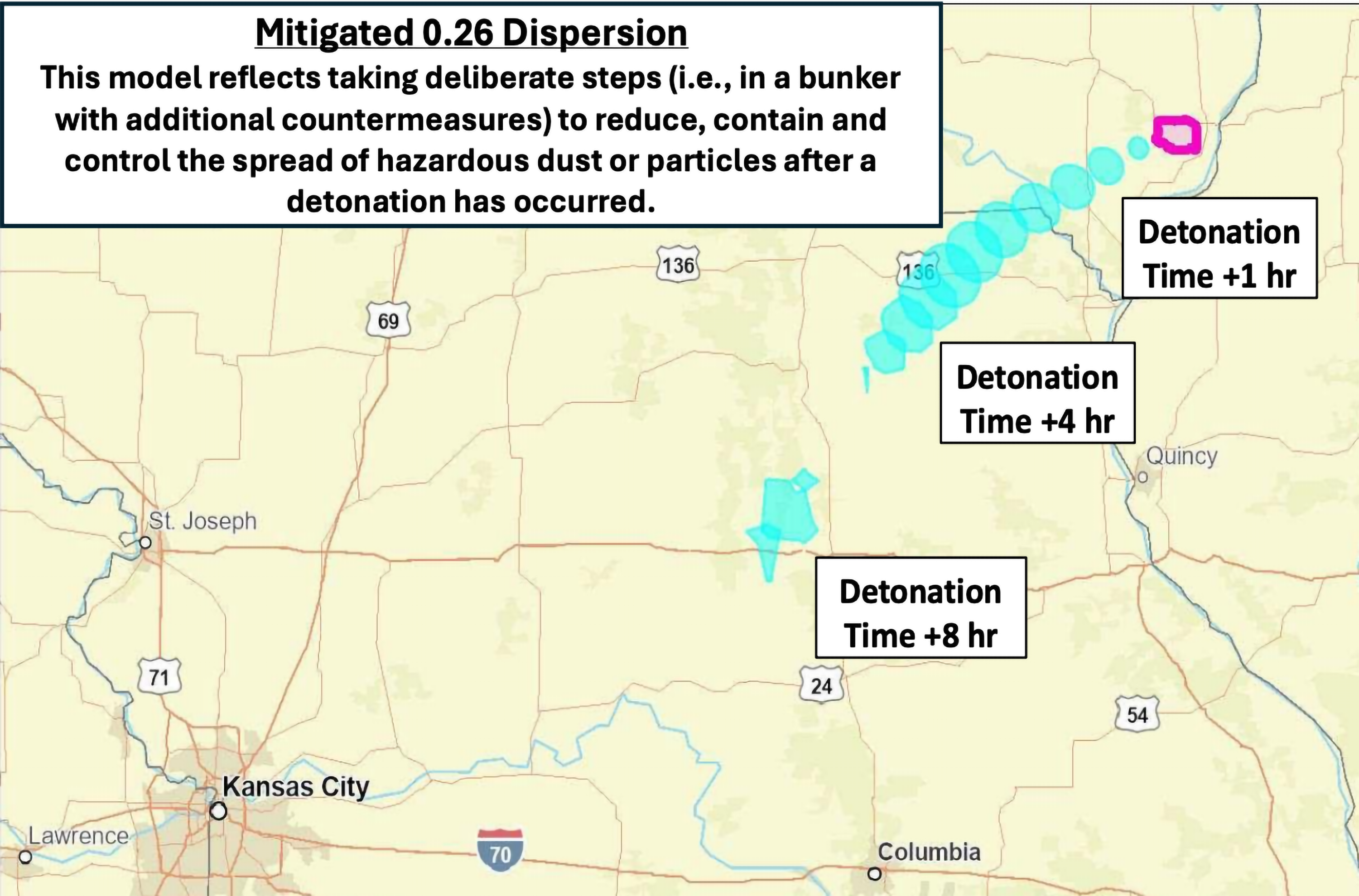
The U.S. Army on Tuesday called for evacuations after it defended its plan to detonate 68 barrels of toxic lead-based explosives stored at a facility in Iowa — despite concerns from environmental groups — following approval from a federal appeals court.
At a press conference at the Iowa Army Ammunition Plant in Middletown, Iowa, acting Army Secretary Adam Telle said there is a consensus among experts that 'a controlled, mitigated detonation' of the entire U.S. stockpile of lead azide 'is far preferable for public safety than an uncontrolled detonation.'
'Inaction is no longer an option,' added Maj. Gen. Eric Shirley, the Army's leader of the operation.
The planned detonation is scheduled for Wednesday morning at 9 a.m. local time.
The Army has recommended that all residents of Middletown and the immediate surrounding areas evacuate starting Tuesday 'out of an abundance of caution.' The Federal Emergency Management Agency is offering transportation and safe lodging for residents who are unable to evacuate on their own.
Iowa Gov. Kim Reynolds backed the Army's decision on Thursday, writing on social media that she has asked for as much information as possible to prepare the surrounding area for the blast.
'I believe, based on the information I've been given, that the danger is immediate, and I trust the Army will do everything in its power to protect the people who could be affected,' she wrote on X.
The announcement followed a judgment from the 8th U.S. Circuit Court of Appeals on Monday, which said the U.S. Environmental Protection Agency had 'adequately incorporated safeguards to minimize the dispersal of lead dust.'
The ruling acknowledged the detonation presented 'real risks,' but concluded that 'we must acknowledge the realities of the situation: the degraded explosives present a risk of an uncontrolled and unplanned explosion, which would occur without the benefit of the safety measures that the Permit puts in place.'
The court's decision came hours after President Trump announced that he had halted the plan. In a Truth Social post, Trump said that while he believes the 'proper course is to get rid of this long-term problem,' he would not allow the Army to destroy the material until federal courts sign off on the plan and Iowa Gov.-elect Rob Sand gives his approval.
Sand, who takes office in January, has said the decision is up to the Trump administration 'based on the information they have from the people they brought in to do the job months ago.'
The explosion threatens to send a plume of toxic lead dust over local communities, livestock and farmland in the surrounding area.
A map depicting the likely range of airborne lead dust from the planned detonation, released Nov. 24.
U.S. Army
'The detonation is expected to produce a dust plume containing lead particles that may travel beyond the installation and settle on surrounding surfaces,' the Illinois Environmental Protection Agency warned in a statement on Tuesday.
Environmentalists sued to stop the detonation last week, setting off a back-and-forth legal battle. The military has argued that the controlled detonation must take place soon, before impending cold weather potentially causes the material to combust on its own.
Here's what led to the current situation, what the dangers are and what might happen next.
How did we get here?
The roots of the controversy reportedly date back to at least March, when the Army discovered nearly 5 tons of deteriorating lead azide, a dangerous bomb-making material, stored at an ammunition plant in rural Iowa. According to legal filings, the lead azide had crystallized over the course of two decades, leaving it highly susceptible to exploding. The material is so volatile, the Army says, that the friction and motion of moving it somewhere safer would likely cause it to explode.
According to the New York Times, the Army originally hired a chemical company to neutralize the material without an explosion, but later determined that detonating it was the right course of action.
Earlier this month, the Environmental Protection Agency approved an emergency permit allowing the Army to carry out a controlled detonation of the lead azide.
The detonation was initially scheduled to take place on Friday. But local environmental groups filed a lawsuit aiming to stop the plan from going forward, arguing that the EPA failed to apply proper environmental standards when it approved the detonation, creating the risk of 'immediate, irreparable harm' to surrounding communities.
On Thursday, a federal appeals court issued an order temporarily blocking the Army from carrying out the detonation. But the Army argued in a filing Saturday that the situation has become so dangerous that it has the authority to proceed under a separate emergency exemption.
The blast was on track to happen on Wednesday until Trump intervened. The court issued its ruling allowing the detonation to proceed about five hours after Trump's post was published.
What are the risks?
Lead is a neurotoxin that poses a serious risk to those who are exposed to it, particularly pregnant women and young children. No one disputes that blowing up the barrels of lead azide could release dangerous material to the surrounding area. The Army shared modeling showing lead particles from the explosion traveling as far as 40 miles and airborne dust drifting up to 100 miles.
The American Lung Association has advised people in the area to stay indoors for 24 to 48 hours after the blast to avoid exposure.
The Iowa Department of Health and Human Services recommended residents take additional precautions, including turning off their home's air conditioning and heating systems, washing outdoor surfaces covered in visible dust with soap and water and washing hands before eating.
The Centers for Disease Control and Prevention announced Thursday that it has mobilized to assist the state in its monitoring and response after the detonation takes place.
The Army argues that, whatever risks the planned detonation poses, doing nothing creates the danger of something much worse.
An aerial view shows homes in Middletown, Iowa, on Nov. 20.
Scott Olson/Getty Images
'The real choice … is not between a detonation and no detonation,' the government wrote in a legal filing. 'It is between a planned and mitigated detonation and an unplanned and unmitigated explosion.'
But environmental groups have countered that the public was only given a few days' notice before the initial planned detonation, not nearly enough time for local residents to understand the full scope of the risk and take the steps they need to stay safe.
The groups also questioned how the Army allowed the situation to become so urgent when it had been aware of the material for at least eight months. Sand echoed that sentiment in a post on social media on Sunday.
'No good options exist and the situation is more dangerous and unpredictable than it ever should have been,' he wrote on X. 'Most clearly, since a contract to remove explosive risk was signed this spring, we must all be asking why it was cancelled, why nothing was done, and why we are rushing to demolition now in late November.'
This article originally appeared on Yahoo News at https://www.yahoo.com/news/us/article/army-defends-plan-to-detonate-tons-of-lead-based-explosives-in-iowa-tomorrow-160114656.html
President Trump on Tuesday presented former New York City Mayor Rudy Giuliani the Presidential Medal of Freedom, the nation’s highest civilian honor.
Giuliani was heralded for his actions after the Sept. 11, 2001, terrorist attacks in New York, becoming known as “America’s Mayor.” A White House official called him “one of the greatest leaders in New York City history who has dedicated his life to serving others.”
White House spokesperson Olivia Wales described Giuliani as “a dedicated public servant whose decisive leadership has left a lasting impact on New York City and our Nation.”
BestReviews is reader-supported and may earn an affiliate commission.
“President Trump will proudly honor Mayor Giuliani — America’s Mayor — with the Presidential Medal of Freedom for his lifetime of service to the American people,” Wales said in a statement.
“Any and all distinction I have received in public office is fully the result of following the advice of my boss, Ronald Reagan, who said: ‘There is no limit to what a man can do or where he can go if he doesn’t mind who gets the credit,’” he said in a statement.
“I share the credit with all the men and women who worked with me, disagreed with me, and loved me — particularly those who lost their lives in the causes we undertook together,” the Trump ally added.
Andrew Giuliani, the former mayor’s son, said the ceremony was “beautiful.”
“There's been nobody more consequential in the history of New York City,” he told reporters at the White House. “And certainly, nobody that saved more lives than Rudy Guiliani.”
Giuliani’s tenure as mayor was also known for his prosecution of several New York City crime bosses and other “tough on crime” policies.
He ran a brief campaign for the Republican presidential nomination in 2008 but ultimately dropped out and endorsed the late Sen. John McCain (R-Ariz.).
Giuliani and Trump have known each other for decades, with the former mayor becoming a big backer of the president's first White House bid in 2016. He later joined Trump’s legal team and led the efforts to overturn the 2020 election.
He faced two defamation cases in connection to unsubstantiated election fraud claims. He also faced charges in Georgia under the Racketeer Influenced and Corrupt Organizations Act.
Trump said last year he would be awarding Giuliani the medal after the former mayor suffered serious injuries in a car accident.
'As President of the United States of America, I am pleased to announce that Rudy Giuliani, the greatest Mayor in the history of New York City, and an equally great American Patriot, will receive THE PRESIDENTIAL MEDAL OF FREEDOM, our Country’s highest civilian honor,' he wrote on Truth Social last September.
The president pardoned Giuliani and other allies connected to the efforts to overturn the 2020 election in November 2025.
During his second term, Trump has awarded the medal posthumously to Welles Crowther, an equities trader and volunteer firefighter who died while helping to save lives on 9/11, and to conservative activist Charlie Kirk, who was assassinated in September 2025.
During his first term he also awarded the honor to several people, including posthumously to famed baseball player Babe Ruth and Elvis Presley. Others included golf legend Tiger Woods and conservative radio host Rush Limbaugh.
Updated at 12:50 p.m. EDT.
Copyright 2026 Nexstar Media, Inc. All rights reserved. This material may not be published, broadcast, rewritten, or redistributed. For the latest news, weather, sports, and streaming video, head to The Hill.This article originally appeared on The Hill at https://thehill.com/homenews/administration/6240166-donald-trump-honors-rudy-giuliani-presidential-medial-of-freedom/
ALBUQUERQUE, N.M. (AP) — Federal narcotics agents monitored the fentanyl deal from every angle, staking out the parking lot and lobby of a hotel while a surveillance plane circled overhead.
As the buyer arrived at 2:24 p.m. in a white pickup, the agents watched as he nonchalantly greeted a mohawked courier and entered the Home2 Suites. Eight minutes later, they exited separately into the blazing sun — one of them toting a backpack stuffed with as many as 100,000 potentially lethal counterfeit pain pills.
But the U.S. Drug Enforcement Administration did not pounce that Sunday in August 2024. Eight months passed before agents dismantled the major fentanyl ring flooding the Southwest as the U.S. reeled from an epidemic of opioid overdose deaths.
The DEA's decision to stand down fit a pattern that would play out as agents allowed staggering amounts of fentanyl to hit the streets.
The controversial tactic has sparked state and federal investigations since The Associated Press in June revealed that agents in New Mexico in recent years permitted hundreds of thousands of fentanyl pills to go unseized. At the time, the DEA denied it ever knowingly allowed the trafficking of a synthetic opioid the White House has designated a 'weapon of mass destruction.'
That denial, however, is further contradicted by new AP findings that the DEA permitted at least 1.4 million additional pills to be trafficked between August 2024 and April 2025 as it closed in on the largest fentanyl bust in U.S. history. The AP based its tally on thousands of pages of court documents, investigative records, detailed wiretap reports and 12 hours of DEA surveillance footage.
As the agents watched, the AP investigation found, dealers trafficked large packages of pills in plastic bins and duffel bags that passed through highly transited hotels, apartment complexes, Airbnb rentals and self-storage facilities in six states.
The AP did not include in its tally numerous drug deals mentioned in the records that did not include specific pill counts or those that were not surveilled by the DEA.
'Everybody wants the big fish, but the big fish isn't guaranteed,' said Brian Besser, a former DEA senior executive who oversaw the agency's Rocky Mountain division. 'When you're dealing with a substance that can take this much human life, you can't gamble like that.'
DEA has long allowed drugs to 'walk'
The DEA at times has allowed traffickers to continue operating under strict surveillance when agents suspect they are moving cocaine, heroin and marijuana so as not to spook bigger targets — a strategy known as permitting drugs to 'walk.'
Fentanyl, however, was supposed to be different. The drug poses such an unprecedented danger that the DEA for years ran a public safety campaign with the slogan 'One Pill Can Kill.'
The Justice Department in 2017 began instructing agents to seize fentanyl whenever 'practicable' since even unintentional contact can prove deadly. However, officials loosened those rules in 2024 to give agents more discretion even after DEA whistleblower David Howell questioned the morality and effectiveness of letting fentanyl hit the streets.
'Agents are driving around in a car plastered with 'One Pill Can Kill' and at the same time walking hundreds of thousands of pills of fentanyl,' said Kevin Small, a former colleague of Howell's. 'They're hypocrites.'
Even as the fentanyl crisis has subsided from its peak, it continues to batter New Mexico, where officials in Albuquerque recently declared a state of emergency and last week sued the Justice Department for $153 million in damages. Overdose deaths from the drug, much of it crudely manufactured in Mexico, spiked 44% last year in the state.
'This is like trying to prevent my house from burning down by negotiating with an arsonist,' New Mexico Gov. Michelle Lujan Grisham, a Democrat, said in an interview, referring to the DEA. 'They are fully engaged in the cover-up because they know they went too far and it's wrong.'
A DEA spokesperson declined to answer questions due to an ongoing review by the U.S. Justice Department's inspector general. The agency previously said its decisions were lawful and coordinated with federal prosecutors to prevent public harm.
'Our response has not changed,' DEA spokesperson Amanda Wozniak wrote in an email.
The U.S. attorney's office in New Mexico and Justice Department declined to answer questions.
'The Department of Justice is committed to using every lawful tool available to identify, disrupt and dismantle the organizations responsible for trafficking fentanyl into our communities,' Tessa DuBerry, a U.S. attorney's office spokesperson, wrote in an emailed statement.
The DEA quickly identified the distribution ring's alleged leader
Defenders of DEA's wait-and-see approach have said it can lead to bigger busts and the removal of higher-ranking bosses. In this case, authorities launched an investigation in the summer of 2024 into Heriberto Salazar Amaya, the alleged leader of a trafficking ring that prosecutors say generated as much as $2 million a month in sales.
The 38-year-old Mexican, who had been on the DEA's radar for a decade, was arrested in April 2025 on charges of drug trafficking and is scheduled to be tried next year. He has pleaded not guilty. His defense attorneys did not respond to requests for comment.
Federal prosecutors have charged 15 other people in the case, many of them low-level couriers. A dozen of those have pleaded guilty, mostly to drug charges. None of the group's foreign suppliers in Mexico has been named.
The DEA investigation was extensive and required finesse as agents eavesdropped on the network's every move.
Agents set up covert cameras on residential streets and self-storage facilities, once nearly blowing the surveillance when a DEA technician stood shoulder to shoulder with a courier in the elevator of an Albuquerque Extra Space.
The DEA confirmed Salazar Amaya's identity through a series of ruse calls, including one in which agents at a Las Vegas eatery secretly filmed him answering a call from a woman asking about a washer and dryer for sale.
'You have the wrong number,' Salazar Amaya answered before hanging up.
In recordings of intercepted phone calls reviewed by AP, the soft-spoken Salazar Amaya sounded more like a switchboard operator than a cartel kingpin. Using a string of aliases and 14 phones, he can be heard taking orders and dispatching couriers to deliver large orders of drugs to major dealers from Phoenix to Denver.
'I'm super stressed,' Salazar Amaya told one buyer, explaining that he had gone to urgent care suffering from blurry vision and an exploding headache.
Airbnb rentals played critical role in fentanyl ring
Short-term rentals served as a logistical linchpin of the ring, court records show. The traffickers stayed at Airbnbs — Salazar Amaya left a public review for one — where they counted cash, stored massive bags of fentanyl pills and used digital scales to ready deliveries.
The DEA frequently surveilled these residences, recording shipments from the street and a reconnaissance plane overhead.
As they passed in and out of hotels and storage units, the dealers took steps to protect themselves. DEA agents found a box of N95 masks at one Airbnb, according to crime-scene photographs reviewed by AP. Several rentals used by the traffickers remain listed today.
In a statement, Airbnb said it first heard from law enforcement after the dealers were arrested and was never told the investigation involved fentanyl.
Experts said the DEA should have immediately alerted Airbnb and health officials so the properties could be checked for potential contamination.
'It's shocking and frightening,' said Michael Polkabla, an environmental hazard consultant who assists law enforcement in cleaning up fentanyl spills. 'Whenever fentanyl is being handled, it's leaving significant residues.'
'One pill can kill'
Throughout the investigation, fentanyl reached multiple communities in New Mexico.
Agents staked out a shipment of 370,000 fentanyl pills at an Albuquerque park and playground where a trafficker struggled to remove a large storage container from a vehicle.
They watched as couriers driving in tandem cars ferried 200,000 pills to a home in Santa Fe's historic Agua Fria neighborhood.
And they looked on as traffickers accessed a self-storage unit stocked with fentanyl nearly 500 times, tapping seemingly endless reserves of the drug.
Almost all of the pills remain unaccounted for today — a loss DEA chalked up to the need to safeguard a sensitive investigation as they sought to trace the source of fentanyl to Mexico.
'One small intervention on our end could cause a whole ripple effect of ruining everything,' DEA Agent David Zimmerman told a federal jury last year. 'You have to have a strategy on when you can stop people or take stuff off or try to intercept narcotics on these big investigations.'
It is not clear why the DEA decided to take down the ring when it did. When it was finished making arrests and raiding stash houses, then-Attorney General Pam Bondi touted the record bust of 4 million pills as evidence the Justice Department takes seriously the threat of fentanyl.
At a May 2025 news conference, she removed a small glass vial from her pocket to emphasize the drug's unique dangers.
'It looks like a few grains of salt,' she said. 'This is what it takes to kill you.'
__
Goodman reported from Miami. Associated Press journalists Susan Montoya Bryan in Albuquerque, New Mexico, and M. Reo in Washington contributed.
This article originally appeared on Associated Press at https://www.yahoo.com/news/us/articles/ap-investigation-dea-allowed-1-110229098.html
Nato chief Mark Rutte and German Chancellor Friedrich Merz respond to reports of Russian plans to launch nuclear weapons into space [Getty Images]
Nato chief Mark Rutte has said the alliance will defend against any threats in space after German reports that Russia is preparing to launch a nuclear-armed satellite.
Intelligence reports about a possible launch in the next 60 days had been shared among Nato countries this month, according to German media. It was not clear which country had authored the reports.
German Chancellor Friedrich Merz said such reports were 'not new, yet they remain no less shocking', and a government spokesman said the reports were being taken 'very seriously'.
Kremlin spokesman Dmitry Peskov said he had not seen the reports but dismissed stories citing 'unknown sources' as 'hardly worth taking seriously'.
The Russian embassy in Berlin told German media it rejected what it called 'unfounded allegations' and said the reports were part of a 'propaganda campaign'.
Citing anonymous German military and intelligence sources, public broadcasters NDR and WDR and newspaper Süddeutscher Zeitung, said the Russian satellite was dubbed 'Sputnik-S' and was equipped with a nuclear warhead. It could be used to disrupt or destroy other satellites, including important communication and observation satellites.
Asked about the reports, the Nato secretary general told a press conference in Berlin alongside Merz: 'We will always make sure we defend every inch of Nato territory, and that includes making sure we are safe when it comes to the space element.'
The Western defensive alliance had a variety of response options, said Rutte.
'When it comes to the military domain, we will always make assessments of our deterrence and defence and make updates where necessary.'
Merz did not confirm or deny the reports of Russia's plans, but said they 'reveal the level of escalation Russia is evidently prepared to pursue'.
German government spokesman Stefan Kornelius warned against causing 'excessive nervousness regarding hypothetical dangers'.
Josef Aschbacher, the head of the European Space Agency, told the Handeslblatt newspaper that having nuclear weapons in space was 'the ultimate nightmare scenario'.
Russia is a signatory to the 1967 Outer Space Treaty, which bans weapons of mass destruction from orbit.
Bleddyn Bowen, co-director of the Space Research Centre at Durham University, said that exploding a nuclear weapon in space would have 'massive infrastructural effects' as there were now more than 15,000 active satellites. But he told the BBC's Today programme that 'the effect of these weapons would be extremely indiscriminate and also take out a lot of Russia's own space infrastructure'.
Other countries, including the US and China, have deployed or plan to deploy other weapons in space, exploring other capabilities outside of the treaty, such as targeting rivals' satellites - which are key for military communications, surveillance and navigation.
In 2024 the US accused Russia of developing a 'space-based' anti-satellite weapon armed with a nuclear warhead. Russia denied the accusation.
'Our position is clear and transparent. We have always been categorically against the deployment of nuclear weapons in space and we are still against it,' President Vladimir Putin said at the time.
In September the US Secretary of the Air Force Troy Meink said the US had 'on-orbit, space-control weapons' circling the planet, but did not provide specifics. In response to the announcement, the Kremlin's Peskov told Russian media that space 'must be free of any weapon'.
This article originally appeared on BBC at https://www.bbc.com/news/articles/c9x2er1ry2mzo?xtor=AL-72-%5Bpartner%5D-%5Byahoo.north.america%5D-%5Bheadline%5D-%5Bnews%5D-%5Bbizdev%5D-%5Bisapi%5D
WASHINGTON (AP) — A magistrate judge who authorized a recent search of U.S. Rep. Ilhan Omar 's home by federal agents ruled that the Minnesota Democrat was entitled to assert her right to privacy protections afforded to sitting members of Congress at the outset of the search, according to court documents unsealed on Monday.
The unsealed filings reveal how Justice Department attorneys and U.S. Magistrate Judge Matthew Sharbaugh resolved their initial disagreement over the thorny constitutional implications of searching a member of Congress’ private residence for a criminal investigation.
The heavily redacted documents — released in response to a lawsuit filed by media organizations — do not appear to shed new light on the reason or outcome of the search itself or disclose new details of an immigration-fraud investigation that Omar claims is politically motivated.
Federal authorities are investigating potential fraud in her family’s immigration paperwork and have issued grand jury subpoenas to some of her relatives, The Associated Press reported last month, citing a person briefed on the investigation who spoke on condition of anonymity because they were not authorized to discuss an ongoing investigation.
The unsealed filings show that Sharbaugh — before authorizing the search of Omar's home — raised concerns about the “Speech or Debate Clause” implications of searching a private residence belonging to a member of Congress. The clause, which is designed to protect legislators from executive branch interference or intimidation, includes a privilege against compelled disclosures.
Sharbaugh said he disagreed with the government's argument that the privilege is limited only to official congressional offices and certain electronic devices.
“That logic does not hold,” the magistrate wrote.
Sharbaugh concluded that the government's law-enforcement interests needed to be balanced against Omar's constitutional rights as a member of Congress. He said the government ultimately agreed to a search protocol allowing Omar to invoke a privilege over any Speech or Debate Clause material before agents carried out the search.
Omar, a naturalized U.S. citizen born in Somalia, has been a target of anti-immigrant rhetoric by President Donald Trump and many Republican allies. She hasn’t been charged with any crimes and has denied any wrongdoing.
Chief Judge James Boasberg ordered the partial unsealing of court filings related to the Oct. 12 search of Omar’s Washington, D.C., home by Department of Homeland Security agents. He ruled after over a dozen news organizations, including The Associated Press, argued that the public has a First Amendment right to access the records.
Boasberg agreed with the government that it would be premature to unseal a 67-page search warrant affidavit containing sensitive details of the government’s investigation. In a court filing last month, the government argued that it would jeopardize the investigation to unseal the court records before a charging decision is made.
An attorney for Omar didn't immediately respond to an email seeking comment Monday on the unsealed documents.
Agents conducted the court-authorized search less than a month before the Nov. 3 midterm elections, when Omar won her reelection bid. The Justice Department historically has avoided public investigative actions involving a candidate within 60 days of an election.
Omar has said DHS agents seized 17 items, including phones, notebooks, a Somali-language children’s book and a vintage camera that her husband had received as a gift.
___
Associated Press writer Alanna Durkin Richer contributed to this report.
This article originally appeared on Associated Press at https://www.yahoo.com/news/articles/records-government-judge-debated-constitutional-031911746.html
To know more about how we can meet your specific requirements, please drop us a message or mail us at 'contact [at] pegasusinfocorp.com'. Please click here to drop us a message.